
Blog

Can You Be Fired for Filing a Workers Compensation Claim
Georgia is an at-will state, but you can't lawfully be fired specifically for filing a workers' compensation claim. By 1920, 42 U.S. states had adopted workers' compensation laws, yet proving that a termination was retaliatory still requires evidence connecting the firing to the claim, not merely evidence that the firing happened afterward.
You reported the injury, followed the instructions, and filed for benefits. Then your supervisor's tone changed. Your schedule became less favorable, small mistakes suddenly became disciplinary violations, or human resources called you into a meeting and handed you a termination letter. The question is immediate and frightening: Can you be fired for filing a workers' compensation claim?
The practical answer is that Georgia's at-will rule gives employers broad power to end employment, but it doesn't protect a firing motivated by your workers' compensation claim. The hard part is proving the employer's real reason. A close timeline helps, but timing alone usually won't carry the case. You need a disciplined record showing what happened before the claim, what changed afterward, and why the employer's stated explanation doesn't hold together.
Understanding Your Rights After a Work Injury
You're working a regular shift when you hurt your back lifting equipment or injure your wrist operating machinery. You report the accident because you need medical treatment and wage benefits. Within days, your manager starts asking whether you're “really” hurt, questioning your restrictions, or suggesting that filing a claim makes you a problem employee.
That fear isn't hypothetical. In a peer-reviewed study of janitors, 21% reported a work-related injury or illness during the prior 12 months, but only 45% of those injured filed a workers' compensation claim. Among the injured workers who didn't file, 29% identified fear of retaliation or employer suppression as the main reason, while 22% cited lack of knowledge about the system. Those findings are reported in the peer-reviewed study of workplace injury reporting and workers' compensation claims.

The protection is real, but it isn't automatic job security
Georgia generally follows at-will employment. That means an employer may usually end the employment relationship for a lawful reason, for no stated reason, or for a reason that seems unfair. At-will employment doesn't give an employer permission to use a workers' compensation claim as the reason for termination.
The distinction matters. Your employer may be able to terminate you because of a genuine business shutdown, a documented violation of a neutral workplace rule, or an inability to perform essential job duties. It cannot use your decision to report a workplace injury or pursue workers' compensation benefits as a forbidden reason for firing you.
That doesn't mean every termination after an injury is retaliation. It means the employer's motive matters. If you're trying to understand the Georgia claims process itself, these four important things to know about workers' compensation in Georgia provide useful background, but a possible firing requires a separate employment-law analysis.
Practical rule: Don't decide that you have no case because the employer says Georgia is at-will. Decide whether the employer's reason was lawful and whether the surrounding evidence shows that the claim caused the adverse action.
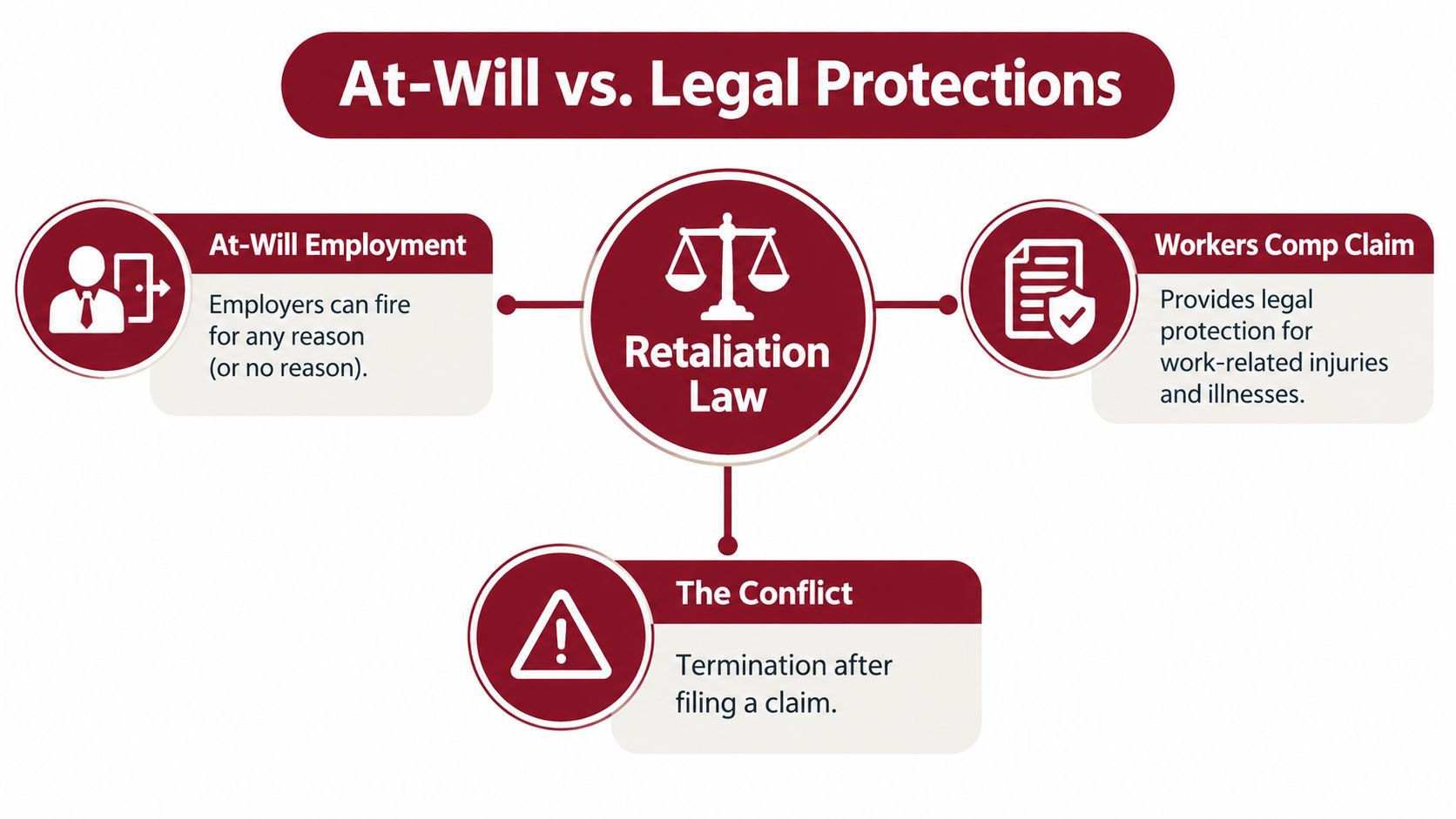
The Conflict Between At-Will Employment and Legal Protections
At-will employment and anti-retaliation law operate at the same time. The first gives an employer broad discretion. The second removes certain reasons from the list of permissible motives. Filing or attempting to file a workers' compensation claim is protected activity in many jurisdictions, and Georgia workers should treat retaliation as a separate legal issue from the underlying injury claim.
The history helps explain why this protection exists. Civilian federal workers first received workers' compensation coverage in 1908. Wisconsin enacted the first state workers' compensation law that survived constitutional challenge in 1911, and by 1920, 42 states had adopted workers' compensation laws. The Congressional Research Service history of workers' compensation describes how this expanding system created the need to protect workers who used it.
What you must prove
A retaliation case usually turns on causation. You need to show that you engaged in protected activity, the employer took adverse action, and the protected activity caused that action. A termination, demotion, reduction in work, or other punishment may qualify as adverse action depending on the facts and the governing law.
Courts commonly use a burden-shifting process:
- Protected activity: You reported the injury, filed a claim, or attempted to pursue workers' compensation benefits.
- Adverse action: The employer fired you or took another materially harmful employment action.
- Employer explanation: The employer identifies a legitimate, nonretaliatory reason.
- Pretext: You show that the stated reason is false, inconsistent, selectively applied, or otherwise a cover for retaliation.
The New Jersey courts' retaliation charge illustrates this commonly used framework. It also reflects the central problem in these cases: a suspicious sequence is evidence, not a verdict. A termination shortly after a claim may justify a closer investigation, but you'll generally need more, such as inconsistent discipline, changing explanations, unusual scrutiny, or comparisons with employees who were treated differently.
The employer doesn't have to admit, “We fired you because you filed.” Most won't. Your job is to preserve the facts that allow a judge or jury to compare the employer's explanation with its conduct.
Distinguishing Retaliation from Lawful Termination
A work injury and a workers' compensation claim can be connected to a termination without making the termination illegal. That's the uncomfortable answer many short online explainers leave out.
Suppose a warehouse employee cannot perform the essential lifting duties of the position after a serious injury. The employer may have to evaluate restrictions and available work, but workers' compensation law doesn't necessarily require the employer to hold the exact job open indefinitely. A documented business layoff may also be lawful if it affects the worker for reasons unrelated to the claim. Neutral guidance from Wyoming explains this difference between firing because someone filed a claim and ending employment because the person cannot perform the job or because of a legitimate business decision. See the Wyoming courts' workplace safety and workers' compensation guidance.
Ask what actually triggered the decision
Compare these two explanations:
| Employer's action | What the evidence must answer |
|---|---|
| Termination after a claim | Did the claim motivate the decision? |
| Termination during medical restrictions | Was the decision based on inability to perform essential work, or on hostility toward the claim? |
| Termination during a layoff | Were similarly situated employees included, and was the layoff independently documented? |
| Termination after alleged misconduct | Did the employer enforce the same rule before and after your injury? |
A valid workers' compensation claim doesn't immunize you from every workplace consequence. You can still be disciplined for genuine misconduct. You can still be included in a real reduction in force. You can still face a termination if the employer can establish a lawful reason unrelated to your protected activity.
The analysis becomes stronger for the employee when the employer's explanation changes. For example, a manager first says the position was eliminated, human resources later cites attendance, and the termination letter refers to performance. None of those reasons is automatically unlawful, but the shifting story may support an argument that the stated reason is pretext.
That is why this guide to workers' compensation retaliation should be read as a starting point, not as a conclusion that every injury-related termination violates Georgia law. The question isn't whether you were injured or whether you filed. It's whether the employer acted because you exercised the protected right.
Common Employer Tactics to Avoid Retaliation Claims
Employers rarely document retaliation in plain language. More often, the employer builds a justification around the termination and asks a court to view each event separately. Your task is to preserve the sequence and identify whether the explanation fits the employer's actual conduct.
Watch for patterns such as these:
- Sudden performance scrutiny: A previously acceptable employee receives aggressive monitoring or negative evaluations only after reporting the injury or claim.
- Inconsistent discipline: Minor mistakes become serious violations, while other employees receive coaching or no discipline for comparable conduct.
- Newly enforced policies: Management begins applying a rule to you that it ignored when other workers committed the same type of violation.
- Changing explanations: The supervisor, human resources representative, and termination letter give materially different reasons for the decision.
- Unusual schedule or assignment changes: Your hours, shifts, duties, or access to opportunities change in a way that makes continued employment harder.
- Pressure around medical restrictions: A supervisor urges you to disregard restrictions or treats compliance with medical instructions as insubordination.

Separate suspicion from usable proof
A coworker saying, “Your boss is mad about the claim,” may be worth recording, but it's stronger if you can identify who made the statement, when it was made, and whether anyone else heard it. A calendar entry showing a disciplinary meeting is useful. A calendar entry paired with the email scheduling the meeting and a copy of the resulting write-up is better.
Direct evidence of retaliatory intent is uncommon. Retaliation cases often depend on circumstantial evidence, and the employee ultimately carries the burden of proving the required connection. The legal authorities discussed in this appellate decision addressing retaliation proof and causation also illustrate that standards can be demanding, including situations involving a clear-and-convincing-evidence requirement or “but for” causation.
Don't secretly alter records, access systems you're no longer authorized to use, or take confidential customer information. Preserve communications lawfully, keep personal notes about events, and give your attorney the original context rather than only the documents that support your side.
Steps to Take If You Are Terminated After Filing a Claim
Move quickly, but don't react impulsively. A termination meeting can leave you angry or embarrassed, yet the first priority is preserving the facts and avoiding statements that the employer can later characterize as an admission.
-
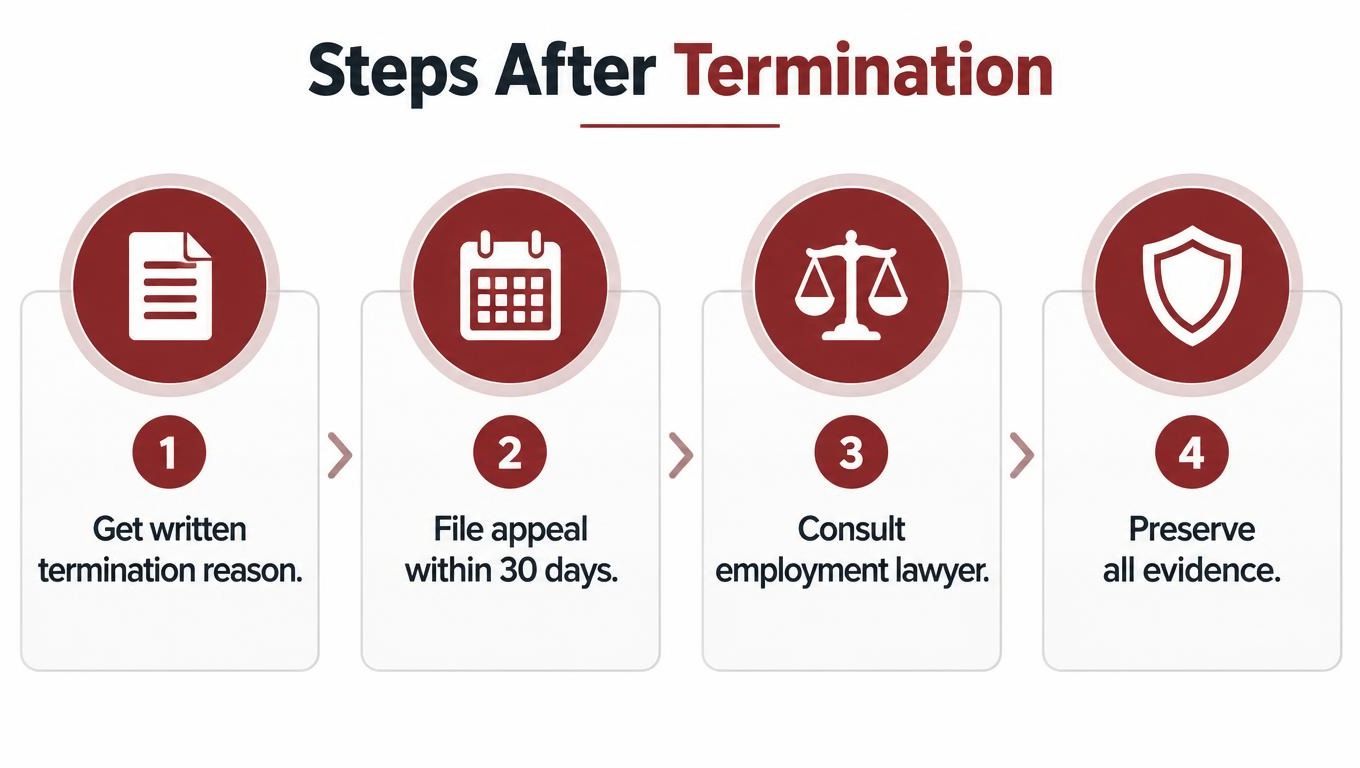
Request the reason in writing. If the employer only gives a verbal explanation, send a calm follow-up message confirming what you understood. Don't argue in that message. Your goal is to create a contemporaneous record.
-
Build a private timeline. Record the injury date, report to the employer, medical visits, restrictions, claim activity, complaints, disciplinary events, schedule changes, meetings, and termination. Use dates, names, exact words when you remember them, and the identity of anyone present.
-
Preserve relevant documents. Keep pay records, evaluations, policies, write-ups, emails, text messages, schedules, medical restrictions, claim correspondence, and termination materials. Don't delete messages that make you look bad. A complete record is more credible than a selective one.
-
Identify comparators. Write down employees who committed similar alleged violations or had similar attendance issues. Note how the employer treated them, but don't pressure coworkers to change their accounts.
-
Follow medical restrictions. Continue following your provider's instructions. If the employer pressures you to violate them, document the request and communicate through an appropriate written channel.
-
Get legal advice before signing. Don't sign a severance agreement, resignation document, release, or admission without understanding what rights you may be giving up.
Deadlines can control the case
Retaliation claims may require proof of protected activity, adverse action, and causation, but the filing deadline depends on the jurisdiction, agency, and legal theory. One 2026 retaliation guide identifies a 30-day OSHA filing window for certain retaliation complaints, while other claims may use different state-specific deadlines and remedies. Review the retaliation filing guidance addressing deadlines and procedural choices promptly, then confirm the deadline with a Georgia attorney or the relevant agency.
If you're already interviewing for another job, don't invent a story about the termination. Explain the circumstances briefly and professionally, without disclosing privileged strategy or attacking your former employer. A practical resource on how to explain being fired in an interview can help you prepare a truthful answer while your legal options are reviewed.
Potential Remedies and Legal Outcomes
A successful retaliation case can produce different outcomes depending on the facts, the claim asserted, and the available remedy under Georgia law. Possible results may include a negotiated payment, restoration of employment, recovery tied to lost wages, or other relief authorized by the applicable legal theory. The exact value and form of relief can't be responsibly predicted from the fact of termination alone.
Evidence affects both litigation and settlement. A clean timeline, consistent employer documents, credible witnesses, and proof that the stated reason changed can give your attorney a stronger position. A case based only on the fact that termination followed a claim is more vulnerable because the employer can point to the timing and offer a separate lawful explanation.
Settlement or trial
Settlement may provide a faster and more predictable resolution, but it can involve a release of claims and other terms that deserve careful review. Trial may offer a path to a judicial decision, but it also exposes both sides to uncertainty, expense, witness credibility disputes, and the risk that the fact finder accepts the employer's explanation.
The practical objective isn't to pursue the most aggressive option automatically. It's to match the strategy to the proof. Before making a demand or accepting an offer, counsel should assess the claim filing records, personnel history, comparator evidence, medical restrictions, termination documents, and applicable deadlines.
A strong retaliation case is built from ordinary records captured at the right time. The email, schedule, write-up, and witness account often matter more than a dramatic accusation made months later.
When to Contact Morgan & Morgan for Representation
Contact an attorney as soon as the employer begins treating your claim as a problem, not only after you receive a termination letter. Early advice can help you communicate without weakening your position, preserve evidence lawfully, evaluate medical restrictions, and avoid signing documents that limit your remedies.
Retaliation claims require more than showing that the employer knew about your injury. Counsel must analyze whether you engaged in protected activity, identify the adverse action, test the employer's stated reason, and develop evidence of causation. That work becomes harder when messages disappear, witnesses leave, personnel records change, or a short filing window expires.
A Georgia attorney can also separate the workers' compensation case from the employment claim. Those matters may involve different procedures, evidence, deadlines, and strategic decisions. Filing a workers' compensation claim may be appropriate even when the retaliation evidence is still developing, and a lawful termination may still require careful review if the employer misstates the reason.
Morgan & Morgan Attorneys at Law P.C. handles workers' compensation matters and offers free consultations, with clients speaking directly with experienced attorneys rather than relying solely on a paralegal. The firm's guidance on whether you need a workers' compensation lawyer can help you identify when professional review is especially important, including after termination, a disputed claim, or pressure to return against medical restrictions.
If you were fired after filing a Georgia workers' compensation claim, Morgan & Morgan Attorneys at Law P.C. can review the timeline, employer explanation, and evidence supporting retaliation during a free consultation. Visit Morgan & Morgan Attorneys at Law P.C. to discuss your next steps before a deadline or severance agreement closes off your options.

Lee Paulk Morgan
With more than 41 years of experience in the areas of Bankruptcy, Disability, and Workers’ Compensation, Lee Paulk Morgan is one of the most respected Bankruptcy and Disability attorneys in Athens, Georgia. His tireless dedication to serving clients has gained him the reputation of a premier attorney in his areas of practice, as well as the trust and respect of other legal experts, who often refer clients to him.
SHARE
RELATED POSTS

Can I File For Chapter 7 Without A Lawyer In GA?
Yes, you can file for Chapter 7 without a lawyer in the United States, and that’s called filing pro se. The problem is that self-filing comes with a much lower success rate than filing with…

Can I Rent An Apartment After Chapter 7? (Practical Guide)
Yes, you can rent an apartment after Chapter 7, and there’s no legal waiting period. The primary challenge is landlord underwriting, which is where many applicants encounter difficulty. You may be doing everything right legally…