
Blog

How to Stop Wage Garnishment in Georgia a Practical Guide
When a creditor gets a court order to take money directly from your paycheck, it's more than just an inconvenience—it's a financial gut punch. You can challenge the order, claim exemptions, or even try to negotiate with the creditor. But the fastest and most decisive way to stop a wage garnishment dead in its tracks is by filing for Chapter 7 or Chapter 13 bankruptcy. This triggers a federal protection called an automatic stay, which instantly freezes all collection activities against you.
What Wage Garnishment Really Means for Your Paycheck

The moment your employer pulls you aside to say your wages are being garnished, a wave of panic and confusion sets in. Suddenly, a chunk of the money you count on for rent, groceries, and everything else is gone before you even see it. It feels invasive and deeply unfair, leaving you scrambling to figure out what just happened and how you're going to make ends meet.
This isn't just a minor setback; it's a harsh financial reality in Georgia. State law allows creditors with a court judgment to seize a significant part of your earnings. This isn't a friendly request—it's a legally binding order sent straight to your company's payroll department.
The Financial Impact of Garnishment in Georgia
The numbers show just how damaging a garnishment can be. In Georgia, creditors can take up to 25% of your disposable earnings, making it one of the toughest states for anyone facing debt collection.
Imagine a retail worker in Athens who earns $22 an hour. For a standard 40-hour week, a creditor could garnish $165 every single week after deductions. For a family of four, that kind of hit could easily drop them below 80% of the federal poverty line. It's this tough reality that has earned Georgia an "F" rating from consumer advocates. You can learn more about national wage garnishment trends and their impacts from recent studies.
This aggressive approach means a once-manageable debt can quickly spiral into a full-blown financial crisis. The reduced income makes it nearly impossible to cover basic living expenses, which often leads to more debt and overwhelming stress.
Key Takeaway: A wage garnishment is not a request. It is a court-ordered seizure of your income that can have a devastating impact on your budget, making it crucial to act quickly to protect your finances.
Finding a Path Forward
The good news is you are not powerless. You have several legal options to fight back and regain control of your paycheck. These strategies range from challenging the garnishment's validity to claiming legal exemptions that protect certain types of income.
When you're facing a wage garnishment, time is of the essence. You have several options, each with its own process and potential outcome. Below is a quick summary of the immediate actions you can take.
Immediate Options to Stop Wage Garnishment in Georgia
| Method | How It Works | Potential Outcome |
|---|---|---|
| Negotiate with the Creditor | You contact the creditor or their attorney to work out a lump-sum settlement or a voluntary payment plan. | The garnishment may be paused or stopped if an agreement is reached, but this is not guaranteed. |
| Claim Exemptions | You file a claim of exemption with the court, arguing that your income is protected under Georgia or federal law. | If successful, the garnishment amount could be reduced or stopped completely. |
| File a Motion to Quash | You challenge the garnishment on procedural grounds, such as improper service or a flawed judgment. | The garnishment could be dismissed if the court finds a legal error in how it was issued. |
| File for Bankruptcy | You file for Chapter 7 or Chapter 13 bankruptcy, which triggers the automatic stay. | This immediately and legally stops the garnishment and all other collection actions against you. |
While some of these methods offer partial relief, only one provides an immediate and complete stop to the seizure of your wages.
The automatic stay, a protection granted under federal bankruptcy law, acts as a powerful shield. The moment you file for bankruptcy:
- Garnishments stop instantly. Your employer is legally required to stop withholding money from your pay.
- Creditor harassment ends. All calls, letters, and lawsuits must cease.
- You get breathing room. It gives you the time and space to create a plan for a true financial fresh start.
This guide will walk you through the practical, actionable steps you can take to understand your rights, fight the garnishment, and ultimately secure your financial future. Solutions are available, and the first step is knowing where to begin.
Confirming the Garnishment and Understanding Your Rights
Before you can fight a wage garnishment, you have to play detective. The first clue usually isn't a formal notice in the mail. More often, it's a surprise deduction on your pay stub that you never authorized. This is your cue to dig in, gather the facts, and make sure every part of this garnishment is legal and accurate.
Your very first move should be a conversation with your employer's HR or payroll department. They are required by law to have a copy of the court order they received, which is almost always a Summons of Continuing Garnishment. Ask for a full copy of that summons and any other paperwork they have on file about it.
This paperwork is your roadmap. It holds all the critical details you'll need to build a defense, including who the creditor is (the plaintiff), which court issued the order, the case number, and exactly how much they claim you owe. Don't just give it a quick scan—you need to scrutinize every single detail.
Decoding the Legal Paperwork
Let's be honest, the Summons of Continuing Garnishment can be intimidating. It's packed with dense legal jargon. But if you can identify a few key pieces, you’ll be in a much better position to take the next steps. What you're really doing here is making sure the creditor played by the rules.
Zero in on these critical details on the summons:
- Plaintiff: The person or company suing you (your creditor).
- Defendant: That’s you. Make sure your name and information are perfectly correct.
- Case Number: This is the unique code for your case in the court's system.
- Court Name: The specific Georgia court that signed off on the garnishment.
- Judgment Amount: The total debt the creditor says you owe from the original court case.
A huge mistake people make is just assuming the garnishment is legitimate. Simple things like a misspelled name, a wrong address, or an incorrect judgment amount can be powerful grounds for a legal challenge. Verifying the order's legitimacy is the first real step in learning how to stop wage garnishment in Georgia.
Verifying the Underlying Judgment
A garnishment is only as strong as the judgment it's built on. If the judgment isn't valid, the garnishment isn't either. You have every right to confirm that a real, legally obtained court judgment actually exists. A creditor can't just decide to take your money; they have to sue you and win in court first.
To check this, you'll need to contact the clerk of the court listed on your summons. Give them the case number and ask for a copy of the original judgment. This is the document that proves the creditor has a legal right to collect from you.
This step is especially important because many garnishments are based on "default judgments." This happens when a court rules against you because they were told you never showed up or responded to the initial lawsuit.
It's surprisingly common for people to have no idea they were ever sued in the first place. If you were never properly served with the original lawsuit papers—a shady tactic sometimes called "sewer service"—the judgment against you could be completely invalid. You can learn more about your rights by checking out our guide on what happens when wages are garnished without a proper judgment.
Confirming these details isn't just about shuffling paper. It’s about protecting your rights. If a creditor didn't follow Georgia's strict legal rules for serving you and notifying you, you might have a solid case for getting the entire garnishment thrown out. Don't skip this verification step—it could be the key to stopping the deductions immediately.
Using Exemptions to Legally Protect Your Income
Just because a creditor gets a court order doesn't mean they have a blank check to your entire financial life. Both Georgia and federal law recognize that you need a certain amount of income to survive. They create legal shields called exemptions to protect that money.
Honestly, many people facing garnishment don't even realize that some—or even all—of their income might be completely untouchable.
Claiming your exemptions is one of the most powerful and direct ways to reduce or even stop a wage garnishment cold. This isn't some shady loophole; it's your legal right. Once you understand what income is protected, you can take immediate action to keep more of your hard-earned money in your pocket, right where it belongs.
What Income Is Protected from Garnishment?
Certain types of income are off-limits to creditors trying to collect on common debts like credit cards or personal loans. If your paycheck includes money from these protected sources, you can file a claim to have those funds excluded from the garnishment calculation.
Key sources of exempt income often include:
- Social Security Benefits: This covers retirement, disability (SSDI), and survivor benefits.
- Supplemental Security Income (SSI): These payments are fully protected.
- Veterans' Benefits: Any payments coming from the Department of Veterans Affairs are exempt.
- Federal Student Aid: Pell Grants, federal student loans, and work-study funds are all shielded.
- Certain Retirement and Pension Payments: Funds from 401(k)s, IRAs, and other qualified retirement plans are typically safe from creditors.
But here's the critical part: these protections aren't automatic. You have to assert them. If you don’t file the proper paperwork, the court and your employer have no way of knowing that a portion of your wages includes protected funds. The full garnishment will just proceed as ordered.
Scenario in Action:
Imagine a single parent in Athens whose monthly take-home pay is a mix of part-time work and Social Security disability benefits for their child. If a creditor garnishes their wages without accounting for the exempt Social Security funds, they could be taking far more than the law allows. By filing an exemption claim, this parent can protect the disability income, significantly reducing the amount taken from each paycheck.
The Georgia Head of Household Exemption
Georgia offers a particularly important protection known as the head of household exemption. This is a state-specific rule that can provide massive relief if you meet the criteria.
To qualify, you must be a Georgia resident who provides the primary financial support for a dependent, like a child or an elderly parent.
If you qualify as the head of household, a creditor can only garnish 50% of your disposable earnings for most debts. This is a huge reduction from the standard 75% that is usually on the table. For someone already struggling, protecting that extra 25% of their income can be the difference between making rent and facing eviction.
To see how this fits into a broader financial strategy, you can explore our detailed guide on Georgia bankruptcy exemptions.
How to Formally Claim Your Exemptions
So, how do you actually protect your income? You have to take a formal step: filing a Defendant's Claim Form.
You should receive this form along with the initial garnishment summons. If for some reason you didn't get one, you can always get a copy from the clerk of the court that issued the garnishment order.
Completing this form is your official declaration to the court that some of your money is legally exempt. You'll list the specific exemptions that apply to your situation and provide any required documentation to prove it—things like bank statements showing direct deposits of Social Security benefits or pay stubs detailing your earnings.
The process generally looks like this:
- Fill Out the Claim Form: Clearly state which exemptions you are claiming.
- Attach Proof: Gather documents that support your claim.
- File with the Court: Submit the form and your proof to the court clerk.
- Serve the Creditor: You must also send a copy to the creditor or their attorney.
Time is absolutely critical here. You must file this claim quickly after getting notice of the garnishment. Missing the deadline could mean you forfeit your right to these protections for the current garnishment period. This simple form is one of the most effective tools you have for stopping wage garnishment in Georgia.
Proactive Legal Strategies to Fight the Garnishment Order
Just because you've received a garnishment notice doesn't mean the fight is over. You have legal options to challenge the order itself, especially if the creditor or the court made a procedural mistake. Taking a proactive stance here can sometimes stop a garnishment in its tracks, but you have to act fast.
This isn't just about kicking the can down the road. It's about making sure creditors followed Georgia's strict legal requirements to the letter. If they didn't, the entire garnishment order could be invalid. These strategies go beyond claiming exemptions—they attack the very foundation of the creditor's right to take your wages.
Challenging the Validity of the Court Order
One of the most powerful ways to fight back is to question the original judgment that the garnishment is based on. A surprisingly common reason for a successful challenge is improper service of process.
Georgia law is extremely specific about how you must be notified of a lawsuit. If you were never legally served with the original complaint, you can file a motion to quash service or a motion to set aside the default judgment.
Imagine a creditor claims they served papers at an old address where you haven’t lived for years. Since you never got the notice, you didn't show up to court, and they won a default judgment against you. In that scenario, the judgment is fundamentally flawed. You can ask the court to vacate it, which would also kill the garnishment.
Successfully challenging the judgment requires solid evidence and a strong legal argument. Be warned: the deadlines for filing these motions are incredibly strict.
This visual guide breaks down the essential steps to take when you learn about a wage garnishment.
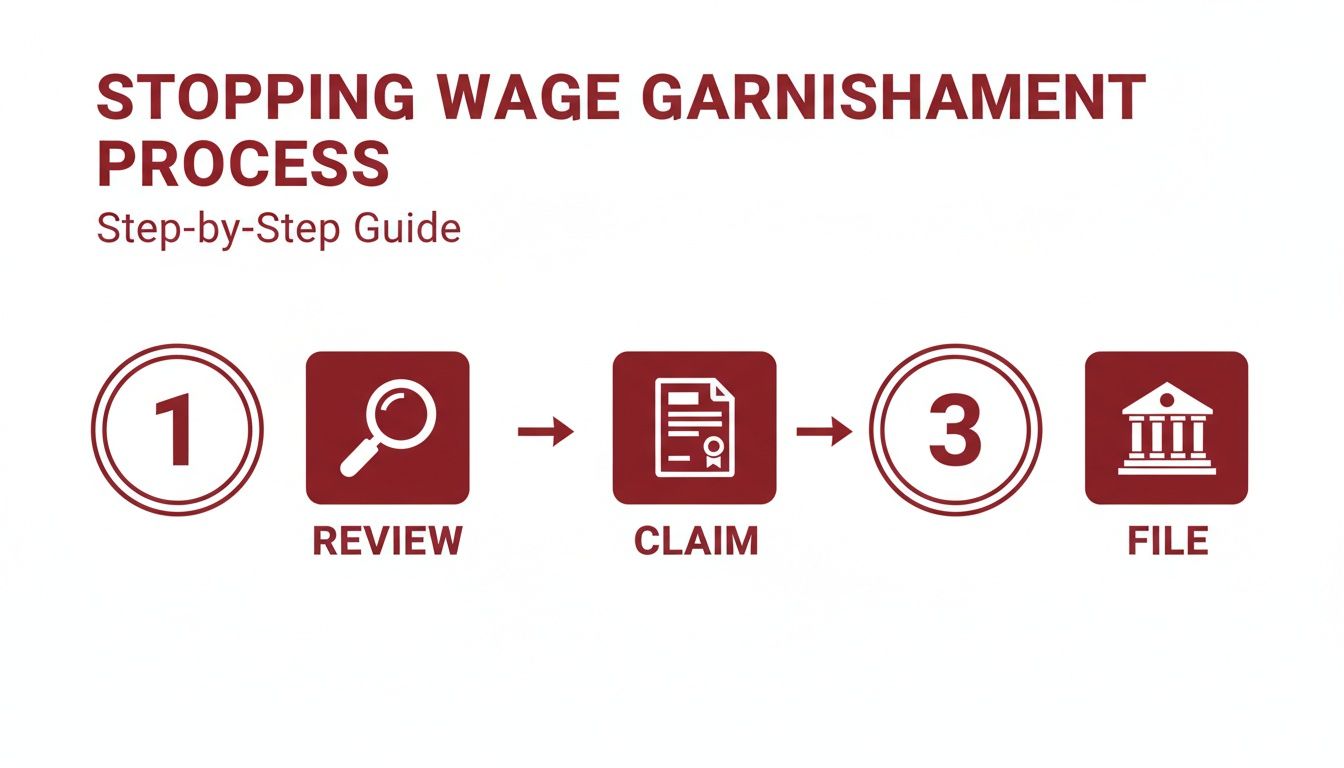
As you can see, the process always starts with a careful review of the facts before you take any formal legal action.
Negotiation and Settlement Outside of Court
Believe it or not, sometimes the most practical solution is found outside the courtroom. Even after a garnishment has started, you can still reach out to the creditor or their attorney to negotiate a settlement.
They might be willing to accept a lump-sum payment for less than the total amount owed just to close the books on the debt. Another option is proposing a new, voluntary payment plan. If you can agree on an affordable monthly amount, the creditor might agree to pause or withdraw the garnishment as long as you make your payments.
Key Insight: Creditors often prefer a guaranteed voluntary payment over a court-ordered garnishment. Garnishments involve ongoing legal costs and administrative hassle, and there's always a risk you could file for bankruptcy, which would stop their collection efforts completely.
Here’s what a negotiation could look like:
- Contact the Creditor's Attorney: Once a lawyer is involved, all communication should go through them.
- Make a Clear Offer: Propose a specific lump-sum amount or a monthly payment you know you can afford.
- Get It in Writing: Never, ever accept a verbal agreement. Insist on a signed document that clearly states the garnishment will be stopped.
Negotiating gives you back some control over the situation, but it's no silver bullet. The creditor is under no obligation to accept your offer.
The high stakes of wage garnishment are a direct result of state laws. Policy researchers have found that Georgia's debt collection lawsuits are a major driver of garnishments, a problem that could be reduced with stronger consumer protections. States with more robust wage garnishment caps see significantly fewer debt collection lawsuits. With its F-rated safeguards, a typical worker in Georgia can lose a quarter of their income, pushing families already struggling with medical debt or job injuries deeper into poverty. You can explore a detailed analysis of wage garnishment protections and their impact.
These proactive strategies are powerful tools in your arsenal for learning how to stop wage garnishment in Georgia. Whether you're challenging the judgment's legitimacy or negotiating a new path forward, taking decisive action is crucial. However, these methods are complex and often require an attorney's guidance to navigate them successfully.
How Bankruptcy Provides Immediate Garnishment Relief

When you need a garnishment to stop right now, bankruptcy is often the most powerful and immediate tool you have. While other strategies can take time and come with no guarantees, filing for bankruptcy triggers instant protection under federal law. It’s designed to give you immediate breathing room.
The moment your bankruptcy petition is filed, a legal injunction called the automatic stay goes into effect. This isn't a request—it's a court order that forces all creditors to stop collection activities immediately. That means garnishments, harassing phone calls, foreclosure proceedings, and lawsuits all have to stop.
Your employer gets notified, and they are then legally required to stop withholding money from your paycheck.
The Power of the Automatic Stay
The automatic stay is the reason bankruptcy provides such rapid relief. Think of it as a legal firewall that instantly pops up between you and your creditors. It doesn't matter what stage the garnishment is in; the stay freezes everything on the spot.
Creditors can't just ignore this, either. Violating the automatic stay comes with serious legal consequences, so they are highly motivated to comply as soon as they get the notice. This immediate halt to the financial bleeding is often the first real step toward getting back in control. To learn more, check out our guide on how the automatic stay in bankruptcy proceedings can help you get back on track.
The automatic stay is your most decisive tool for stopping wage garnishment in Georgia. It bypasses negotiations and legal challenges, providing an immediate and legally enforceable stop to the seizure of your income.
In Georgia, you generally have two options for personal bankruptcy: Chapter 7 and Chapter 13. Both trigger the automatic stay, but they work very differently and are suited for different financial situations.
Chapter 7 Bankruptcy: A Fresh Start
Often called a "liquidation" or "fresh start" bankruptcy, Chapter 7 is designed to wipe out qualifying unsecured debts completely. This covers the most common reasons for garnishments, like:
- Credit card debt
- Medical bills
- Personal loans
- Old utility bills
A court-appointed trustee reviews your assets to see if anything can be sold to repay creditors. Here's the good news: Georgia's exemption laws are there to protect your essential property. Most people who file for Chapter 7 do not lose any of their property—including their home, car, and retirement savings—because these assets are covered by legal exemptions.
For many Georgians, Chapter 7 not only stops the garnishment but eliminates the underlying debt that caused it, giving you a truly clean slate. The whole process is usually over in just a few months.
Chapter 13 Bankruptcy: A Reorganization Plan
If you have a steady income but are just overwhelmed by debt, Chapter 13 might be a better fit. Instead of wiping out debt right away, it lets you reorganize it into a single, manageable payment plan that lasts for three to five years. The automatic stay still stops the garnishment the moment you file.
Chapter 13 is especially useful if you:
- Are behind on your mortgage or car payments and want to catch up over time to avoid foreclosure or repossession.
- Have valuable property that isn't fully protected by Georgia's exemption laws.
- Don't qualify for Chapter 7 because your income is above the state median.
You make one monthly payment to a trustee, who then pays your creditors according to the court-approved plan. When the plan is over, any remaining unsecured debt is typically discharged for good.
Addressing Common Fears About Bankruptcy
Lots of people hesitate to even think about bankruptcy because of the myths and fears floating around. It's often seen as a personal failure, but the reality is that bankruptcy is a legal tool designed to help honest people get a second chance.
Fear: "I'll lose my house and my car."
Reality: This is the biggest misconception out there. Georgia's exemption laws are specifically designed to protect your essential property. In most Chapter 7 cases, filers keep their home and car. Chapter 13 is actually designed to help you save these assets.
Fear: "My credit will be ruined forever."
Reality: A wage garnishment and defaulted accounts are already ruining your credit. While bankruptcy does impact your score initially, many people find their credit starts to improve relatively quickly after their debts are wiped out because their debt-to-income ratio gets a massive boost.
Filing for bankruptcy is a big decision, but it's also a proactive step toward financial freedom. It stops the immediate crisis of a wage garnishment and gives you a structured, legal path to resolve the underlying debt for good.
Getting slapped with a wage garnishment notice brings a flood of questions and a whole lot of stress. The legal paperwork is confusing, your paycheck just shrank, and you need answers, fast. Let's cut through the noise and tackle some of the most common questions we hear from Georgians facing this exact situation.
Think of this as your starting point. Understanding the basics is the first step toward figuring out your best move.
Can a Creditor Garnish My Wages Without a Court Order?
In Georgia, the answer is almost always no. For everyday consumer debts—think credit cards, medical bills, or personal loans—a creditor can’t just start taking money from your paycheck. First, they have to sue you, win a judgment in court, and then get a separate garnishment order.
But there are a few big exceptions where the government doesn't have to play by the same rules.
These exceptions include:
- Federal Tax Debts: The IRS has the power to levy your wages directly, no court judgment needed.
- Defaulted Federal Student Loans: The Department of Education can also garnish your pay without suing you first.
- Court-Ordered Child Support: Unpaid child support is typically enforced through an income deduction order, which functions like a garnishment.
So, if a private collection agency is taking money out of your check and you were never served with a lawsuit, that garnishment might be illegal. It’s worth looking into immediately to protect your rights.
Key Takeaway: For most private debts, a creditor needs a court judgment to garnish your wages. If you don't remember being sued, the whole garnishment could be invalid from the get-go.
How Long Does a Wage Garnishment Last in Georgia?
A standard "continuing wage garnishment" in Georgia isn't forever, but it can feel like it. Each garnishment order is legally active for 179 days—just shy of six months. During that time, your employer has to keep withholding money from every single paycheck.
Here's the problem: what happens after those 179 days are up? If the debt isn't fully paid off, the creditor can simply file for a renewal and start the whole process over again. There's no legal limit on how many times they can do this.
This can create a brutal cycle, trapping you for years while a big chunk of your income disappears. The only real ways to break this cycle for good are to pay the debt in full, negotiate a settlement, or use a legal tool like bankruptcy to stop the collection cold and wipe out the underlying debt.
Will Filing Bankruptcy Stop a Garnishment Immediately?
Yes. Absolutely. This is one of the most powerful and immediate benefits of filing for bankruptcy. The second your bankruptcy case is filed with the court, a federal protection called the automatic stay kicks in.
This legal injunction is like hitting a giant pause button on all collection activities, including wage garnishments. Your attorney will immediately notify your employer and the creditor about the filing. Once they get that notice, your employer is legally required to stop taking money from your paycheck for that debt. This brings immediate financial relief, often as quickly as your next pay cycle.
Can I Be Fired for Having My Wages Garnished?
Federal law, specifically the Consumer Credit Protection Act (CCPA), gives you some solid job protection here. Your employer cannot legally fire you for having your wages garnished for a single debt.
However, that protection has its limits. The law doesn't shield you if you have multiple garnishments from two or more different creditors. While Georgia has some of its own employee protections, your job could genuinely be at risk if you're getting hit with several garnishments at once.
This is another huge reason why it’s so critical to deal with the root cause of the debt. Filing for bankruptcy doesn't just stop the garnishment and save your paycheck—it can also provide crucial protection for your job by resolving all your debts at the same time.
If you're facing a wage garnishment in the Athens area, you don't have to go through this alone. The experienced attorneys at Morgan & Morgan Attorneys at Law P.C. can look at your specific situation, walk you through your options, and help you take immediate action to protect your income. Contact us today for a free consultation to see how we can help you get back in control of your finances.

Lee Paulk Morgan
With more than 41 years of experience in the areas of Bankruptcy, Disability, and Workers’ Compensation, Lee Paulk Morgan is one of the most respected Bankruptcy and Disability attorneys in Athens, Georgia. His tireless dedication to serving clients has gained him the reputation of a premier attorney in his areas of practice, as well as the trust and respect of other legal experts, who often refer clients to him.
SHARE
RELATED POSTS

Do Employers Have To Notify Employees Wage Garnishment Georgia: 2026 Guide
Let's get straight to the point: do employers have to notify employees about wage garnishment in Georgia? The short answer is no. Under Georgia law, your employer doesn’t have to give you a separate heads-up…

What Is Cram Down In Bankruptcy: A Georgia Debtor’s Guide
A cram down is one of the most powerful tools you have in a Chapter 13 bankruptcy. It can force a lender to reduce your loan balance to match the property's current value. It basically…