
Blog

How Long Does It Take Workers Comp To Approve Surgery
In Georgia, when an authorized treating physician submits a complete Form WC-205 for surgical approval, the insurer has 5 business days to respond. If the insurer doesn’t respond within that period, the requested treatment is considered pre-approved.
That answer is straightforward, but the experience often isn’t. You may have a surgeon’s recommendation, imaging that supports the procedure, and a growing list of unanswered calls, yet still not know whether the insurance company has started reviewing the request. The important question isn’t only, “How long does workers comp take to approve surgery?” It’s also, which deadline is running, and what exactly did the insurer receive?
Waiting for Your Surgery Approval
Consider a common Athens-Clarke County situation. Your authorized treating physician examines you, reviews your imaging, and recommends surgery. The office tells you the request has been sent to workers’ compensation. You leave expecting a scheduling call, but days pass. Then the adjuster says the request is “under review,” while the surgeon’s office says it hasn’t received a decision.
At that point, the uncertainty becomes part of the injury. You may be managing pain, worrying about work, and trying to determine whether the delay is ordinary processing or a failure to follow Georgia’s authorization rules. The answer depends on the submission date, the completeness of the request, and whether the insurer has issued a response or formally disputed the treatment.

The date that matters most
The date your surgeon first recommends surgery may be medically important, but it doesn’t necessarily start the insurer’s response period. Georgia’s process focuses on the insurer’s receipt of a completed Form WC-205, submitted by an authorized treating physician.
That distinction explains why two workers can hear different timelines from their doctors. One request may contain the form and supporting medical information and be ready for review. Another may sit in an office queue, go to the wrong recipient, or lack records needed to evaluate the procedure.
Practical rule: Don’t measure the deadline from your appointment date. Measure it from confirmed receipt of a complete authorization request.
The Georgia State Board of Workers’ Compensation Form WC-205 instructions provide the governing benchmark. They also clarify that advance authorization isn’t generally required as a condition for payment under the Workers’ Compensation Act, although providers may seek it before significant treatment to reduce the risk of a payment dispute.
The rest of the process becomes easier to understand once you separate a routine insurer response from a contested medical-treatment dispute. Approval may come quickly after a properly completed submission, but approval alone doesn’t guarantee that the surgeon can place you on the operating schedule immediately. Scheduling depends on the provider, facility, and practical arrangements that follow authorization.
How Workers Compensation Authorizes Surgery in Georgia
The authorization process has several moving parts, and each one can affect the date you believe the clock began. The physician’s office usually controls the medical submission, while the insurer or self-insurer controls the review. Your job is to verify what happened rather than rely on informal assurances.
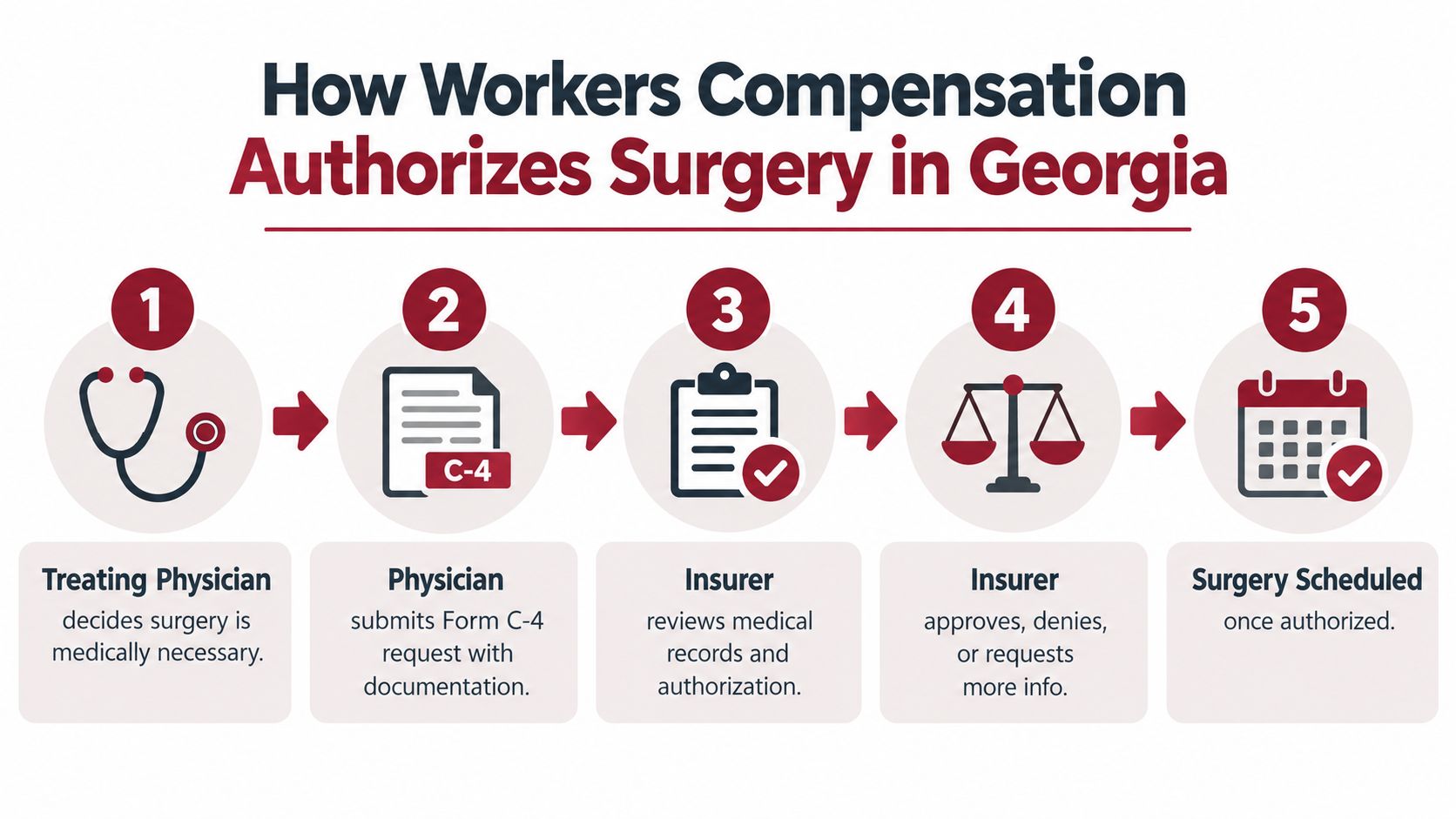
Step one, confirm the treating physician
The request must come from an authorized treating physician. That doctor identifies the proposed surgery or other treatment and explains why it is appropriate for the accepted work-related condition. A recommendation in a patient portal or a conversation in an examination room isn’t the same thing as a completed authorization request.
Step two, submit Form WC-205
The physician submits Form WC-205 to the workers’ compensation insurer or self-insurer. The form should be accompanied by the medical information needed to evaluate the procedure. Depending on the request, that may include relevant records, diagnostic material, and a clear explanation of medical necessity. The practical issue is completeness. If the carrier says the package is missing information, the parties may disagree about whether the response period has started.
The Georgia form instructions state that the insurer must respond within 5 business days after receiving the completed form, and the response must approve or address the requested treatment. If there is no response during that period, the treatment or testing is considered pre-approved under the instructions.
Step three, identify the recipient and preserve proof
Sending the form isn’t enough if it goes to an outdated fax number, a general claims mailbox, or the wrong utilization-review contact. Ask the physician’s office where it was sent, when it was sent, and how receipt was confirmed. Keep the transmission record, portal acknowledgment, or other delivery evidence.
For broader context about the roles of employees, employers, and medical providers, review these important Georgia workers’ compensation considerations. The key operational point remains the same: the response deadline is tied to the insurer’s receipt of a properly completed request, not just to the existence of a surgical recommendation.
Step four, track the response
The insurer may approve the request, address it in writing, or fail to respond within the applicable period. A request for more information deserves careful attention because it can indicate that the reviewer doesn’t consider the submission complete. The doctor’s office should identify exactly what was requested and send the missing material through a traceable channel.
Step five, separate approval from scheduling
Once authorization is clear, the surgeon’s office can work with the facility and the patient on scheduling. That administrative step is separate from the insurer’s decision. A worker shouldn’t assume that an approval letter means an operation will occur immediately, particularly if the facility still needs records, medical clearance, or an available operating date.
The Two Different Timelines That Matter
A worker can be told that surgery is “under review” while two different deadlines are already running. Georgia workers’ compensation law separates two distinct stages: the insurer’s initial response and the formal process for disputing treatment. Knowing which stage applies prevents a routine wait from being confused with a Board proceeding.
The initial response window
The first clock starts when the insurer or self-insurer receives a completed Form WC-205. The carrier then has 5 business days to approve the requested surgery or otherwise address the treatment request. Weekends and holidays do not count, so the period is roughly one calendar week, although the exact deadline depends on the documented receipt date.
The response must address the proposed treatment. If the insurer remains silent after those five business days, the requested treatment or testing is considered pre-approved under the form instructions. That result can be useful, but it does not eliminate the need for clear records.
A worker should not arrive at a hospital based only on silence. The carrier may later claim that the form was incomplete, sent to the wrong recipient, or received on a different date. Those arguments can create practical problems with scheduling and payment, even when the legal consequence of the missed response deadline favors the worker.
The formal dispute window
A written refusal changes the issue from ordinary processing to a potential Board dispute. Within 21 days of receiving the request, the insurer must either authorize the treatment in writing or file Form WC-3 with the Georgia State Board of Workers’ Compensation, stating the specific grounds for the dispute. A telephone denial from an adjuster is not the same as that formal filing.
The deadlines work together, but they do different jobs:
| Stage | Timeline | Action required | Outcome if no response |
|---|---|---|---|
| Complete WC-205 received | Day the insurer receives the completed request | Confirm the receipt date and preserve proof of delivery | That date may control the response calculation. Download the official Georgia Form WC-205 instructions |
| Initial insurer response | 5 business days | The insurer approves or addresses the requested treatment | The treatment or testing is considered pre-approved under the form instructions. View the Georgia Form WC-205 PDF form |
| Formal dispute deadline | 21 days from receipt of the request | The insurer authorizes treatment in writing or files Form WC-3 with specific grounds | The worker may need to respond to a formal Board dispute instead of waiting for ordinary processing. |
A routine authorization may be resolved within about one business week. A contested surgery can move into formal proceedings that require a different response. Calling both situations “waiting for approval” conceals the point at which the claim has changed tracks.
A five-business-day silence issue and a twenty-one-day dispute issue are not interchangeable. The first concerns the insurer’s initial response. The second concerns whether the insurer has formally contested treatment.
A denial during the initial period does not give the insurer unlimited time. Check when the carrier received the request, what the written response says, and whether Form WC-3 was filed with the Board. Those records identify the deadline that is controlling.
What Actually Causes These Delays
The most damaging delay often occurs before anyone agrees that the clock has started. A physician may believe the request was sent, while the insurer may say the submission lacked records needed for review. Until the parties identify the received package and its contents, each side may be working from a different timeline.
The incomplete medical package
A surgical request needs more than the name of a procedure. The reviewer must be able to connect the proposed treatment to the work-related condition and assess the medical basis for it. Missing imaging, an unclear operative recommendation, or an incomplete explanation can prompt a request for additional information.
The solution isn’t to send every document without organization. A better submission identifies the proposed procedure, the condition being treated, the relevant findings, and the supporting records. Ask the physician’s office to confirm what was sent and whether the insurer identified any missing item.
The wrong submission channel
A fax confirmation can show that a transmission occurred, but it may not establish that the correct department received a readable, complete package. A portal acknowledgment can be useful, but keep the confirmation and the uploaded documents together. If the request went to the wrong recipient, the carrier may not treat the earlier date as the operative receipt date.
Track four details:
- Recipient: Record the insurer, self-insurer, claims administrator, or utilization-review contact that received the request.
- Contents: Keep the exact Form WC-205 and the medical records transmitted with it.
- Receipt: Preserve a fax confirmation, portal acknowledgment, or other delivery evidence.
- Follow-up: Write down the name of each person contacted and the response given.
Different states illustrate the problem
Georgia’s five-business-day benchmark shouldn’t be treated as a national rule. California’s utilization-review guidance, for example, generally provides 5 business days for a prospective or concurrent treatment decision after receipt of a completed request, 72 hours for an urgent medical situation after the reviewer receives information reasonably necessary to decide it, and up to 30 days for a retrospective review after sufficient information is received. The claims administrator may also have 14 additional days when more information is needed, as described in the California Division of Workers’ Compensation utilization-review guidance.
That comparison shows why incomplete submissions create practical trouble. The jurisdiction, type of review, urgency, and completeness of the medical package all affect the applicable process. If your Georgia claim is dragging out medical treatment, focus first on proving what was submitted and when it was received.
Practical Steps to Protect Your Case
A surgery request can stall because no one can prove when the insurer received it, what records were included, or whether the carrier asked for more information. Build that proof early. A clear timeline gives the physician’s office, adjuster, and attorney the same factual record and identifies whether the five-business-day response period or the longer formal-dispute deadline is running.
Build a receipt file
Start with the completed Form WC-205 request. Ask the physician’s office for a copy of the form, the medical records sent with it, the destination used, and proof of transmission. If the office cannot release the full package immediately, request written confirmation of the delivery date, recipient, and method.
Keep a log of:
- The date and time the request was sent.
- The date and time receipt was confirmed.
- The name and contact information of the receiving person or department.
- Any request for additional information.
- The date each added record was transmitted.
- Every approval, denial, or status statement.
The receipt date may determine whether the initial five-business-day response period has expired. The original request date may matter to the 21-day formal-dispute deadline. Those are different questions, so record both dates rather than relying on a general statement that the request was sent “weeks ago.”
Work with the medical office
Call the surgeon’s staff and ask specific questions. Has the office received an approval, denial, or records request? Did the insurer say the submission was complete? If the office sent more information, what changed, and when did the carrier receive it?
Ask the office to document each response in the patient file. That record can clarify whether the carrier reviewed the original package or a later submission. It also helps separate an insurer’s request for missing records from a true denial.
Continue following the physician’s treatment instructions and report symptom changes through the proper medical channel. Do not cancel appointments or change prescribed care because an adjuster has not returned a call. The treatment decision belongs to the treating medical team, while authorization remains a claims issue.
Confirm silence in writing
Georgia’s form instructions treat non-response after the applicable five-business-day period as pre-approval, but silence can lead to later disputes about whether the request was complete or received. Ask the insurer to confirm in writing the receipt date, the response-period status, and whether the treatment is authorized or considered pre-approved. Send the same request to the physician’s office so its scheduling staff understands why the procedure may proceed.
Document first, escalate second. A dated request, receipt confirmation, and copy of the exact medical package carry more weight than repeated calls with no record.
Utilization review can delay care even when a surgeon recommends surgery. Professional guidance describes utilization review as an assessment of a treating provider’s care plan for an insurer or claims administrator and says denial notices should identify appeal or independent-review options. The professional utilization-review guidance also explains that timing varies by jurisdiction and that unnecessary delays can harm an injured worker.
If a denial arrives, save the complete notice, not just its first page. Preserve the medical recommendation, imaging, operative report, fax or portal confirmation, and every deadline in the correspondence. Together, these documents can show whether the insurer received a complete request, which deadline applied, and whether it followed the required procedure.
When to Seek Legal Help After a Denial
A denial is a decision to analyze, not a reason to stop pursuing necessary treatment. The first question is whether the insurer issued a proper response and whether it took the next procedural step required for a contested request. The second is whether the medical record directly answers the stated reason for denial.
A written refusal may challenge medical necessity, the relationship between the surgery and the work injury, or the sufficiency of the records. It may also be partial, approving one aspect of treatment while leaving another unresolved. Those differences matter because a partial approval can still leave you without the operation your treating physician recommended.
Review the paper trail
An attorney evaluating the dispute will need more than the denial letter. Gather:
- The medical recommendation: Include the physician’s explanation of why surgery is necessary.
- The authorization package: Provide the completed WC-205 and every record sent with it.
- Proof of receipt: Include transmission reports, portal confirmations, and delivery records.
- The insurer’s response: Preserve the denial, partial approval, requests for information, and correspondence.
- The deadline history: Identify when the insurer received the request and when each response occurred.
This evidence helps determine whether the carrier acted within the initial response period, whether silence created a pre-approval issue, and whether a formal dispute was filed with the State Board. It also helps counsel distinguish a correctable documentation problem from a genuine medical or legal disagreement.
Know when delay has changed character
Routine follow-up is reasonable when the doctor’s office is confirming receipt or sending a missing record. Continued uncertainty after a documented submission is different. If the insurer won’t identify what remains incomplete, refuses to acknowledge receipt, denies the surgery without a clear explanation, or fails to honor an apparent pre-approval, early legal advice can protect your position.
The Georgia workers’ compensation system has procedural requirements that are difficult to manage while you are dealing with pain, work restrictions, and medical appointments. A lawyer can evaluate the denial rationale, communicate with the insurer, and determine whether the matter should proceed through the State Board or another available review process. Waiting can also make it harder to preserve evidence about when the request was submitted and what the insurer received.
Get advice before making a damaging choice
Don’t pay for a disputed procedure without understanding the possible payment consequences. Don’t sign a settlement or release just because the carrier has delayed authorization. Don’t assume a telephone denial is the same as a formal Board filing. Each choice can affect your medical care and the way your claim proceeds.
An attorney can also help when the insurer approves the request but disputes related treatment, when the surgeon’s office won’t schedule the procedure, or when the carrier argues that the request was incomplete. The goal isn’t to turn every administrative question into litigation. It’s to identify the point at which ordinary follow-up has failed and a legal response is necessary.
If your workers’ compensation claim was denied, bring the complete file to a Georgia attorney promptly. A review is especially important when the five-business-day response period has passed, the insurer disputes pre-approval, or Form WC-3 appears in the record.
Morgan & Morgan Attorneys at Law P.C. helps injured workers evaluate delayed or denied medical treatment, organize authorization records, and understand options in Georgia workers’ compensation disputes. Visit Morgan & Morgan Attorneys at Law P.C. to request a consultation about your surgery approval timeline and the next step in your claim.

Lee Paulk Morgan
With more than 41 years of experience in the areas of Bankruptcy, Disability, and Workers’ Compensation, Lee Paulk Morgan is one of the most respected Bankruptcy and Disability attorneys in Athens, Georgia. His tireless dedication to serving clients has gained him the reputation of a premier attorney in his areas of practice, as well as the trust and respect of other legal experts, who often refer clients to him.
SHARE
RELATED POSTS

Can You Be Fired For Filing A Workers Compensation Claim
Georgia is an at-will state, but you can’t lawfully be fired specifically for filing a workers’ compensation claim. By 1920, 42 U.S. states had adopted workers’ compensation laws, yet proving that a termination was retaliatory…

What Not To Say To A Nurse Case Manager (7 Risks)
A nurse case manager’s work often involves communication for 60% or more of the workday, so the safest approach is to be honest, specific, and cooperative. Don’t exaggerate or conceal information, refuse care without discussing…