
Blog

Does Chapter 13 Stop Garnishments? (Georgia Guide)
Filing Chapter 13 generally stops wage and bank garnishments for debts incurred before the filing date, and the stop starts the moment the petition is filed, not when the plan is confirmed. The pause typically holds for the three to five years the repayment plan runs, with a short list of debts that keep collecting no matter what.
So why do so many people who file still see a deduction on their next paycheck? Because payroll got the notice late, or because the garnishment sits in one of the exceptions, or because an earlier case was dismissed and the stay never fully switched on. The answer to “does Chapter 13 stop garnishments” is yes for most consumer debts, but the useful work happens in two places the general articles skip: sorting your garnishment by type, and separating what happens to future deductions from what happens to money already taken.
Which Garnishments Chapter 13 Stops and Which Continue
For most debts that existed before the filing date, a Chapter 13 petition stops a wage garnishment or bank levy right away. The sorting tool below is the fastest way to know where you stand. Find the debt type on your garnishment notice, check the result, then confirm one thing: was the debt owed before the date you filed?
| Garnishment type | Stopped by Chapter 13 stay? | Why |
|---|---|---|
| Credit card or medical debt judgment (wage or bank) | Yes, from filing date | Prepetition unsecured debt is covered by the stay |
| Unsecured personal loan judgment | Yes, from filing date | Same rule as credit card and medical debt |
| Child support or alimony withholding | No, generally continues | Domestic support obligations are not discharged and withholding can continue |
| Back federal income taxes | Usually stayed; priority taxes paid through the plan | Collection is paused and tax claims are paid over the plan term |
| Student loan collection | Collection paused, debt not discharged | Stay pauses collection; the loan stays owed |
| Criminal fines or restitution | Generally no | Criminal proceedings fall outside the stay |
| Debt incurred after the filing date | No | The stay covers only prepetition debts |
| Garnishment for a co-signer’s debt | Yes for qualifying consumer debts, unless the court grants relief | Co-debtor stay protects individuals jointly liable on the debt |
Read the table against the actual notice, not against memory. A single garnishment order sometimes bundles a judgment on a credit card with a support withholding, and those two lines behave differently on the same paycheck. If your case involves support arrears, the interplay with a Chapter 7 filing is worth understanding before you choose a chapter, and this explanation of how Chapter 7 affects support payments covers the family law side that bankruptcy courts won’t touch.
A stopped garnishment is paused, not cancelled. Chapter 13 doesn’t erase the underlying debt. It channels eligible claims into the court-supervised plan, so the creditor still gets paid, just on a schedule you can survive. Support works the same way in one respect: the obligation survives the discharge, but a plan can give you time to get caught up on arrears rather than losing the whole check each week.
Before you call anyone, write three things on the top of the notice: the creditor’s name, the notice date, and the case number if a petition is already on file. Those three items decide which row applies and whether a motion is needed.
How the Automatic Stay Halts Your Paycheck Deductions
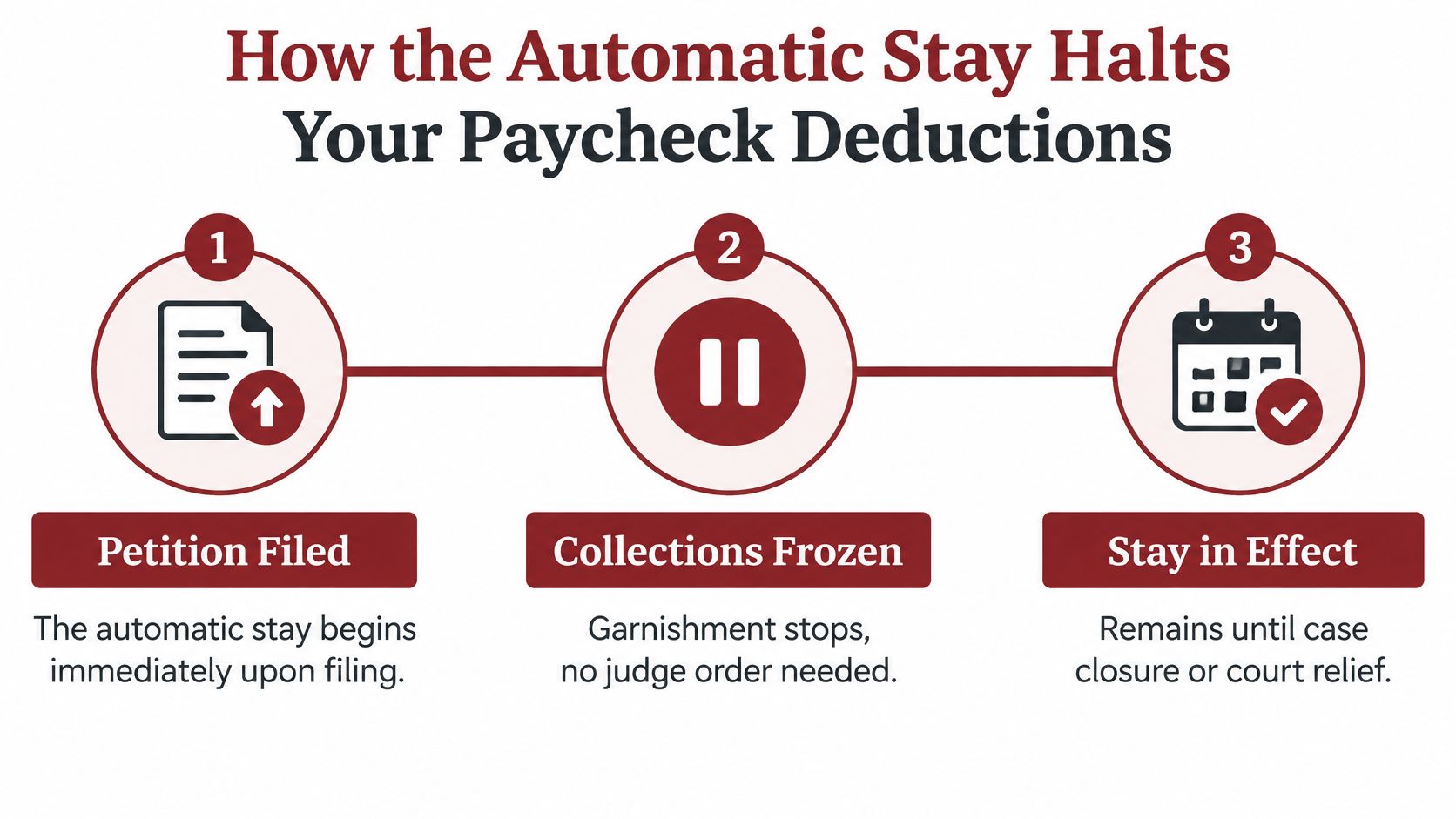
Think of the automatic stay as a pause button pressed on a recording. Nothing gets erased and nothing gets re-recorded, but the collection activity freezes at the instant the petition lands. The U.S. Courts’ Chapter 13 basics page explains that the stay arises automatically by operation of law under 11 U.S.C. § 362, so a separate judge’s order is ordinarily unnecessary.
That single fact drives the whole timeline. The filing date is the stop date, and the clerk’s time stamp on the petition is what a later motion will point to. While the stay is effective, creditors generally may not begin or continue lawsuits, wage garnishments, repossessions, or other collection efforts on debts incurred before filing. Collection calls should stop too, and so should enforcement against property such as a bank account.
The notice has to reach payroll, not just the creditor
The statute freezes the creditor. Your employer’s payroll department is the hand that stops writing the deduction, and payroll acts on paperwork. Send the bankruptcy notice with the case number to HR or payroll by email and by letter, and keep proof of when it arrived. The practical effect, as the same court resource describes it, is that an employer should generally stop withholding for a covered creditor garnishment after receiving appropriate notice of the case.
What to check on your next pay stub
Look at the deduction line, not the gross pay. If the amount still comes out after payroll confirms receipt of the notice, you have a stay violation to document rather than a mystery to absorb. Note the pay date, the amount withheld, and who received the money. How much could legally be withheld before you filed is a separate state question, and this walkthrough of state garnishment rules explained is useful context for reading the numbers on older stubs.
A later confirmation hearing doesn’t reset the start date. Protection runs from filing, and it continues while the case is open, which is the point most filers miss when they assume relief only arrives at confirmation. If you want the broader view of how that shield works in practice, this firm’s explanation of how the automatic stay can help a filer get back on track lays out the same sequence.
While the plan runs: you’re protected from your creditors, and you can’t be sued, garnished, or harassed about the debts in your plan.
Repeat Filings and Exceptions That Let Garnishments Continue
The exceptions in the table aren’t loopholes. They’re categories Congress deliberately left outside the shield, and they follow their own logic.
Support and criminal debts keep collecting
Child support and alimony withholding usually continues after filing because Chapter 13 doesn’t discharge those obligations. A parent with an income withholding order keeps seeing the deduction on each check while the plan handles the past-due arrears over time. That’s not a failure of the filing. It’s the design. Criminal fines and restitution run through the criminal court, and the bankruptcy stay doesn’t reach proceedings that aren’t collecting a dischargeable debt.
Debts you take on after filing
A judgment on a debt incurred after the petition date isn’t covered, because the stay protects only prepetition obligations. A new balance on a card used after filing, or a new medical bill, can be collected the ordinary way. This is why the filing date has to be pinned down precisely on every notice.
When a bankruptcy case is filed, an automatic stay goes into effect with few exceptions. The stay prevents creditors, including mortgage lenders, from taking any action to collect a debt.
The repeat filing trap
Here is where a second case behaves nothing like the first. If one earlier case was dismissed within the prior year, the stay terminates 30 days after the new petition unless you file a motion to extend it and show the new case was filed in good faith. If two or more earlier cases were dismissed within the prior year, no automatic stay arises at all without court action.
Say a debtor filed in March, the case was dismissed in June, and a new petition goes in eight months later. The clock is already running on day one. Bring the old case number and the dismissal date to the attorney at intake, because that 30-day deadline has to be calendared before anything else happens. The rules on how many times someone can file Chapter 13 in Georgia are worth reading before a refiling, since eligibility and the stay are two different questions.
How to Stop an Ongoing Garnishment Step by Step
The order of operations matters more than the paperwork volume. Work through these in sequence.
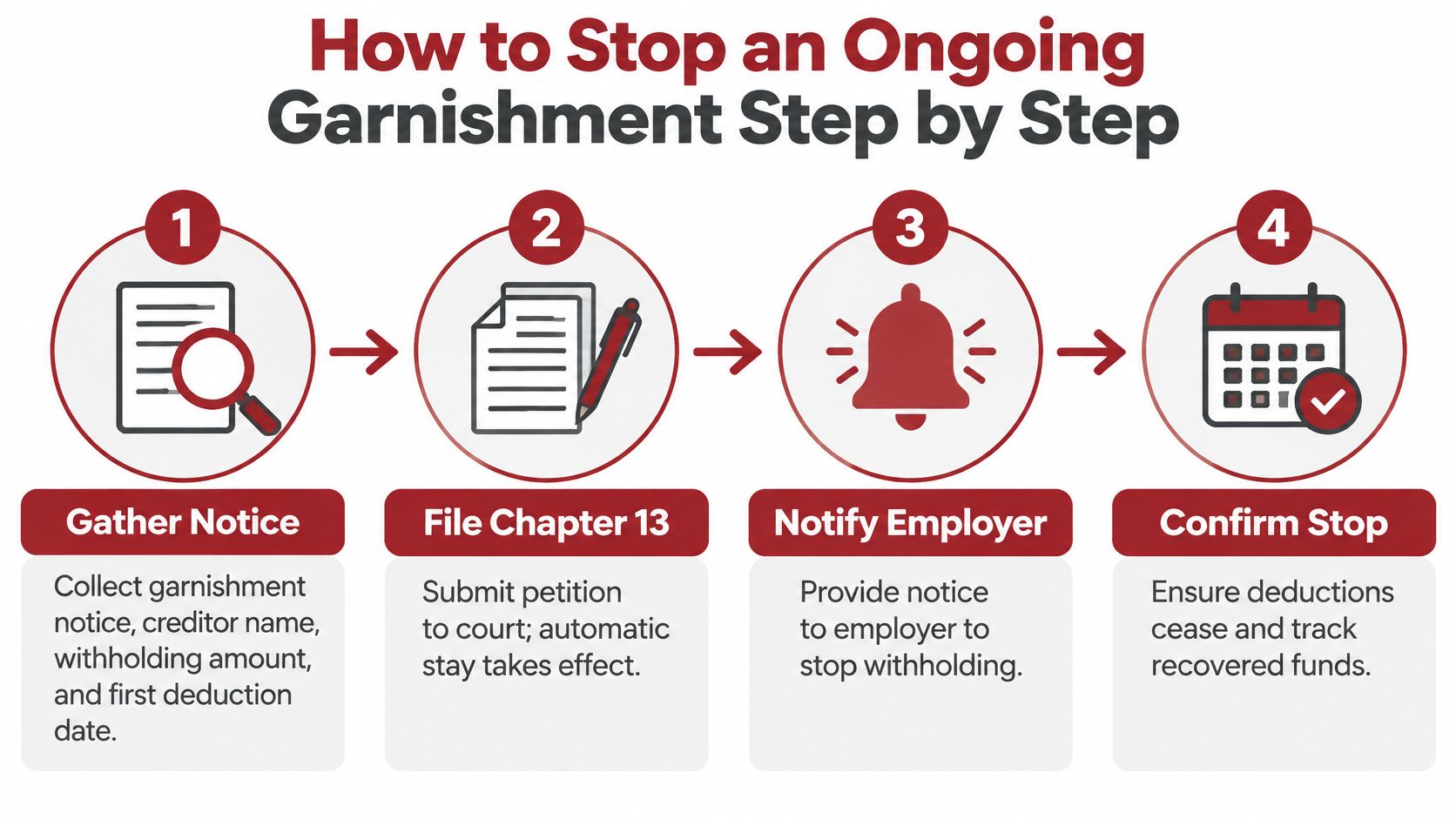
- Gather the notice. Pull the garnishment notice, the creditor’s name, the withholding amount, and the date of the first deduction. That date decides what can be recovered later, so write it down before anything else.
- File the petition. Whether an attorney files it or you do, the petition date is the stop date. If you have a prior dismissal in the last year, flag it now because the motion to extend the stay must be filed within 30 days of the new petition.
- Notify payroll directly. Email and mail a copy of the bankruptcy notice with the case number to HR or payroll. Keep the delivery confirmation, the fax receipt, or the certified mail slip.
- Get written confirmation. Ask payroll to confirm the next pay date on which withholding stops, and log the date they stopped. A verbal “we’ll take care of it” is not documentation.
- Handle a frozen bank account. If a levy hit your account, send the bank the same notice along with proof of the levy and ask for release of the frozen funds.
- Escalate if deductions continue. Document each deduction date, send a written demand to the creditor or its attorney, then ask the bankruptcy court to enforce the stay.
- Keep one log. Every deduction, phone call, and letter goes in a single dated log so your attorney can decide whether a motion for sanctions or damages makes sense.
A motion to enforce the stay comes after notice, not before. The court wants to see that the employer or creditor knew about the case and kept withholding anyway, which is why step three and step four exist.
Practical rule: notice to payroll protects your next check. Notice to the creditor protects your claim for damages. Send both, and prove both.
Georgia Rules That Change a Chapter 13 Garnishment Case
Georgia’s exemption rules affect which assets a filer may protect, while federal limits govern how much an ordinary creditor can take from wages before bankruptcy. The two rules address different stages of a garnishment.
Exemptions and the withholding cap
Georgia filers rely on state exemptions to protect qualifying property, including home equity. A homestead exemption protects a set amount of home equity. In Chapter 13, you can also catch up on past-due home payments over time instead of paying the arrears in one lump sum.
Federal law limits how much an ordinary creditor may take from a paycheck. Once the automatic stay applies, it stops garnishment deductions for debts covered by the stay, subject to exceptions. For a closer look at the state rules governing wage deductions, see Georgia wage garnishment laws.

District deadlines and dismissal risk
Georgia has three federal bankruptcy districts: Northern, Middle, and Southern. Response deadlines can differ under local rules, so follow the deadline stated in the motion and check the rules that apply to your case.
A missed plan payment can put the case at risk. The trustee or a creditor may ask the court to dismiss the case, and in some districts a written response is required or the motion may be granted without a hearing. If a motion arrives after you fall behind on a payment, treat the deadline printed on it as controlling. Confirm it with your attorney or the clerk’s office promptly, and do not assume a hearing will be scheduled automatically.
Recovering Money Taken Before You Filed
Filing does not refund every dollar already taken. That’s the assumption worth challenging, because it drives bad decisions about timing.
The automatic stay prevents further collection after filing. It does not automatically guarantee that every amount previously withheld comes back. Recovery turns on four questions: when the funds were transferred, whether the creditor or the garnishing agency still holds them, which exemptions apply, and whether the payment could be treated as a preferential transfer or another avoidable transaction. The official bankruptcy forms and instructions describe the disclosure obligations around property and transfers, which is where these questions get answered on paper.
The co-debtor stay most articles skip
Chapter 13 has a separate co-debtor stay protecting individuals jointly liable for qualifying consumer debts, unless the court authorizes collection. That matters when a spouse or a co-signer is the one whose wages are being garnished. Many consumer articles discuss only the person who filed and never mention that the household’s other earner may be shielded too.
The stay is a shield against future collection, not a refund button for past deductions.
The records that decide it
Pull these together before the consultation:
- Pay stubs covering the months before filing, showing each deduction and pay date
- Every garnishment notice, including superseded ones
- Bank statements showing any levy, freeze, or withdrawal
- The employer’s remittance dates, so you know when money left payroll
- The petition filing date and time, to mark the line between before and after
Then ask one question directly: were the funds collected before or after the petition, and does a motion to recover them make sense? That answer, not the filing itself, tells you whether money comes back.
Confirm Your Next Step Before the Next Paycheck
Before you call an attorney, assemble the file. Bring all garnishment notices with their dates, the case number if a petition is already filed, pay stubs for the last several months, bank statements showing any levy, a list of every debt with creditor names, your tax returns, and the dates of any prior bankruptcy cases. The prior case dates are the item people forget and the one that can shorten your stay.
Two things are true at once. A Chapter 13 case can stop a foreclosure, a car repossession, and wage garnishments, and it lets you deal with your debts at a payment level you can afford. It also gives you a plan to repay over three to five years rather than a lump sum you don’t have. Cost shouldn’t be the reason you wait, because court costs in a Chapter 13 case can be paid in installments if necessary.
Schedule a consultation with Morgan & Morgan Attorneys at Law P.C. at https://morganlawyers.com to confirm which garnishments can be stopped, which will continue, and whether a motion to extend or enforce the stay is needed. This information is general. Your next paycheck may be the most urgent deadline in the file.
Morgan & Morgan Attorneys at Law P.C. handles Chapter 13 filings for Athens-area families who need a garnishment stopped and a payment plan they can realistically keep, from the first notice to payroll through the confirmation hearing. Bring your garnishment notice, your pay stubs, and any prior case number to a free consultation, and we’ll map which deductions stop, which continue, and what paperwork has to go to your employer before the next pay date. Start at Morgan & Morgan Attorneys at Law P.C. and get the timeline in writing.

Lee Paulk Morgan
With more than 41 years of experience in the areas of Bankruptcy, Disability, and Workers’ Compensation, Lee Paulk Morgan is one of the most respected Bankruptcy and Disability attorneys in Athens, Georgia. His tireless dedication to serving clients has gained him the reputation of a premier attorney in his areas of practice, as well as the trust and respect of other legal experts, who often refer clients to him.
SHARE
RELATED POSTS

Is Chapter 13 Bankruptcy Worth It? (Georgia Guide 2026)
Chapter 13 bankruptcy is usually worth it when you have steady income, property at risk, and enough room in your budget to cover a repayment plan plus current bills for three to five years. It’s…

Negotiating With Creditors After Chapter 13 Dismissal
The dismissal notice shows up, and you read one line before your mind jumps straight to the mortgage, the car, the paycheck, and the phone calls you thought had finally stopped. That reaction is normal….