
Blog

Suing Creditor For Incorrect Reporting (Steps That Work)
Yes, a creditor or furnisher can be sued for incorrect reporting, but usually only after a documented dispute that it failed to investigate reasonably or correct. A damages claim generally needs proof of actual harm or willful conduct, not just proof that a credit report contains a mistake.
You may be looking at a collection you already paid, a late payment your bank records contradict, or an account you never opened. Meanwhile, a mortgage application, apartment approval, or job offer is on hold. The immediate goal is to fix the entry without losing the evidence you’ll need if the creditor refuses.
The dispute record, not just the original mistake, usually determines whether suing a creditor for incorrect reporting is viable. A carefully documented dispute can support both correction and a later claim. An angry phone call usually does neither well.
When a Creditor Can Be Sued for Bad Reporting
Yes, but the creditor’s legal responsibility must match what happened. A 2024 Consumer Reports and WorkMoney study found that 27% of participants who checked their credit reports identified errors that could affect their credit scores, according to CNBC’s explanation of credit-report disputes. That finding supports checking your reports, not assuming every error creates a lawsuit.
There are distinct actors. The consumer supplies the dispute and supporting evidence. The credit bureau, such as Equifax, Experian, or TransUnion, maintains the report. The furnisher, which might be a lender, servicer, or collector, supplies the account information.
Match the claim to the defendant
Claim types against a creditor or furnisher for inaccurate reporting
| Claim | Who It Applies To | Remedies | What You Must Prove |
|---|---|---|---|
| FCRA negligent violation | Agency or furnisher that breached an applicable reasonable-investigation duty | Actual damages and attorney fees in a successful qualifying claim | Inaccuracy, breached duty, causation, and actual harm |
| FCRA willful violation | Party that knowingly or recklessly disregarded an applicable duty | Actual or statutory damages, potentially punitive damages, and attorney fees | Willfulness and the other applicable claim requirements; statutory damages don’t require proof of actual financial loss |
| State negligence or defamation | Furnisher that published false information | Actual damages and potentially punitive damages under applicable law | Falsity, fault, publication, and injury; federal preemption can limit the claim |
For a plain-language introduction to the federal framework, Superior Credit Repair’s explanation of your rights under the FCRA provides useful context. It isn’t a substitute for evaluating the particular duty a defendant allegedly breached.
Look for the missing link
Most furnisher cases turn on whether the information was inaccurate, whether a specific dispute reached the furnisher through a bureau, and whether the furnisher then failed its investigation or correction duties. An original reporting mistake and an actionable post-dispute failure aren’t interchangeable.
State negligence or defamation theories may sound straightforward, but federal preemption can restrict them. Don’t assume adding a state-law label gets around the FCRA’s requirements. A collector’s conduct may also raise separate issues under the Fair Debt Collection Practices Act, which requires its own analysis.
The practical test is whether you can connect each defendant to dated events and a consequence: a denied loan, more expensive financing, or a withdrawn job offer. A lawyer needs that connection before deciding whom to sue and which claims to bring.
Send a Dispute That Creates a Legal Record
A useful dispute tells the recipient exactly what to investigate. The CFPB’s report on disputes on consumer credit reports explains the dispute framework, including an investigation period generally lasting 30 days, with extensions to 45 days in some circumstances.
The sequence matters because a private furnisher claim generally rests on the duties triggered when a bureau forwards the dispute. A direct letter to the creditor is useful, but it usually doesn’t create the same privately enforceable claim by itself.
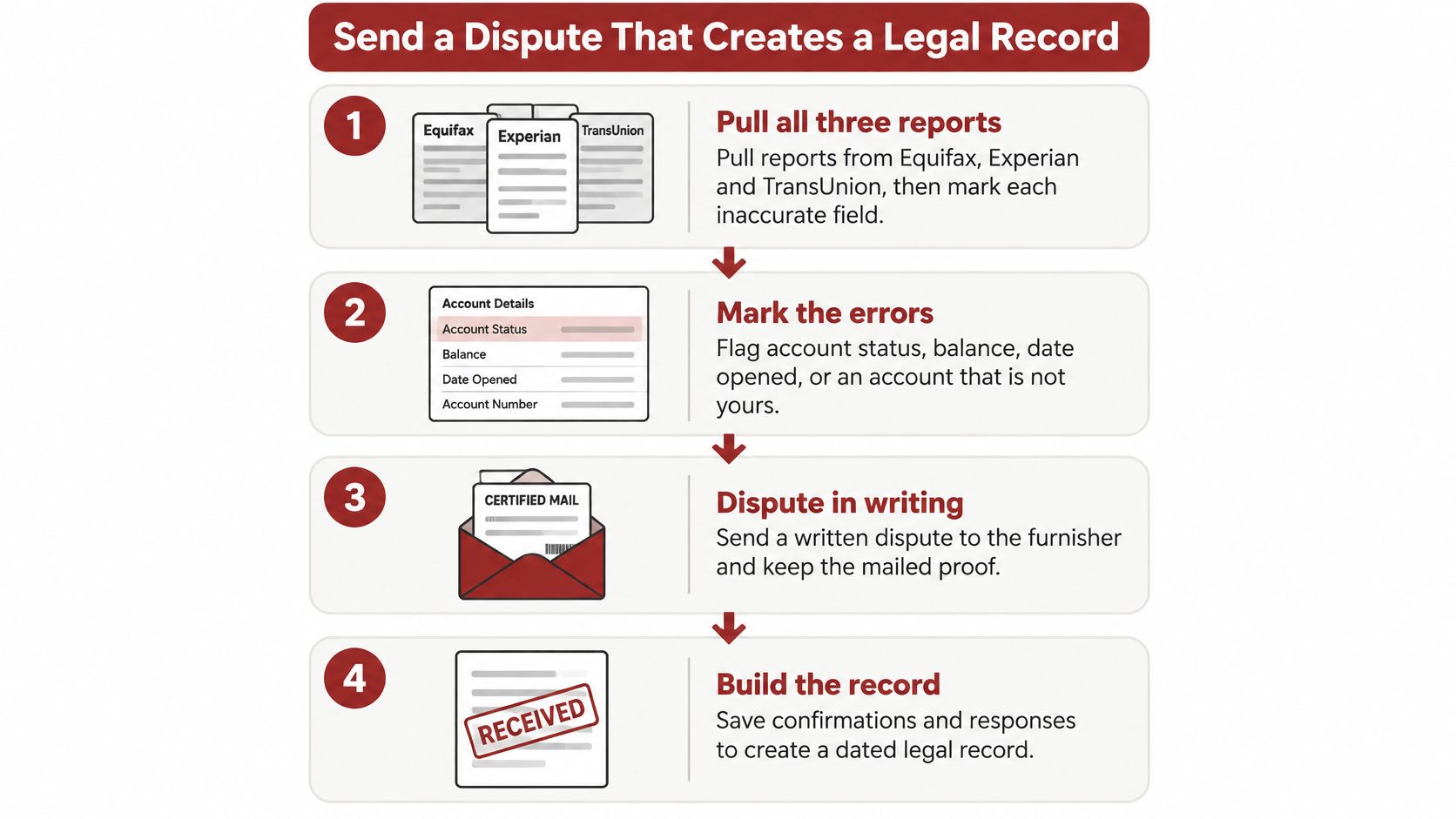
Build the packet in order
- Pull reports from Equifax, Experian, and TransUnion. Save the complete reports, not just a credit-monitoring alert. Mark the specific account status, balance, date opened, payment notation, or ownership information you dispute.
- Collect primary proof. Use account statements, cleared-payment records, creditor letters, identity-theft reports, or relevant court orders. Match each document to the field it proves is wrong.
- Explain each error separately. Identify the account, describe what the report currently says, state what it should say, and identify the supporting enclosure. A general assertion that an account is wrong gives the investigator little to work with.
- Send the dispute to every bureau reporting that error. Certified mail with return receipt provides a traceable mailing record. Keep a complete duplicate of the packet because a delivery receipt alone doesn’t establish what you sent.
- Send a separate written dispute to the furnisher. Use its designated dispute address when available and retain mailing proof. This gives direct notice without replacing the bureau dispute.
- Calendar the investigation period. Record receipt dates, not merely the day you drafted the letter. Save requests for additional information because they may affect the investigation timeline.
- Compare the result against the original report. Check whether the disputed field was modified, deleted, or verified. Don’t assume a corrected balance means an incorrect payment history was also fixed.
- Follow up on the unresolved field. Identify the remaining discrepancy and attach the document that contradicts it. Keep the follow-up specific rather than resending an unchanged template.
Keep debt validation separate
A collector’s obligation to address a debt dispute is a different issue from correcting a bureau’s tradeline. Our explanation of what a debt validation letter does can help you separate those tasks so you don’t mistake one letter for the other.
If you disagree with a bureau’s result, you can request a brief statement of dispute in your file, as the CFPB explains in its guidance on disputed results. That right concerns a dispute submitted to the reporting company, not merely a complaint sent directly to the furnisher.
A dispute statement isn’t deletion. It records your disagreement but doesn’t establish that the creditor investigated unreasonably or compensate you for harm.
Evidence That Shows the Furnisher Failed to Fix It
The strongest file lets someone unfamiliar with your account reconstruct the problem without guessing. Preserve the actual documents, then use a short chronology to explain how they fit together.
A practical evidence folder should contain:
- Before-and-after reports. Preserve complete versions showing the disputed field at each stage.
- Notice documents. Include dispute letters, enclosures, delivery confirmations, and written investigation results.
- Account proof. Keep payment confirmations, settlement terms, statements, and furnisher correspondence.
- Consequences. Save denial notices, rate offers, rental correspondence, and employment communications that identify the report’s role.
The documents below illustrate the kind of field-by-field review your file should support.
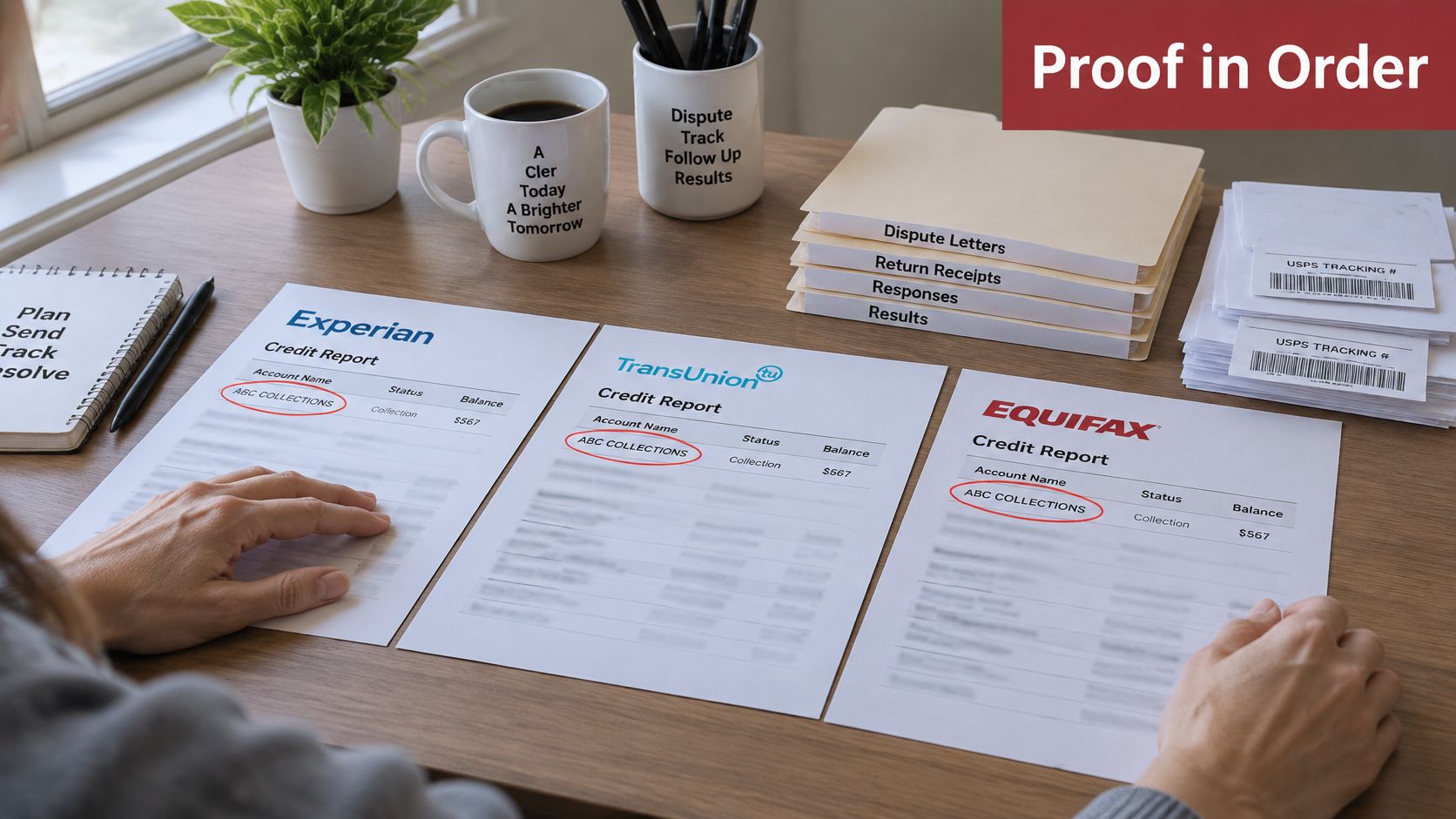
Turn documents into a chronology
Say a Georgia renter paid a collection, but the report still shows an unpaid balance. The renter sends payment proof to the bureau and furnisher, receives a verification response, and later loses an apartment after the landlord reviews that report.
The useful chronology connects the receipt of payment, the inaccurate balance, the dispute’s delivery, the verification response, and the rental denial. The landlord’s stated reason matters. A denial based on unrelated rental history won’t establish that the reporting error caused the loss.
A paid collection’s continued appearance isn’t necessarily the error. An inaccurate unpaid balance is different from an accurate historical collection entry. Identify what should change rather than demanding removal of everything unfavorable.
Use complaints as supporting evidence
The CFPB’s report on credit-bureau complaint responses found that the bureaus reported relief in fewer than 2% of covered complaints in 2021. That isn’t a court success rate, and filing a regulatory complaint doesn’t prove liability or damages.
A complaint can preserve your explanation and the company’s response. It can’t replace account records or establish that a bureau forwarded particular evidence.
Evidence rule: Keep the original document and the version you sent. A timeline is an index to your proof, not a substitute for it.
Common weaknesses include unnamed data fields, unsupported boilerplate, missing reports from other bureaus, and litigation filed before the investigation record is preserved. The governing standard is reasonable investigation, not automatic deletion whenever a consumer objects.
Deadlines That Can Kill Your Claim
Waiting for another customer-service response can feel safer than contacting counsel. It isn’t safe if you’re approaching a filing deadline. An investigation deadline and a lawsuit deadline serve different purposes, and neither should be confused with the time allowed to collect an underlying debt.
The investigation clock concerns the recipient’s handling of your dispute. The filing clock concerns your right to bring a claim in court. Don’t assume an ongoing dispute, a complaint to a regulator, or settlement discussions preserve that right.
Separate the clocks before calculating dates
Say an account appeared incorrectly long before you noticed it. Your discovery date, the date of the disputed conduct, and the date of a later investigation failure may be different. Counsel needs those events separately identified rather than a single entry labeled account problem.
Don’t treat every new report containing the entry as automatically restarting every possible deadline. Likewise, don’t assume the account’s opening date necessarily identifies the violation you would sue over.
Deadlines for disputes and lawsuits over inaccurate reporting
| Issue | Time Limit | Notes |
|---|---|---|
| Agency or furnisher investigation after a dispute | Applicable investigation period, subject to qualifying extensions | Track receipt, additional submissions, and the written result |
| FCRA lawsuit | Federal discovery-based deadline and an outside limit measured from the violation | Have counsel calculate both using the alleged violation |
| Georgia written-contract debt | Most have a six-year limit to sue | Confirm the debt classification and relevant dates with counsel |
| Georgia oral or open-account debt | Commonly four years | Confirm the applicable rule before relying on it |
| Georgia negligence or defamation claim | Claim-specific state limitation period | Confirm with counsel; don’t borrow a contract-debt deadline |
Our firm’s Georgia-law FAQ addresses the contract-debt periods summarized in the table. The explanation of debt-collection limitations in Georgia concerns collection issues, which must be distinguished from a consumer’s inaccurate-reporting claim.
Calendar events rather than assumptions
Record when you obtained the report, when you first recognized the discrepancy, when each recipient received your dispute, and when each response arrived. Preserve envelopes and electronic timestamps where available.
Don’t wait for the last dispute response before asking a lawyer to calculate the filing deadline.
State negligence and defamation periods require independent confirmation. A plausible state claim can still fail if you apply the wrong deadline or overlook federal preemption.
Damages, Demand Letters and Realistic Settlements
Say a Georgia nurse receives a job offer, then the employer withdraws it after a background check shows an unpaid debt she already paid. Her first task isn’t choosing a settlement number. It’s preserving the offer, the background report, the withdrawal explanation, and the account evidence.
Those documents help distinguish an inaccurate entry from a loss caused by an actionable reporting failure. If the employer withdrew the offer before a qualifying dispute and investigation, the timing may complicate the damages theory.
Separate the available remedies
The CFPB’s guidance on reasonable dispute investigations emphasizes that companies must address disputes reasonably rather than avoid their investigation duties. Proving an inadequate investigation still leaves the separate question of what relief the consumer can recover.
- Actual damages. Lost earnings, increased financing costs, and documented expenses require a causal connection to the violation.
- Statutory damages. These may be available for willful violations without establishing an actual financial loss, but willfulness must still be proved.
- Punitive damages. These require the applicable willfulness showing and aren’t an automatic addition to a demand.
- Attorney fees. Fee recovery may be available in a qualifying successful claim; confirm the representation agreement separately.
- Emotional distress. Availability and proof requirements require careful legal review. Preserve contemporaneous records rather than relying only on a later description.
Make the demand verifiable
For the nurse, a useful demand would identify the inaccurate account field, the dispute and response dates, the supporting payment record, and the employer’s explanation. It would state the legal basis, explain the requested compensation, set a reasonable response date, and request written confirmation of the reporting correction.
Request relief matched to the problem. That may mean correcting the balance, deleting an unverifiable item, notifying affected bureaus, or stopping a particular inaccurate report. Demanding deletion of accurate history can distract from a well-supported correction request.
A settlement offer should be in writing. Review the release, payment terms, reporting obligations, and consequences of noncompliance before signing, because a release can surrender claims beyond the entry you intended to resolve.
Correcting an error also doesn’t replace broader financial planning. Our guide to steps you can take to improve your credit score addresses that separate task. The strongest demand is tied to documented harm, not an assumed payout.
Federal or State Court and the Filing Process
FCRA claims may be brought in federal or state court, but choosing a forum involves more than convenience. Federal court has its procedural requirements; state court has its own jurisdictional, service, and scheduling rules. A state filing may also raise removal issues.
Georgia magistrate court shouldn’t be selected merely because it seems simpler. Counsel should confirm that the court can hear the particular claim and award the requested relief. The defendant, remedy, venue, and potential procedural disputes all affect that choice.
Compare practical constraints
| Consideration | Federal court | State court |
|---|---|---|
| Claim presentation | Federal statutory claims fit directly within the forum | Confirm jurisdiction over each claim and requested remedy |
| Procedure | Federal pleading, discovery, and scheduling rules apply | State and court-specific procedures apply |
| Location | Confirm proper federal venue | Confirm proper county and court |
| Strategic concern | Technical motion practice and evidence requirements | Possible removal and limits of the selected court |
Living nearby doesn’t automatically make a particular court proper. Venue requires checking the defendant’s connections and the events underlying the claim.
Follow the litigation sequence
- Draft the complaint. Identify each defendant, the inaccurate reporting, the relevant notice, the investigation failure, and the requested relief. Don’t group unrelated companies together without explaining each company’s conduct.
- File and address court costs. Follow the selected court’s filing requirements. If you can’t pay, determine whether you qualify for a fee waiver.
- Complete proper service. Sending another dispute letter isn’t service of a lawsuit. Use the method required for that defendant and court.
- Review the response. The defendant may answer or challenge the complaint through a motion. Missing a response deadline can damage an otherwise viable case.
- Develop evidence through discovery. Document requests, written questions, and depositions can reveal what the bureau forwarded and what the furnisher reviewed.
- Evaluate settlement or adjudication. Mediation may help resolve the dispute; unresolved claims may proceed through motions or trial.
Filing on your own is possible, but it places procedural compliance and evidence development on you. A clear payment receipt doesn’t eliminate the need to prove notice, breach, causation, and the other applicable elements. Ask about litigation costs, attorney compensation, and your obligations before deciding how to proceed.
Decide Whether to Sue or Call Morgan & Morgan
Continue building the dispute record when you can’t yet identify the inaccurate field or support your position with account documents. Consider legal review when the written result conflicts with clear evidence, an investigation appears inadequate, or an inaccurate report is interfering with housing, borrowing, or employment.
Don’t keep submitting the same template merely because the previous version failed. A lawyer can assess whether another targeted submission would help, whether a demand is appropriate, or whether further delay creates unnecessary risk.
Bring a file someone can evaluate
For a consultation, organize:
- Reports with dates. Bring complete reports from Equifax, Experian, and TransUnion, including relevant earlier versions.
- Dispute packets. Include exactly what you sent, the enclosures, and delivery evidence.
- Company responses. Preserve bureau results and furnisher correspondence, including electronic messages.
- Loss documents. Bring denial notices, higher-rate offers, withdrawn offers, and related communications.
- Other legal papers. Include collection letters, lawsuits, garnishment documents, and relevant bankruptcy orders.
Missing documents shouldn’t stop you from seeking time-sensitive guidance. Identify what’s missing so the attorney can distinguish an evidence gap from a weakness in the legal theory.
Choose the next step deliberately
At Morgan & Morgan Attorneys at Law P.C., we offer a free consultation for people dealing with a debt collector or with questions about debt collection. Bring credit-reporting concerns connected to that debt so we can discuss the issues together; confirm the scope of any proposed representation and its fees directly with us.
If foreclosure, collection litigation, or bankruptcy is also involved, identify those issues immediately. A reporting dispute doesn’t replace responding to court papers or addressing an imminent housing problem.
This is general information, not legal advice. Outcomes depend on the documents, applicable law, and facts of the particular claim, and no settlement or correction is guaranteed.
This week, pull your reports and start a dispute log with a separate row for each error. Record the field, supporting document, recipient, delivery date, response, and consequence. That gives you a practical correction plan and a usable starting point for legal review.
Morgan & Morgan Attorneys at Law P.C. offers debt-collection consultations and handles bankruptcy, real estate, and debt collection defense matters. If inaccurate reporting is connected to a collection problem, visit Morgan & Morgan Attorneys at Law P.C. to request a consultation and bring your reports, dispute packets, and written results for discussion.

Lee Paulk Morgan
With more than 41 years of experience in the areas of Bankruptcy, Disability, and Workers’ Compensation, Lee Paulk Morgan is one of the most respected Bankruptcy and Disability attorneys in Athens, Georgia. His tireless dedication to serving clients has gained him the reputation of a premier attorney in his areas of practice, as well as the trust and respect of other legal experts, who often refer clients to him.
SHARE
RELATED POSTS

What Happens If A Creditor Objects To Discharge?
If a creditor objects to your discharge, the creditor must file a formal adversary complaint within 60 days after the first date set for the meeting of creditors, and that filing starts a separate lawsuit…

Do Wage Garnishments Show On Credit Report in 2026
A wage garnishment generally doesn’t appear as its own item on Equifax, Experian, or TransUnion credit reports. The comparison table below separates the paycheck deduction from the debt records that may still appear. If there’s…