
Blog

What Happens If A Creditor Objects To Discharge?
If a creditor objects to your discharge, the creditor must file a formal adversary complaint within 60 days after the first date set for the meeting of creditors, and that filing starts a separate lawsuit that can deny your whole discharge. You’re not facing an automatic loss because a letter arrived. You’re facing a court case inside your bankruptcy case, with its own complaint, response date, evidence exchange and decision.
That distinction matters because what happens if a creditor objects to discharge depends on what the creditor attacked. One type of complaint tries to erase protection for every eligible debt. The other tries to keep one debt alive while the rest of your discharge proceeds.
What Happens Right After a Creditor Objects
You filed Chapter 7, sat through the meeting of creditors, and expected a discharge order in the mail. An envelope arrives instead: a creditor has objected. The fear is easy to name. Someone is calling this fraud, and every debt might come back.
An objection is an allegation the creditor still has to prove. The filing starts an adversary proceeding, its own lawsuit inside the bankruptcy, with pleadings, discovery, motions, a possible settlement, and a trial if the dispute is not resolved earlier. Discharge works like one cleanup order that can clear every eligible debt at once. A complaint aimed at that order can put the entire cleanup at risk, not only the balance on a single card or medical bill.
The Deadline That Starts the Case
For Chapter 7, Federal Rule of Bankruptcy Procedure 4004 sets the normal deadline at 60 days after the first date set for the meeting of creditors. A court may extend that period only under specified procedures, generally on a timely motion and for cause. Missing the line between a timely complaint and a late one can decide whether the challenge proceeds at all.
Once that window passes, most Chapter 7 cases still move to discharge if the filer completes debtor education and any requested follow-ups. A timely objection pauses that path. It does not restart wage garnishment or create an instant collection judgment. The automatic stay usually remains in place while the case is pending, and the creditor still has to prove its claim in the adversary proceeding.
An objection opens litigation. It doesn’t prove wrongdoing, and it doesn’t by itself revive collection.
Read the first page for three labels and dates: whether the complaint attacks the whole discharge or one debt, the day it was filed, and the day your response is due. In Chapter 7, a win against the discharge itself can leave credit cards, medical bills, and other eligible unsecured debts still owing. The chapter and the statute named in the complaint are what set those stakes.
Objection to Discharge Versus Objection to Dischargeability
Two complaints can land in the same week and look almost the same on the docket. One is a separate lawsuit against the discharge order itself. If that creditor wins, eligible debts stay in place because there is no discharge to wipe them out. The other lawsuit leaves the rest of the case alone and fights over a single bill.
A section 727 objection asks the court to deny the entire Chapter 7 discharge. The protection that normally covers eligible debts, such as credit card balances, medical bills, and unsecured loans, is what the objector is trying to take away. A section 523 complaint is narrower. It argues that one obligation fits a statutory exception, while your other qualifying debts can still be discharged.
| Feature | Objection to discharge (section 727) | Dischargeability complaint (section 523) |
|---|---|---|
| Target | Entire Chapter 7 discharge | One specific debt |
| Typical grounds | Concealment, false oath, destroyed records, unexplained asset loss | Fraud, willful and malicious injury, and other statutory exceptions |
| If the creditor wins | No discharge for any debt, and creditors keep their claims | That debt survives while other eligible debts are discharged |
| Deadline | 60 days after the first date set for the 341 meeting | Generally the same 60-day framework |
| Burden | The objecting party must prove the facts | The creditor must prove the exception applies |
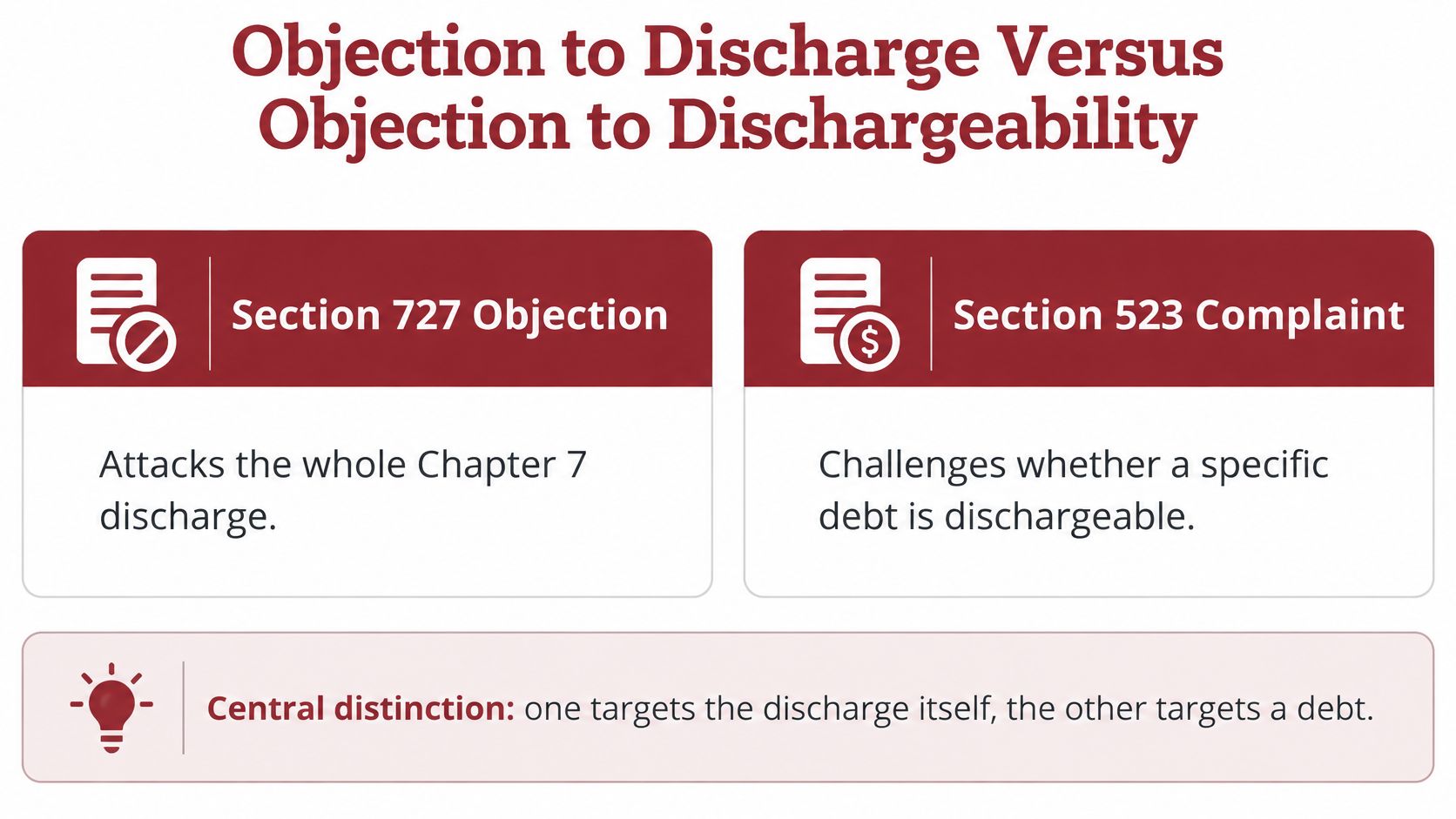
If you are unsure what the discharge order itself does, review what a bankruptcy discharge means before you judge the size of the risk. Then read the complaint heading and the cited statute. That citation tells you whether the creditor wants the entire order denied or only its own claim preserved.
Grounds and Chapter 13
Section 727 grounds in the table focus on conduct that undermines the bankruptcy process itself, such as hiding property, a false oath, destroyed records, or an asset loss you cannot explain. Section 523 grounds focus on how one debt arose, such as alleged fraud or a willful and malicious injury tied to that obligation. Two complaints filed on the same day can therefore carry very different stakes. Readers often mix those up because both arrive as adversary complaints and both use the same short response window.
Chapter 13 changes which lawsuit is even available. According to the United States Courts guide to discharge in bankruptcy, creditors generally cannot object directly to the eventual discharge after successful completion of the repayment plan, although they may object to plan confirmation or pursue issues involving particular debts. Chapter 13 plans commonly run three to five years, so creditors usually raise their fight at confirmation or over a specific debt instead of trying to undo the whole discharge after the plan is finished.
Practical test: If the complaint cites section 727, your entire discharge is at issue. If it cites section 523, identify the single debt and the exception the creditor claims.
The Adversary Proceeding Step by Step
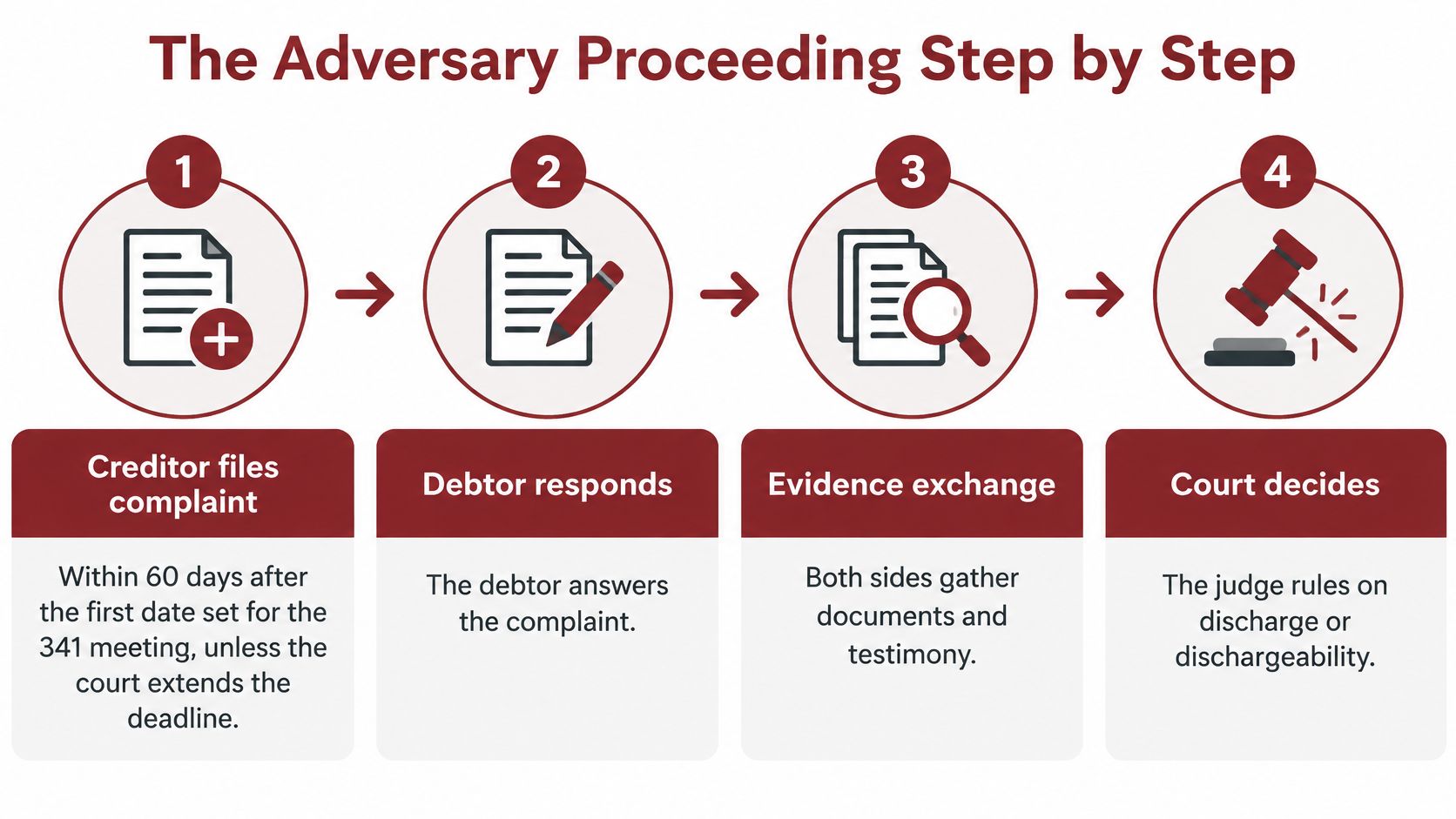
An adversary proceeding follows a sequence that looks much more like ordinary civil litigation than the main bankruptcy filing. Each stage has a purpose. Each stage also creates a date or duty you can’t safely ignore.
Filing and Response
- The creditor files the complaint. The Central District of California bankruptcy court discharge FAQ explains that under Federal Rule of Bankruptcy Procedure 4004, the creditor generally has 60 days after the first date set for the meeting of creditors under section 341(a) to file a complaint objecting to the overall discharge, and the same 60-day framework generally applies to a section 523 claim. If that deadline expires without a timely objection, the court will ordinarily enter the discharge. Extensions must be properly requested before the deadline.
- You’re served and must respond. The summons sets your response date, and you answer the allegations or file a motion asking the court to dismiss a legally insufficient claim. Ignoring the papers can let the objector seek a default win without proving the dispute at trial. Your answer should admit, deny or state a lack of knowledge claim by claim, so don’t treat it as a general letter explaining hardship.
After the 60 day objection window passes with no complaint, most Chapter 7 cases proceed to discharge if you complete debtor education and any requested follow ups. Once a complaint is filed, that ordinary path pauses for the disputed issue while the adversary case moves forward.
Evidence, Motions and Possible Settlement
- Discovery begins. Both sides exchange written questions and documents, and a creditor may subpoena bank records or take depositions. You’ll commonly be asked for tax returns, bank statements, transfer records, loan applications and explanations for missing assets. Discovery tests whether the complaint rests on documents or suspicion.
- Pretrial motions narrow the dispute. A party may ask the judge to dismiss a claim, exclude evidence or decide an issue where the material facts aren’t disputed. These motions can end part of the case before trial, which is why the precise statutory ground matters from the start.
- Settlement talks run alongside discovery. Parties often negotiate while evidence is still being exchanged because documents clarify risk for both sides. A settlement can dismiss the complaint, reduce the disputed debt or set agreed payment terms without the cost and uncertainty of trial.
Don’t wait for a trial date to learn what your records show. Discovery usually reveals the strengths and weaknesses of both positions first.
Trial and Judgment
- A bankruptcy judge hears the case if it isn’t resolved. Witnesses testify, documents are admitted, and the objecting party must prove the facts supporting its objection. Grounds can include concealing or transferring property with intent to hinder, delay or defraud creditors, destroying financial records, making false statements under oath, failing to explain loss of assets or failing to complete required financial management education.
- The court enters judgment. The discharge may stand in full, one debt may be declared nondischargeable, or discharge may be denied entirely. A successful section 727 objection doesn’t merely exclude debts one at a time. Creditors generally retain their claims because the general discharge never enters.
Most bankruptcy filers never appear before a judge in the main case. They attend a short 341 meeting with the trustee. An adversary proceeding changes that experience because a judge may decide motions and preside at trial. Put two dates where you can’t miss them, the creditor’s filing deadline and your response date.
Who Must Prove What and How Long It Takes
The creditor who objects carries the burden of proof. You don’t start the case by having to prove that you deserve a discharge in the abstract. The objector must establish each element of the ground it pleaded with admissible evidence.
For many discharge objections, that standard is a preponderance of the evidence. In plain language, the judge must find that the alleged ground is more likely than not true. A suspicious transaction alone may prompt questions, but the creditor still has to connect the facts to the statutory requirement.

Why Intent Is Often the Hardest Element
Say you transferred a valuable car to a sibling for a token sum shortly before filing and now can’t explain where any sale money went. The creditor can’t read your mind, so it will point to timing, the family relationship, the low price and missing records. A court may infer intent to hinder, delay or defraud from those surrounding facts if they fit together.
Your records can break that inference. A fair market appraisal, proof of payment, bank deposits and records showing the money paid rent or medical bills tell a different story. The dispute becomes less about labels such as fraud and more about whether the paper trail supports an innocent explanation.
That burden analysis changes under section 523. The creditor doesn’t need to prove that your whole case was dishonest. It must prove that a specific exception applies to its specific debt, such as how that debt was incurred or what injury it involves.
How Long the Separate Lawsuit Can Run
The complaint runs alongside the main bankruptcy case, but it follows its own schedule. Discovery disputes, motion briefing, settlement talks and the judge’s calendar can stretch the matter well beyond the date you first expected discharge. Reading what happens 60 days after the 341 meeting helps separate the ordinary waiting period from this added litigation track.
These cases aren’t rare side events nationally. The Administrative Office of the United States Courts Judicial Business 2023 report recorded 12,504 adversary-proceeding filings in 2023, including creditor actions to object to or revoke a discharge and to determine whether a debt is dischargeable. Volume alone doesn’t predict your timeline, but complete records usually reduce fights over basic facts and make settlement or judgment easier to reach.
Possible Outcomes and What the Debtor Keeps, Loses or Still Owes
| Outcome | What happens | Effect on the debtor |
|---|---|---|
| Denial of entire discharge | Court rules for the objector under section 727 | No eligible debts are discharged and the full balances remain owed |
| Denial as to one debt | Court finds a specific debt nondischargeable under section 523 | That debt survives while other eligible debts are discharged |
| Debtor prevails | Complaint dismissed or judgment entered for the debtor | Discharge enters as normal |
| Settlement | Parties agree to dismissal, a reduced payment or an agreed judgment | Terms are set by agreement, often avoiding the cost of trial |
| Reaffirmation | Debtor agrees in writing to keep paying a debt | Debt remains owed, and the debtor keeps the collateral while payments continue |
The worst outcome is denial of the entire discharge. No eligible debts are wiped out, so creditors can pursue the full balances subject to other applicable law once bankruptcy protection ends. You’ve spent time in bankruptcy without receiving the central relief the case was meant to provide.
A one debt loss hurts, but it’s contained. Say you have $40,000 in credit card debt and a disputed $6,000 personal loan. If the creditor wins only on that loan under section 523, the card debt can still be discharged and you still owe the $6,000 loan. That worked example shows why reading the statute in the complaint matters before you assume the worst.
Settlement, Reaffirmation and Winning Outright
If the judge rules for you or dismisses the complaint, discharge enters normally for eligible debts. If your evidence is weak, settlement may be more efficient than risking a broader judgment. You might agree to a reduced amount, structured payments or an agreed judgment on one debt in exchange for dismissal of the complaint.
Reaffirmation is different from losing a dischargeability fight. You voluntarily agree in writing to keep paying a debt, often a car loan, so you can keep the collateral while payments continue. It requires court approval and includes a short window to rescind, so don’t sign it just because a creditor pressures you during settlement talks.
Don’t confuse any of these outcomes with dismissal. A dismissal ends a case without wiping out debts, so creditors can collect again. A discharge is a court order that permanently eliminates eligible debts. If you’re weighing whether bankruptcy removes a particular balance, whether bankruptcy eliminates all debt is the right starting question.
Debts and Risks That Remain Either Way
Some obligations survive regardless of the objection. In Chapter 7, credit card debt, medical bills and unsecured loans are typically discharged. Taxes, student loans and divorce or child support obligations can’t be discharged in Chapter 7.
Child support deserves a separate sentence because families often misunderstand it. Child support, both past due and ongoing, is not dischargeable in bankruptcy. Bankruptcy can still erase or restructure other debts so you can stay current on support, but winning the adversary case doesn’t erase support itself.
- You may keep discharge protection: Eligible unsecured debts are eliminated if you prevail or if the creditor wins only on another specific debt.
- You may lose the fresh start: A section 727 judgment leaves eligible balances collectible instead of discharged.
- You still owe excluded debts: Support and other nondischargeable categories remain even when the objection fails.
The automatic stay also doesn’t last forever. It protects you during the case, but it ends when the case closes or is dismissed, or when the court lifts it for a secured lender. If you relied on the stay to keep a financed car while behind on payments, repossession risk can return. A denied discharge can also limit future Chapter 7 relief for years, so discuss any refiling idea with counsel before you act.
Confirm Your Deadlines and Build a Response Plan
Start with two dates that can’t be missed. The first is 60 days after the first date set for your section 341 meeting. The second is the response date in the summons after the complaint is served. Every other decision becomes harder if either date passes while you’re still gathering papers.
A Numbered Response Checklist
- Confirm both dates on a calendar. Write down the first date set for the meeting, the objection deadline and your answer deadline. Note whether an extension motion would have to be filed before the deadline rather than after it. Don’t rely on the date printed on a creditor’s cover letter.
- Read the complaint statute by statute. Mark whether each count attacks the whole discharge under section 727 or one debt under section 523. List every claim separately because a complaint can contain both types. Your defense to a false oath allegation may look nothing like your defense to a claim about one loan application.
- Gather the records the creditor will request. Pull bank statements covering the period before filing, tax returns, property sale and transfer records, loan applications, records of gifts or payments to relatives, your financial management course certificate and every message exchanged with the creditor. Organize them by account and date so you can answer discovery without reconstructing your finances under pressure.
- Build a money timeline. Show what you owned, what you sold or transferred, what you received and where the money went before filing. Flag gaps now and prepare a truthful explanation supported by receipts, deposits or other documents. Unexplained gaps are often where intent arguments gain strength.
Record rule: If a transaction looks unusual, pair it with the document that explains price, payment and use of proceeds. One complete paper trail is stronger than a long verbal explanation.
- Choose a negotiating position. Decide whether you’ll contest every claim, offer a reduced or structured payment on one debt, accept an agreed judgment or reaffirm a secured debt to keep a car. Put your highest acceptable settlement in writing for your attorney before talks begin. That prevents an emotional offer during a call from becoming your position.
- Weigh settlement against the actual stakes. Losing one debt may be manageable if the rest of your discharge survives. Losing the whole discharge can leave every eligible balance collectible. A settlement that looks expensive beside one loan may be rational if it removes a credible section 727 risk.
Getting Help Before the Response Date
An attorney can review the counts, file a timely answer, object to improper discovery requests, negotiate with the creditor’s counsel and present evidence at trial. Our firm assists clients in handling banks and creditors, which is useful when settlement talks and court deadlines are moving at the same time. Bring the complaint, summons, bankruptcy schedules and your timeline to the first review so advice is based on the actual allegations.
Readers outside the United States shouldn’t apply these Chapter 7 rules to a local insolvency case. If your debts and assets are in Singapore, get help with personal bankruptcy in Singapore through The Lawyer Guide and compare that process separately. For a United States case, contact Morgan & Morgan Attorneys at Law P.C. before the response date, not after discovery deadlines have already started to run.
If a creditor has filed an adversary complaint against your discharge, Morgan & Morgan Attorneys at Law P.C. can review whether it targets your entire discharge or one debt, confirm your deadlines and build a response grounded in your records. Visit Morgan & Morgan Attorneys at Law P.C. to discuss your complaint before the response date passes and get clear guidance on settlement, discovery and trial.

Lee Paulk Morgan
With more than 41 years of experience in the areas of Bankruptcy, Disability, and Workers’ Compensation, Lee Paulk Morgan is one of the most respected Bankruptcy and Disability attorneys in Athens, Georgia. His tireless dedication to serving clients has gained him the reputation of a premier attorney in his areas of practice, as well as the trust and respect of other legal experts, who often refer clients to him.
SHARE
RELATED POSTS

Do Wage Garnishments Show On Credit Report in 2026
A wage garnishment generally doesn’t appear as its own item on Equifax, Experian, or TransUnion credit reports. The comparison table below separates the paycheck deduction from the debt records that may still appear. If there’s…

Should I Hire an Attorney for Debt Settlement? (2026 Georgia Guide)
You should hire an attorney for debt settlement if you have been sued, your wages are being garnished, you owe more than roughly $10,000, or a creditor is threatening legal action. For a single small…