
Blog

How Does Bankruptcy Affect Your Spouse? (Georgia Guide)
Your spouse’s bankruptcy does not automatically put you into bankruptcy, but joint debts and shared property can still affect you. If you never signed the loan, could you still lose access to money in a shared account or face a problem with your home?
That’s the gap many explanations miss. Personal liability, whether a creditor can demand payment from you, is different from property exposure, whether an asset you own together could be affected. For married readers in Georgia, understanding both questions is the starting point for choosing a filing path.
Whether Your Spouse’s Bankruptcy Reaches You
Only the person who files becomes a bankruptcy debtor unless both spouses file. The U.S. Courts’ instructions for individual bankruptcy forms distinguish an individual case from a joint case filed by a married couple. Marriage alone doesn’t add your name to your spouse’s petition or give you a discharge.
A discharge removes the filing debtor’s personal responsibility for eligible debts. It doesn’t automatically cancel another borrower’s promise to pay, erase a mortgage lien, or protect everything the household owns.
Start with who signed
Pull the account agreement, not just the latest statement. A card bearing your name might make you a joint borrower, a co-signer, or merely an authorized user. Those roles don’t carry the same responsibility.
An authorized user generally has permission to use a credit card without assuming contractual responsibility for its balance. A joint borrower or co-signer generally promises to repay it. The Northern District of Georgia Bankruptcy Court’s frequently asked questions explain that a discharge doesn’t eliminate a co-obligor’s liability.
Who Is Liable and Who Is Exposed After One Spouse Files
| Debt or asset | Filing spouse | Non-filing spouse | Property exposure |
|---|---|---|---|
| Credit card in filer’s name only | Eligible debt may be discharged | Generally not personally liable without a separate legal basis | Ownership, exemptions, and state law determine asset exposure |
| Joint credit card | Eligible personal liability may be discharged | Still responsible for the unpaid balance | Collection against accounts requires applicable ownership and collection rules |
| Co-signed car loan | Eligible personal liability may be discharged | Still liable under the loan agreement | Lender may repossess after default when legally permitted |
| Joint mortgage | Discharge doesn’t by itself remove the lien | Remains liable if named on the note | Home may face foreclosure if the mortgage isn’t resolved |
| Child support owed by filer | Not dischargeable | Doesn’t become liable merely through marriage | Permitted support enforcement may reach the filer’s income |
Read the rows as separate questions, not a promise that bankruptcy will erase every listed loan. For an individual credit card, eligibility for discharge comes first. For a joint credit card, the creditor can generally seek the unpaid balance from the non-filing borrower, not merely an assumed marital share.
For a car loan, keeping the vehicle requires addressing the lender’s rights in the vehicle. For a mortgage, signing the deed establishes an ownership interest, while signing the note generally establishes repayment responsibility. A spouse can have one role without the other.
Protection for the filer isn’t protection for everyone
In Chapter 7, creditors can generally continue pursuing a non-filing spouse who remains legally responsible. That exposure continues unless the obligation is paid, settled, separately discharged, or covered by another protection.
Chapter 13 may offer a temporary co-debtor shield for qualifying consumer debts. It isn’t a discharge for the non-filing spouse, and its scope needs review before anyone stops making payments.
Our explanation of co-signed and joint debts in Georgia bankruptcy helps distinguish these obligations. Build your account inventory around signatures, guarantees, ownership, and collateral, rather than treating every household bill as jointly owed.
Joint Filing or Filing Alone for Married Couples
The choice isn’t whether you want your spouse involved. It’s whether making both spouses debtors produces a better result after considering their obligations, property, income, and available protections.
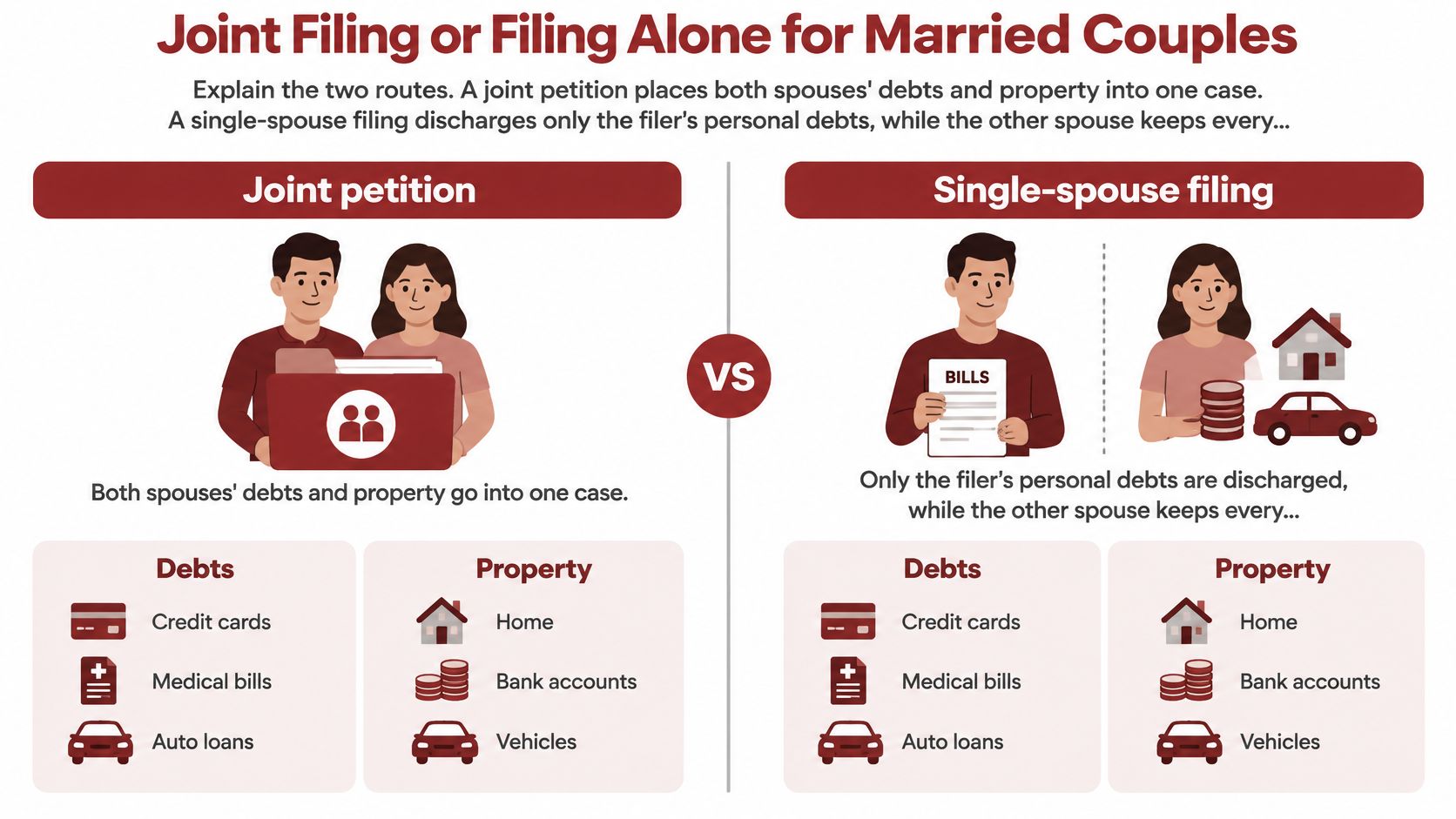
A joint petition brings both spouses into the case. An individual petition leaves the other spouse outside it, although household financial information can still matter. Household income still counts for eligibility when only one spouse files, so separate filing doesn’t mean separate financial calculations.
Compare the practical results
Joint Petition Versus Filing Alone
| Factor | Joint petition | One spouse files alone |
|---|---|---|
| Who receives a discharge | Both spouses, if each qualifies | Filing spouse only, if eligible |
| Household income in eligibility | Both incomes considered under applicable rules | Non-filing spouse’s income still matters, subject to applicable adjustments |
| Joint debts | Both spouses’ eligible liabilities addressed together | Non-filer remains liable unless another protection applies |
| Chapter 13 co-debtor shield | Both debtors receive debtor protections; qualifying additional co-debtors may receive a shield | May temporarily protect a spouse jointly liable for qualifying consumer debt |
| Shared property | Both ownership interests disclosed and reviewed | Filer’s interest reviewed; state law determines additional exposure |
Chapter 13’s co-debtor stay concerns qualifying personal, family, or household debts, not every obligation a couple shares. Creditors may seek permission to proceed, and dismissal can end the protection. The U.S. Courts’ voluntary petition form also shows why filing status and household financial disclosures need careful attention.
While you’re protected under a Chapter 13 plan, creditors generally can’t sue, garnish, or harass you about debts covered by those protections. Don’t assume that the same protection reaches every obligation owed by your spouse.
Decision guide: Consider joint filing when both spouses need debt relief. Consider individual filing when the problem debts belong primarily to one spouse, but test shared-property exposure before deciding.
Joint filing isn’t automatically best merely because you share a home. Likewise, clean credit and separate account names don’t automatically make individual filing safer.
Before comparing the routes, gather income records for both spouses, a complete list of joint accounts, and the home deed and vehicle titles. Those documents let an attorney evaluate the actual household rather than rely on assumptions about marriage.
Shared Property and Georgia Marital Assets
You can have no personal responsibility for a debt and still face disruption involving shared property. Ownership and repayment liability are separate legal questions.
Georgia isn’t a community-property state. Its equitable-distribution rules for divorce shouldn’t be confused with the rules governing a bankruptcy estate. For bankruptcy planning, the deed, title, source of funds, ownership interests, liens, and exemptions all need attention.
A California bankruptcy court opinion addressing community property illustrates the broader distinction: property can be exposed even when a spouse lacks personal liability. That community-property analysis isn’t a Georgia ownership rule, but it shows why “I never signed” doesn’t answer every asset question.
Read the ownership documents
Say a married couple owns a home together, but only one spouse files. The trustee can examine the filing spouse’s interest and the available equity. The non-filing spouse’s ownership doesn’t disappear, but it also doesn’t guarantee that administration of the property cannot affect them.
A trustee may, in appropriate circumstances and with court authorization, seek a sale involving co-owned property. That makes equity and exemptions, not just the names on the deed, important.
Georgia Property Titling and Exposure
| Ownership form | Filer’s share | Non-filer’s share | Notes |
|---|---|---|---|
| Tenancy by the entirety, where recognized outside Georgia | Applicable law may protect against individual creditors | Joint-creditor claims can change protection | Georgia doesn’t recognize this ownership form; both names on a deed aren’t enough |
| Joint tenancy or tenancy in common | Ownership interest generally enters the estate | Separate ownership interest isn’t automatically the debtor’s property | Trustee may examine equity and possible sale rights |
| Property in filer’s name only | Generally enters the estate, subject to exemptions | No ownership share established merely by marriage | Actual ownership, transfers, and other legal interests still require review |
| Joint bank account | Filer’s ownership interest requires disclosure | Ownership claims require supporting records | Trace deposits, withdrawals, and the source of funds |
Inventory more than the house
Gather documents for these categories:
- Home and vehicles: Deeds, titles, loan statements, and realistic current values.
- Bank accounts and wages: Statements showing whose money entered each account and when.
- Inherited or gifted property: Records identifying the recipient and any later transfer or commingling.
- Property acquired during marriage: Purchase records and documents showing ownership, even if only one name appears.
Georgia exemptions can protect specified interests in assets, but they aren’t blanket protection for everything a family owns. Eligibility and the applicable exemption scheme need review, particularly after a move between states.
Our guide to assets protected in Georgia bankruptcy provides a starting point. Don’t retitle assets or empty joint accounts to prepare for filing. Transfers can create problems that accurate disclosure and advance planning could avoid.
Child Support, Alimony and Divorce Timing
Past-due and ongoing child support aren’t dischargeable in bankruptcy. Chapter 13 can provide time to catch up on arrears, but it doesn’t erase them. Eliminating or restructuring other debts may still make it easier to keep support current.
Consider a couple who separates while their jointly owned home is listed for sale. One spouse owes support, both signed the mortgage, and they expect the divorce decree to divide the sale proceeds. Filing bankruptcy during that sequence requires more than deciding whose name belongs on the petition.
Follow the couple’s timeline
Moving apart doesn’t remove either borrower from an existing mortgage. Nor does an expectation about future sale proceeds establish that the property has already been legally divided.
The bankruptcy court’s analysis in Cohen illustrates how undivided community property and divorce timing can intersect. Its community-property conclusions shouldn’t be transplanted into Georgia, but its practical warning applies: separation, property division, and bankruptcy filing aren’t interchangeable events.
Suppose one spouse buys a car after separation. If only that spouse signs, the other doesn’t become a borrower merely because the marriage continues. If both sign, both may be responsible despite living apart.
A divorce agreement assigning a joint debt to one spouse doesn’t, by itself, rewrite the creditor’s contract with the other borrower.
Support obligations also need to be distinguished from property settlements and other divorce-related debts. Alimony and domestic support receive special treatment, while the treatment of other divorce obligations can differ by chapter and by the obligation’s legal character. Don’t assume that calling an obligation a settlement payment decides its bankruptcy treatment.
Put each event on paper
Build a timeline containing:
- Separation date: When the spouses began living apart and what agreements existed.
- Debt dates: When each obligation arose and who signed it.
- Petition date: The proposed bankruptcy filing date.
- Divorce decree and property-division dates: Including whether transfers were completed.
- Foreclosure or sale dates: Including deadlines affecting the home and expected proceeds.
Our explanation of bankruptcy and child support payments addresses why debt relief doesn’t eliminate support.
Place each debt and asset on the timeline before choosing a filing route. If divorce is pending, coordinate bankruptcy and family-law advice before signing a settlement, distributing sale proceeds, or transferring title.
Credit Scores, Foreclosure and Georgia Venue
Your credit report and your spouse’s credit report are two separate files. A bankruptcy entry lands only on the filer’s file. Joint accounts, though, work like a shared page in both records: a missed payment on a co-signed loan can appear on each borrower’s report, no matter who made the payments.
Lenders also read the household as a whole. When a couple applies jointly after one spouse’s bankruptcy, the lender may weigh combined income, remaining joint debts, and the filing spouse’s history together. So when someone asks, “How does bankruptcy affect your spouse’s credit?” the honest answer is account by account, not a blanket yes or no.
Check reporting separately from court protection
Compare every shared account’s ownership designation and payment history across both reports. Two different problems can surface: an accurate late mark on a joint loan, which reflects real borrowing history, and a bankruptcy notation wrongly attached to a spouse who never filed, which calls for a dispute.
Filing generally triggers an automatic stay that stops most collection activity, including action by mortgage lenders, with few exceptions. The stay pauses the pressure. It does not erase missed mortgage payments, and it does not automatically shield a non-filing co-borrower from collection. Mortgages follow their own default timeline once payments stop, and when mortgage arrears lead to foreclosure explains how arrears build toward a sale. Your Georgia notices and scheduled sale date set your real deadlines.
Foreclosure warning: A discharge of personal liability doesn’t, by itself, remove the lender’s lien or guarantee that the household can keep the home.
That warning captures the distinction most couples miss. Personal liability is the obligation to pay; the lien is the lender’s claim against the property. A discharge can end the filer’s personal obligation while the lien stays attached to the home. If foreclosure later proceeds, a non-filing co-borrower who remains personally liable may face a claimed deficiency, subject to applicable Georgia requirements and defenses. Bring the note, security deed, payment history, and every foreclosure notice to the legal review.
Confirm where the case belongs
In most cases, a bankruptcy must be filed in the district where the person lives. Recent moves and spouses living in different places call for closer review rather than a courthouse chosen for convenience. Whatever the venue, most filers never appear before a judge; they attend a short 341 meeting with the trustee instead.
- Record residence history: Include where each spouse has lived and when any move occurred.
- Identify urgent deadlines: Keep foreclosure notices and scheduled sale information with the residence records.
- Separate objectives: Decide whether the priority is keeping collateral, stopping collection, or resolving unaffordable debt.
Bankruptcy is not a cure-all, and it is rarely sensible to file solely to rebuild credit. A filing decision this tied to deadlines and addresses belongs in front of an experienced bankruptcy attorney, not guesswork.
Decide Your Filing Path and Book a Consultation
The most useful preparation is a clear record of who owes what, who owns what, and what happens next. You don’t need to solve the legal questions yourself. You need enough documentation for an attorney to identify them accurately.
Keep uncertain items on the list. Marking an account’s borrower status as unconfirmed is better than assuming it belongs only to the person who usually pays it.
Prepare a household filing packet
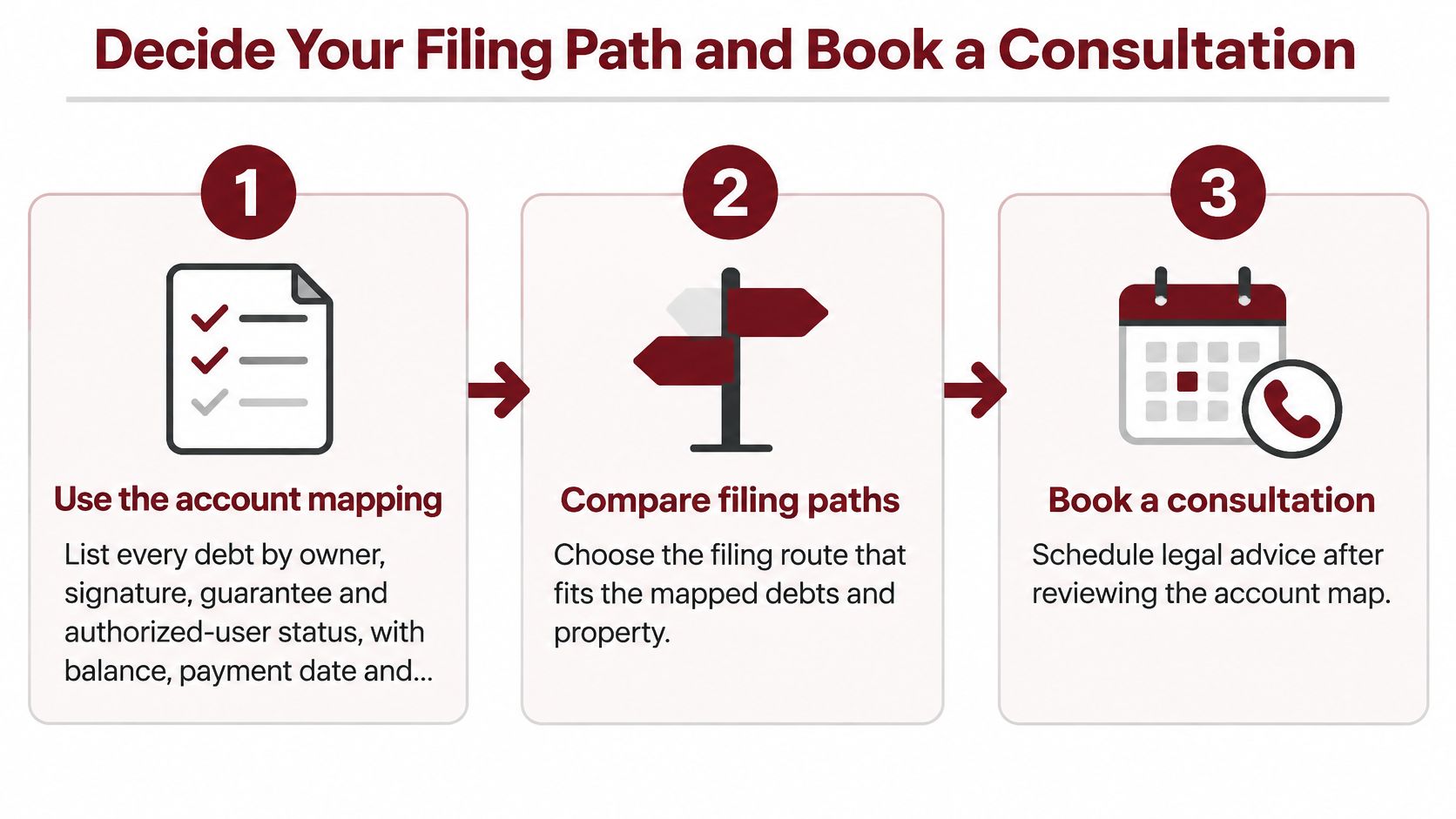
- Map every debt. Record the account owner, signatures, guarantees, authorized-user status, current balance, payment due date, and collateral. Attach the agreement if borrower status is unclear.
- Pull both credit reports. Flag joint-account defaults, unfamiliar obligations, and any bankruptcy notation attributed to the wrong person. Keep supporting statements beside disputed entries.
- Inventory property ownership. Collect deeds, vehicle titles, joint-account statements, acquisition dates, and records showing the source of inherited or gifted funds.
- Document the family-law timeline. Record separation, divorce, property-division, and transfer dates. Include pending agreements rather than treating them as completed events.
- Confirm residence history. List where each spouse has lived so an attorney can determine the proper district and identify any move-related issues.
- Compare the filing paths. Use the packet to assess whether both spouses need relief or whether an individual case addresses the problem without unnecessary exposure.
- Book a consultation with Morgan & Morgan Attorneys at Law P.C. Bring the packet so we can evaluate the chapter, exemptions, and timing before any petition is filed.
Use the consultation to resolve uncertainty
Our free case review maps the appropriate bankruptcy chapter, exemptions, and timeline to your situation. When you call, you speak with an experienced bankruptcy lawyer, not a paralegal.
Use that conversation to ask concrete questions: Could administration of the home affect the non-filing owner? Which creditors could still pursue the other spouse? Would a pending divorce or property transfer change the proposed strategy?
The outcome may be filing jointly, filing alone, or waiting while a specific issue is resolved. Waiting should be a deliberate legal decision with attention to collection and foreclosure deadlines, not an assumption that delay is harmless.
Make the filing decision only after consulting an experienced bankruptcy attorney. A petition can affect both spouses’ finances even when only one spouse signs it.
Morgan & Morgan Attorneys at Law P.C. offers a free case review to help you understand how bankruptcy could affect your spouse, shared debts, and property. Visit Morgan & Morgan Attorneys at Law P.C. to arrange a consultation, and bring your account list, ownership documents, and any divorce or foreclosure deadlines so we can evaluate your options before you file.

Lee Paulk Morgan
With more than 41 years of experience in the areas of Bankruptcy, Disability, and Workers’ Compensation, Lee Paulk Morgan is one of the most respected Bankruptcy and Disability attorneys in Athens, Georgia. His tireless dedication to serving clients has gained him the reputation of a premier attorney in his areas of practice, as well as the trust and respect of other legal experts, who often refer clients to him.
SHARE
RELATED POSTS

How To Stop Wage Garnishment For Car Loan in Georgia
Your paystub lands and the net pay is short. There’s a new line tied to your car loan, rent is due, and payroll says they can’t change it without paperwork. That panic is understandable, but…

Can I Be Jailed For Credit Card Debt? (What Georgia Law Says)
Generally, no: unpaid credit card debt is a civil matter, not a crime. Jail exposure comes from separate conduct around the debt, such as willfully ignoring a lawful court order or committing fraud, not from…