
Blog

Delete Bankruptcy From Credit Report (When It Can Work)
Search for advice on how to delete bankruptcy from credit report and you’ll find the same recommendation in a dozen places. Dispute the entry and get it removed. That advice fails often enough to cost people real money.
In most cases a bankruptcy cannot be deleted early at all, no matter how much damage it’s doing to your score. It leaves on a schedule set by federal law, and the only thing a dispute can change is whether the entry is accurate. The filers who get relief aren’t the ones fighting the record itself. They’re the ones who sort their report into two piles.
One pile holds errors. A case number that isn’t yours, a chapter that’s wrong, a debt you discharged that still shows a balance. Those entries can be corrected or removed, and the evidence that wins them is usually sitting in a court filing you already own. The other pile holds an accurate entry that hasn’t aged off yet. Nothing removes it early, and paying a company that promises otherwise buys you a bill and nothing else.
Both piles start with a date. Get the deadline right and you’ll know which one you’re in.
Check the Reporting Deadline First
A bankruptcy entry works like a calendar item, not a debt you can pay early to make disappear. Experian’s credit education team states that in the United States, a bankruptcy generally cannot be deleted early merely because it is damaging a consumer’s credit. The reporting period depends on the chapter filed, and the clock begins with the original court filing date. That distinction separates two very different tasks: waiting out an accurate entry, and disputing an entry that is wrong.
| Chapter | Typical reporting period | Clock starts | Notes |
|---|---|---|---|
| Chapter 7 | 10 years | Original filing date | Discharge does not restart the clock |
| Chapter 13 | 7 years | Petition filing date | A 3 to 5 year plan does not extend the period |
| Chapter 11 or 12 | Up to 10 years | Order or adjudication date | Confirm the exact date against the court record |
Use the chapter field first. It can move your expected removal date by three years, which changes whether you are planning around a long remaining reporting period or watching for an entry that should soon age off.
The clock starts at the filing date, not the discharge
The most common mix-up is starting the count at discharge. A Chapter 13 case often uses a payment plan to repay debt over a three to five year period, but the credit-reporting clock still starts when the petition is filed. Case closure and plan completion do not reset it. The same applies when Chapter 7 discharges eligible debts such as credit card debt, medical bills, and unsecured loans. The public bankruptcy entry can remain on schedule even after those debts are gone.
That is why a letter demanding early deletion usually goes nowhere. If the chapter, date, and status are accurate, the entry is doing what the reporting rules allow. Once the applicable period expires, the entry should be removed automatically. A company promising guaranteed early deletion cannot make the date arrive sooner.
The test that matters: ask whether the entry is accurate and how old it is. A credit score that hurts is not a legal ground for removal.
Dismissal and discharge aren’t the same exit
A dismissal ends a case without wiping out debts, so creditors can collect again. A discharge is a court order that permanently eliminates eligible debts. Neither event deletes the public bankruptcy record from your report, and filers routinely confuse a discharge with deletion.
If your case was dismissed, expect the entry to show the dismissal status and to keep aging from the original filing date. If your case was discharged, expect eligible debts to be gone while the bankruptcy entry remains until its reporting period ends. Those are different outcomes, and both can be reported accurately at the same time.
A worked example with two filers
Say two neighbors file in the same courthouse in March 2019. One files Chapter 13 and finishes a five-year plan in 2024. The other files Chapter 7 and receives a discharge a few months after filing. The Chapter 13 entry should drop off around March 2026. The Chapter 7 entry should age off ten years after its original filing date. Same month, same court, different tracks.
The point is not that one filer gets special treatment. The point is that chapter and filing date drive the timeline. If you calculate from discharge or plan completion, you may treat lawful reporting as an error and spend time on a dispute that cannot win.
What to write down from your case
Pull five fields from the bankruptcy docket and keep them next to your reports:
- Chapter filed so you know whether you’re on the 7-year or 10-year track.
- Filing date, the exact day the petition was entered, not the discharge date.
- Court and district so a mismatch jumps out when you compare.
- Case number, because a duplicate entry usually shows a different one.
- Expected expiration date, calculated once, so you stop guessing.
Compare each field against every report you hold. An entry that outlives its expiration date, or shows the wrong chapter, filing date, court or case status, stops being accurate reporting and becomes a dispute candidate. Treat the date as a filter: accurate and still within the period means wait; wrong, duplicated, or expired means there is something concrete to challenge.
Audit All Three Reports for Errors
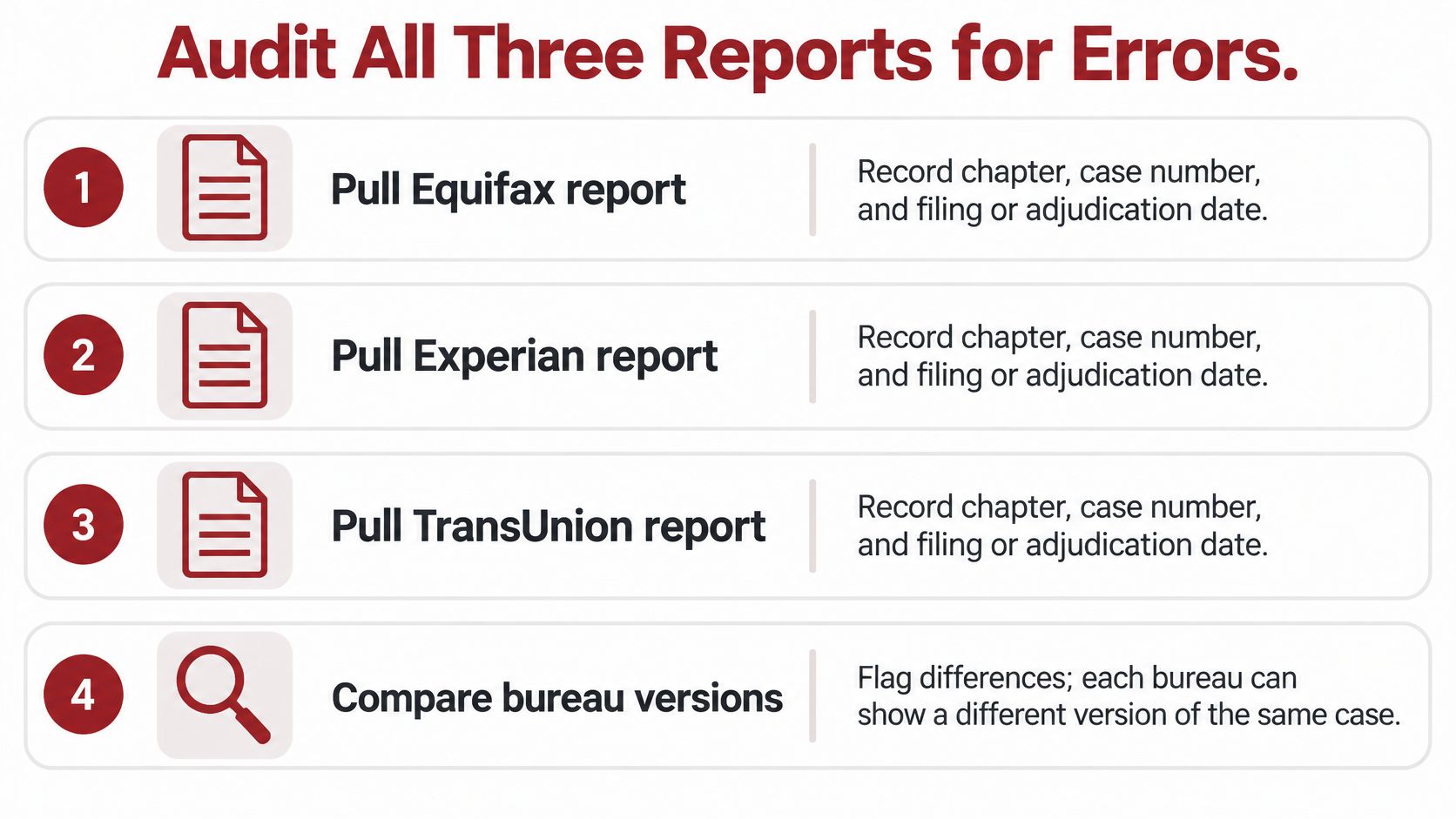
Pull all three files before you write a dispute. Equifax, Experian and TransUnion each keep their own version of the same bankruptcy, and they don’t always agree on the chapter, the date or the case number. A dispute sent to one bureau fixes one file and leaves the other two untouched.
Four checks cover the audit.
Record the same fields on every report
For each bureau’s file, note the chapter, case number, filing or adjudication date, court, the public-record entry and every account notation tied to the bankruptcy. Compare those fields against the bankruptcy docket and your identity documents, not against memory. Memory is the weakest evidence you have, and it’s the one people reach for first.
| Error type | Evidence to attach | Send dispute to |
|---|---|---|
| Entry belongs to someone else | Government ID and Social Security number match | Each bureau showing it, plus the furnisher |
| Duplicate of one filing | Docket showing one case number | Each bureau showing the duplicate |
| Wrong chapter or filing date | Court docket or order showing the correct chapter and date | Each bureau and the furnisher that reported it |
| Discharged debt still shown as owed | Discharge order and creditor’s final statement | Furnisher first, then each bureau |
| Entry past its reporting period | Calculated expiration from the filing date | Each bureau displaying it |
What makes a dispute actionable
A bureau only has to act when the entry is wrong in a way you can document. The actionable list is short:
- Not your case, with an identity or case-number mismatch you can prove.
- Wrong date or chapter, measured against the docket.
- A duplicate of a single filing, usually filed under a similar name.
- An entry that outlived its period, still reporting after expiration.
- A discharged debt still marked as owed, carried into collections or shown delinquent.
A duplicate is the easiest error to spot in practice. Picture a filer named Maria Sanchez whose Chapter 7 appears twice, the second entry under “Maria Sanches” with a different case number. If the docket shows one filing, the second entry is the error, and the docket page is the exhibit that proves it.
Under the framework in the Consumer Financial Protection Bureau’s summary of your rights under the Fair Credit Reporting Act, bureaus generally must investigate within 30 days, although the period can extend to 45 days in some circumstances, and a bureau may reject a dispute it reasonably considers frivolous or insufficiently documented. Accurate bankruptcy information generally cannot be deleted merely because it’s damaging, and accurate negative information is ordinarily removable only when the reporting period expires.
A bureau investigates the field you name. Tell it the chapter is wrong and it checks the chapter. Tell it to delete the bankruptcy and it has nothing to verify.
Discharged debts still reported as owed are a separate and frequent problem, and they belong to the furnisher as well as the bureau. Send the discharge order and the creditor’s final statement to the lender first, then dispute the balance with each bureau if the account stays wrong.
The same record-matching trouble shows up in background screening, where a common name and a county of residence decide whose history gets pulled. VolunteerBadge’s guide to false-positive background check records explains how those matches get made, which is useful context if your name is common where you filed.
Before you mail anything, take dated screenshots of every report page. The bureau’s response and any later changes need a baseline to compare against, and a screenshot stamped with today’s date settles arguments about what the file said.
Send the Dispute and Build the Letter
A dispute that wins is narrow and documented. One entry, one wrong field, one piece of paper that proves it.
Two moves carry the whole letter.
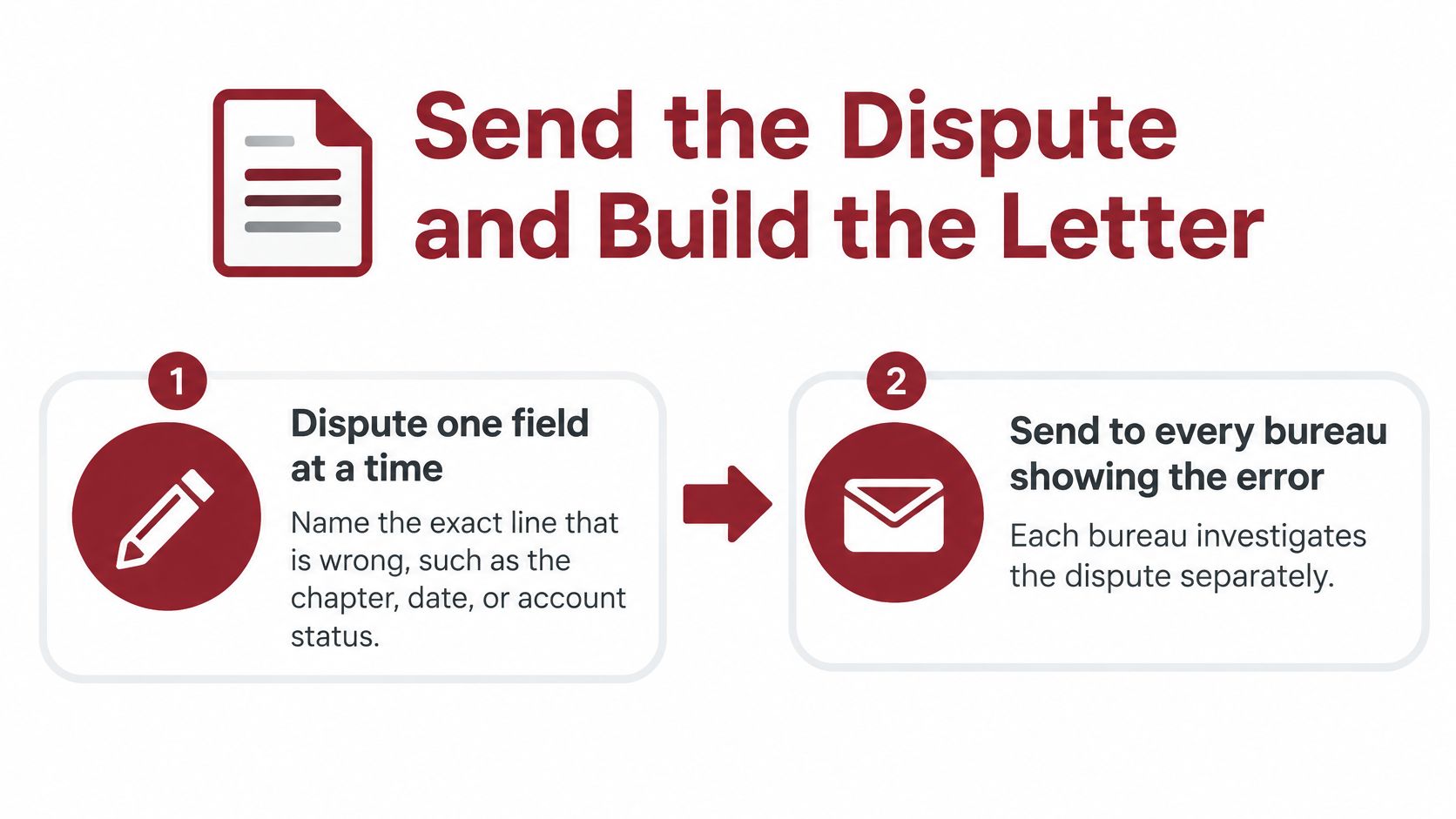
- Dispute one field at a time. Name the exact line that’s wrong, whether that’s the chapter, the filing date, the account status or the balance. A letter that lists six complaints gives the investigator six chances to answer none of them properly.
- Send it to every bureau showing the error. Each bureau investigates separately, and each keeps its own file. Send a direct dispute to the furnisher or court reporter at the same time, in its own envelope.
- Attach copies, never originals. Highlight the disputed line on the report page. Court documents don’t come back if they’re lost in a processing center.
- Send by certified mail. Keep the delivery receipt, because the investigation window runs from the date the bureau receives the letter, not the date you wrote it.
- Expect an investigation, and diary the deadline. Write the mailing date and the response date in one place. Silence from a bureau is a missed response, not a win, and it’s the escalation trigger rather than the end of the road.
- Request the results and an updated report. If the bureau verifies an error despite your evidence, ask for the investigation results in writing and keep them with the letter.
Bureaus scan for weak submissions first. A bare demand to delete a bankruptcy, with no docket attached and no field named, is the fastest route to a rejection letter.
The three lines that do the work
Keep the letter to those three moves and the tone stays factual.
“I am disputing the bankruptcy entry for chapter [number], case number [number], filed on [date] in [court], which appears on my report. This entry is inaccurate because [the specific field and its correct value]. Please investigate, correct or delete the disputed entry, and send me written results and an updated copy of my report.”
The middle line is where cases are won or lost. “This entry is inaccurate because the report shows Chapter 13 while the docket shows Chapter 7 filed on March 4, 2019” gives an investigator a specific fact to check. “This is hurting my credit” gives them nothing.
What goes in the packet
- Government ID plus proof of current address, so identity can be matched to the file.
- The highlighted report page, with the disputed line marked in ink.
- The court docket or discharge order, showing the correct chapter, date, court and case number.
- Earlier dispute correspondence, in case this is a second attempt at the same field.
- The certified-mail receipt, dated and kept with a copy of everything sent.
Keep one folder per bureau and per creditor, with a dated log of letters, responses and outcomes. That log is the record an attorney will ask for later.
Not every complaint needs a letter. The Federal Trade Commission’s guide to disputing errors on your credit reports advises contacting both the reporting company and the information provider, and federal guidance makes clear that disputing inaccuracies is free. If a bureau or furnisher verifies an entry you’ve documented, request the investigation results and an updated report, then escalate through a CFPB complaint or legal advice rather than refiling the same letter.
Legal Remedies, FCRA Claims and Special Cases
A bureau dispute handles an ordinary error well. It is the wrong tool when the problem is identity theft, a mixed file, a false status, or a court record that needs correction at its source. Think of the process like fixing a bad address on a map. If only the map is wrong, a correction request may solve it. If the road itself was recorded under the wrong name, you need the record keeper to fix the underlying file.
Identity theft and mixed files
These two need their own evidence path, separate from a standard dispute letter.
- Identity theft. FTC guidance in its Money Matters guide to taking control of your credit report says identity-theft victims should obtain an Identity Theft Report and use it when contacting bureaus and affected businesses. That report does work a dispute letter can’t, because it establishes the fraud as documented rather than merely alleged.
- Mixed files. When another person’s records merge into your file, typically a relative or a stranger with a similar name in the same county, you need proof of your own identity plus an explicit request to separate the files. Ask each bureau to block the other person’s information from your report.
The gap matters most for families with similar names, recent moves, or limited access to digital records. Those are exactly the households where a merged file goes unnoticed for years.
When the record is incomplete rather than false
The bankruptcy happened. That does not end the analysis. A bureau can still violate accuracy requirements by omitting material context, reporting the wrong chapter, attaching another person’s case, failing to mark a debt discharged, or continuing to report an obsolete balance.
Use the docket as the control copy. If your discharge order says eligible debts were eliminated, a tradeline that still shows an active balance may need review. If the report lists the wrong chapter, the wrong case number, or a debt that belongs to someone else, the dispute should name that exact mismatch. Accurate bankruptcy entries age off on their own. Inaccurate details should not wait for that clock.
If a bureau or furnisher keeps verifying a documented error, the conversation shifts to liability. Our page on suing a creditor for incorrect reporting covers what that process involves and what the written record needs to show. FCRA claims carry their own filing deadlines, which an attorney will check against the date you discovered the problem.
Dismissed and involuntary cases
An involuntary bankruptcy should be identified accurately, and a dismissed case or later reaffirmation may need to appear with its correct status. A dismissal that still reads as a pending or active case is a dispute in its own right, and it is proven with the dismissal order rather than a letter of explanation. The key is matching the report to the court’s actual disposition, not arguing that the case never existed.
Court-record errors
Some errors aren’t the bureau’s to fix. If the court itself entered the wrong date, chapter or disposition, the correction starts with a motion in the bankruptcy court that holds the docket, on that court’s schedule. Dispute the bureau entry at the same time so the two records converge. Pushing a legal remedy forward is a decision to make with an experienced bankruptcy attorney, not on a forum thread.
Georgia Rules That Change Your Dispute
Four Georgia-specific details change what your report should show and what you compare it against.
- Venue. A bankruptcy generally must be filed in the district where the person lives, and Georgia has more than one federal district. Confirm which court holds your docket before you pull records, because comparing an Athens filing against a document from the wrong division wastes a dispute cycle. Our explanation of how a bankruptcy appears as a public record in Georgia covers what the docket exposes and who can look it up.
- Exemptions. Georgia applies its own exemption rules to decide which assets you keep after filing. If your report shows a vehicle or a home as surrendered or sold, check that entry against your exemption claim and the trustee’s records before you assume it’s wrong. The docket says what happened to the asset, and the report should match it.
- Joint and co-signed debts. One spouse can file alone, but household income still counts for eligibility, and joint or co-signed debts affect both spouses. A shared car loan can appear on two reports when only one person filed. Check and dispute each person’s file separately, because clearing one spouse’s entry does nothing for the other’s.
- Pre-filing lawsuits. If a creditor sued you in a Georgia court before you filed, pull that case record too. A judgment that was discharged but still reports as an owed balance is a dispute candidate, and the letter needs the discharge order attached to prove the debt is gone.
The common thread is that the court record decides. Where the docket and the report disagree, the report is wrong and the docket is your exhibit.
Rebuild Credit While the Entry Ages
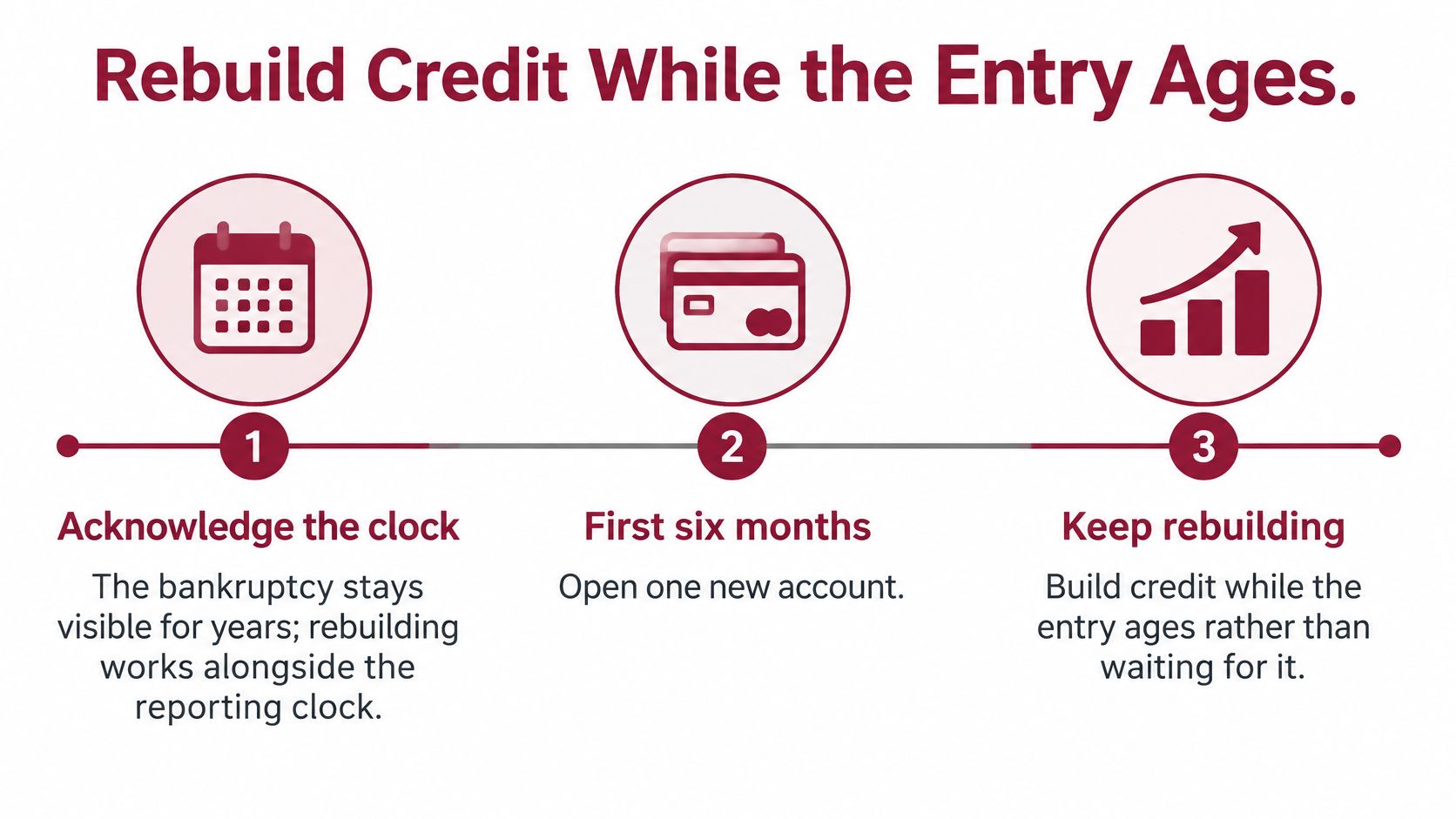
The entry stays visible for years either way, so rebuilding runs alongside the reporting clock rather than after it. Waiting for the removal date to start building history gives away the years when your file is thinnest and easiest to improve.
Acknowledge the clock, then open one account, then keep going.
First six months
Open one secured card with a deposit you can afford, put a small recurring bill on it, and pay the full balance every month. One card used lightly reports better than three used heavily. Set autopay the day the account opens, not the day before the first due date.
Six to eighteen months
Add a small installment account only if the payment fits your budget without borrowing to make it. Keep utilization low. When a month looks tight, move the due date rather than miss it, since a single 30-day late can undo six months of clean history.
Eighteen to thirty-six months
Review all three reports every quarter and confirm discharged debts show a zero balance. Keep older accounts open when they’re in good standing, because closing them shortens your average account age. Our tips for rebuilding your credit after bankruptcy go further into account mix and what lenders weigh.
Year three until the entry drops off
Steady payments and no bursts of new applications. Each hard inquiry adds a small, temporary drag, and five applications in one month looks like someone in trouble rather than someone rebuilding.
A clean recent history moves a lender more than the age of a bankruptcy entry. Underwriters read the last twelve to twenty-four months first.
Filing a bankruptcy case is not a cure all, and it is rarely a good idea to file just to help rebuild credit. The case carries costs and consequences that outweigh the score gain for many, and the reporting clock outlasts any short-term boost.
Monthly habits worth adopting this week:
- Keep one card active with a small recurring charge and full payment.
- Pay every account on autopay so nothing depends on remembering a due date.
- Check one bureau each month on a rotating schedule, so all three get reviewed quarterly.
- Dispute a wrong balance immediately, before it gets copied into the next cycle.
- Log every new account with its opening date in the same folder as your bankruptcy paperwork.
Decide Whether to Dispute Alone or Call an Attorney
A dispute is often a paperwork job. A bankruptcy entry that will age off is different. One can be corrected. The other needs time.
Handle it yourself when one field is clearly wrong, your docket is complete, and no legal claim is pending. A wrong chapter and a clean docket can be handled with a certified letter and copies of the record. Keep the dispute narrow. Name the field, explain the error, attach proof, and ask for the exact correction. That works like fixing a typo on a form before it gets copied into every later version.
Call an attorney when the entry belongs to someone else, you are an identity-theft victim, a case was dismissed or involuntary, a discharged debt still reports as owed, a collector has sued or contacted you, or a bureau verified an error after you sent evidence. At that point the file needs a legal read, not another letter. Repeated disputes without a new document or legal issue can leave you stuck with the same answer.
A firm that handles these disputes keeps the audit and the correspondence in one place.

Morgan & Morgan Attorneys at Law P.C. is the next step if any of those conditions apply. When you call the firm, you speak with an experienced bankruptcy lawyer and not a paralegal. The firm has been assisting clients with bankruptcy filings for over 30 years and offers services including Chapter 7 and Chapter 13. Bring your reports from all three bureaus, the bankruptcy docket, the discharge order and your dated correspondence, so the first conversation is about evidence rather than guesswork. The attorneys can review your reports, docket and discharge order before advising on disputes, then explain what the reporting should say. Visit Morgan & Morgan Attorneys at Law P.C. to arrange a free consultation.
Before you pay anyone to clean up the old record, protect the new one. A cash advance app is a cash-flow tool, not a credit fix, and fees or repayment risk can make a short gap more expensive. Focus on the record you can control: pay on time, keep balances low, and challenge only entries that are wrong. A clean payment streak matters far more to the next lender than an early removal promise.

Lee Paulk Morgan
With more than 41 years of experience in the areas of Bankruptcy, Disability, and Workers’ Compensation, Lee Paulk Morgan is one of the most respected Bankruptcy and Disability attorneys in Athens, Georgia. His tireless dedication to serving clients has gained him the reputation of a premier attorney in his areas of practice, as well as the trust and respect of other legal experts, who often refer clients to him.
SHARE
RELATED POSTS

How Does Bankruptcy Affect Your Spouse? (Georgia Guide)
Your spouse’s bankruptcy does not automatically put you into bankruptcy, but joint debts and shared property can still affect you. If you never signed the loan, could you still lose access to money in a…

How To Stop Wage Garnishment For Car Loan in Georgia
Your paystub lands and the net pay is short. There’s a new line tied to your car loan, rent is due, and payroll says they can’t change it without paperwork. That panic is understandable, but…