
Blog

How Many Times A Day Can A Creditor Call You
There is no legal daily call quota. A covered debt collector is presumed compliant at no more than 7 calls about one debt in 7 consecutive days, and must not call during the 7 days after a conversation about that debt.
So why does the search for how many times a day can a creditor call you keep turning up a daily number? Because a calendar day is the wrong unit. Three quiet rings on Monday and five more by Friday can cross a federal line even when no single afternoon felt outrageous. The useful question is who is holding the phone, which debt they are chasing, and what your rolling week shows.
The Call Limits That Actually Apply
People type a daily number because the phone feels like a daily problem. Federal law does not work that way. There is no rule that a creditor may call a fixed number of times each calendar day.
For a debt collector covered by the Fair Debt Collection Practices Act and Regulation F, the benchmark is a rebuttable presumption, not a daily allowance and not a permission slip. In 2024, the U.S. Code of Federal Regulations stated that a debt collector is presumed compliant when it makes no more than 7 calls about a particular debt within 7 consecutive days and does not call during the 7-day period after speaking with the consumer.
A collector is presumed compliant at no more than 7 telephone calls about one particular debt in any 7 consecutive days, and is presumed to violate the rule by calling during the 7 consecutive days after a telephone conversation about that debt.
That average looks like one call a day. The clock does not reset at midnight. It runs across any seven days in a row. A voicemail attempt counts as a telephone call. Dialing a cell phone and a work number about the same debt does not create extra attempts. The count runs per person and per debt, so a second account has its own week.
Some calls sit outside that presumption. A call you asked the collector to make, a call you consented to, and some calls tied to a payment arrangement can be excluded. Write down who asked for the call. Without that note, an excluded call and a harassing call look the same on a phone bill.
Calls under seven are not automatically fine. If the purpose or pattern is to annoy, abuse, or harass, the collector can still break the law. Going over seven creates a presumption of a violation, and the collector may try to rebut it with an exception or with facts. You do not have to decide that legal fight on the call. You have to keep a record that makes the fight possible later.
| Rule | Who it covers | Limit | What it is not |
|---|---|---|---|
| Seven calls in seven days | FDCPA debt collector, per person and per debt | No more than 7 telephone calls in any 7 consecutive days | Not a right to dial 7 times and not a per-calendar-day cap |
| Pause after a conversation | Same collector and same debt | No call during the 7 consecutive days after a phone conversation about that debt | Not erased by earlier unanswered attempts |
| Calls under the threshold | Covered debt collector | Fewer than 7 calls can still violate the law if the purpose is to annoy, abuse, or harass | Not a safe harbor |
| Original creditor on its own account | Often outside the FDCPA frequency rule | No federal 7-in-7 number; harassment standards and state law still apply | Not the same caller as a collection agency |
| Texts, email, and letters | Separate limits from the phone presumption | Not added into the 7 telephone calls | Not proof that total contact is legal |
| Time of day | Debt collectors under the FDCPA | Generally 8 a.m. to 9 p.m. local time | Not a substitute for the frequency rule |
Your next job is small and specific. Log the date, the time, the number that called, the debt they named, and whether anyone spoke.
How to Count Calls on a Seven-Day Log
Treat the rule like a parking meter that runs for seven days, not a punch card that resets every morning. Pick one debt and one collector. Everything else goes on a different row.
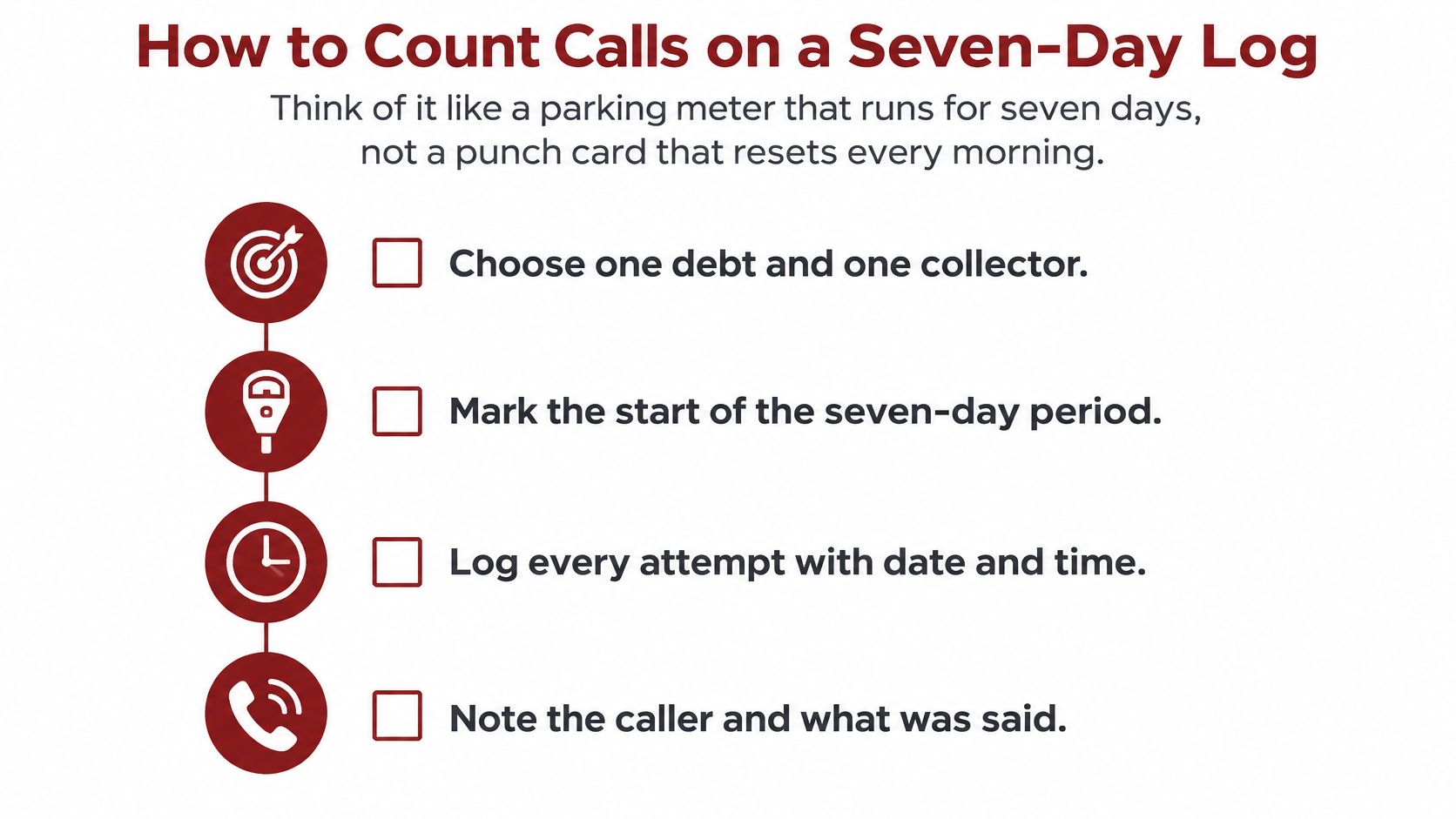
One debt, one meter
The Consumer Financial Protection Bureau explains that a debt collector is presumed to violate the ban on repeated or continuous calls if it places more than seven telephone calls about the same debt within any seven-consecutive-day period. The same guidance says the threshold is not a guaranteed entitlement to seven calls, that voicemail counts, and that the rule generally applies per person and per particular debt no matter how many phone numbers the collector uses.
Build the log with five columns: date, time, phone number used, what happened, and which account it concerned. “What happened” should be one of three outcomes. It rang and nobody answered. It reached voicemail. Or it became a live conversation.
A call to your cell phone and a call to a work number about that same debt both count. Leaving a voicemail counts as a telephone call. Switching numbers does not start a fresh allowance.
A week that never looks extreme
Say a collector is working one store-card balance. You log three unanswered calls on Monday, two on Wednesday, and three on Friday. That is eight telephone attempts inside seven consecutive days. The presumption of a violation is there even though no single day looks wild. Friday’s third call is the one that pushes the meter over, and Monday’s unanswered rings are part of the same count.
Now change the week. You speak with the collector on Tuesday about that debt. The collector is presumed not to call again about that debt until seven consecutive days have passed. A Thursday follow-up is the problem even if the weekly total is only two calls. Earlier unanswered attempts do not erase that pause. The conversation starts its own seven-day clock.
What you can leave off the phone total
A returned call you requested, a call you consented to, and some calls arranging a payment may be excluded. The log should say who asked for the call and what you agreed to. If you only said “call me back with the balance,” write that down. Do not let a collector treat a request for information as open-ended permission to ring you all week.
Texts, emails, and letters stay in a separate column. They are not part of the seven-call phone total. Screenshots still matter, because a quiet phone plus a full inbox can be its own problem.
Keep at least this much:
- Caller ID screenshots: Capture the number, the date, and the time before the log rolls off your phone.
- Voicemails: Save the audio or a written transcript, including any limited callback message.
- The account name: Write the debt they spoke about, not just “a collector called.”
Seven or fewer calls can still be worth saving when the timing, the repetition, or the words show harassment. The log is the proof, not the legal conclusion.
Creditors Collectors and Other Callers
The annoying part is not only how often the phone rings. It is who is holding it. The seven-in-seven presumption was written for debt collectors, not for every person who wants money from you.
The Federal Register record shows how that number got here. The Consumer Financial Protection Bureau proposed, on May 7, 2019, a limit of no more than 7 telephone attempts during a 7-day period about a specific debt, plus at least 7 days without another call after a telephone conversation. The final Regulation F rule, published November 30, 2020, kept those figures inside a rebuttable-presumption system: 7 calls per person, per debt, per 7 consecutive days, and no call during the 7-day period after a completed conversation about that debt. That history is why the “7-in-7 rule” is not a universal daily allowance and does not govern every entity that contacts you.
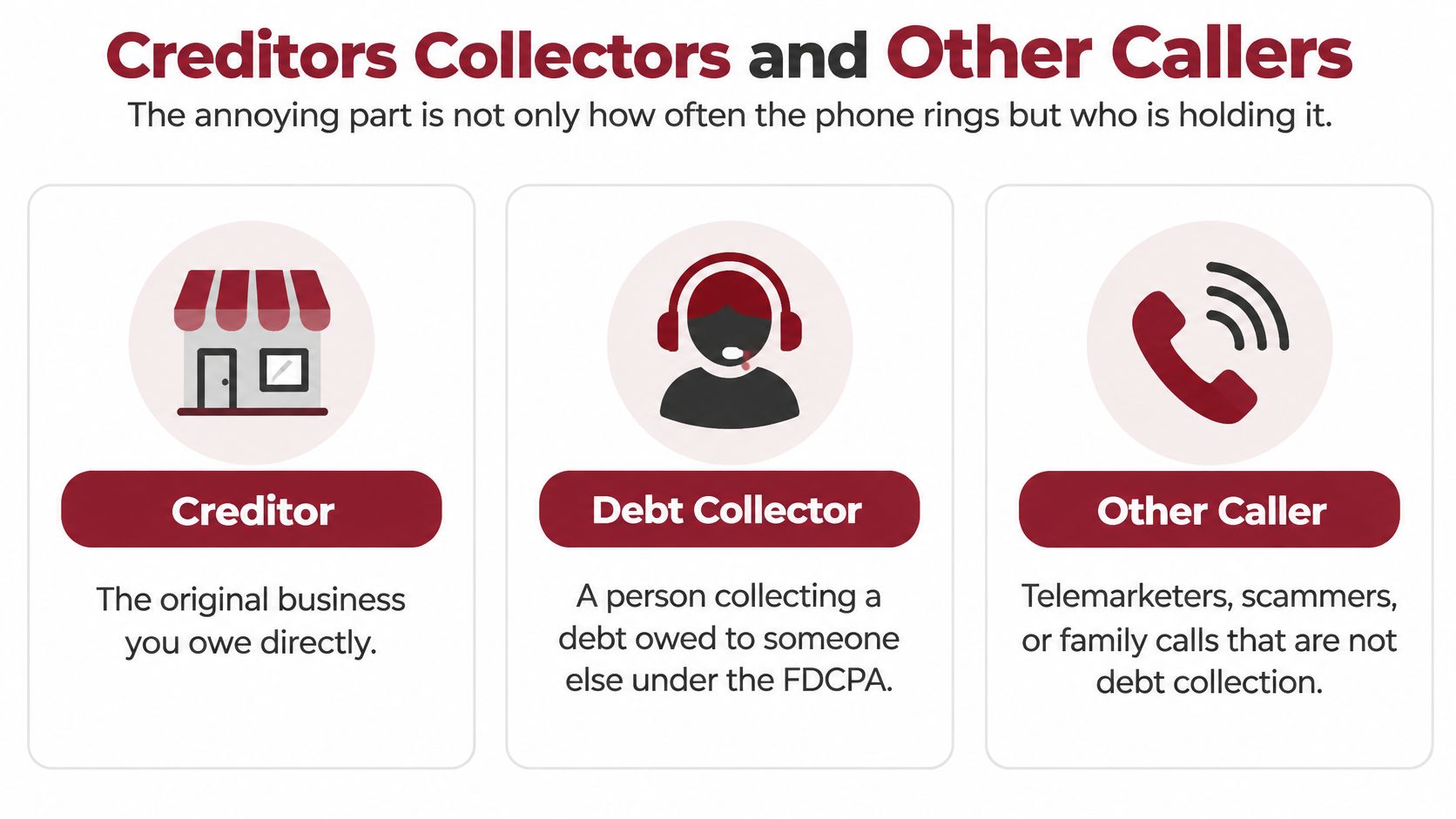
Three people who might be calling
Picture a Tuesday night in Athens. The first caller is the bank that issued your credit card, using its own collections desk. That is usually an original creditor calling about its own account. Federal frequency math often does not apply, which is why a bank can sometimes call more often than an agency without breaking the seven-call presumption. Harassment standards and Georgia law can still apply. Document the calls anyway.
The second caller is an agency that bought the account or was assigned to collect it. That person is generally collecting a debt owed to someone else. Many collection agencies, and attorneys who regularly collect consumer debts, fall in this group. This is the caller the presumption was built for. Ask whether they own the debt or are collecting for the bank, then write the answer in the log before you argue about the balance.
The third caller says they can settle everything if you send money to their company. If you hired them, they are not your creditor and they are not a debt collector working the account. Pressure from a settlement company is a different problem from creditor calls. Fake collector calls are a third problem again. If the voice will not name the company or the account, treat it as a possible scam and read how we sort debt collection phone scams before you share a Social Security number or a bank login.
Why co-borrowers need their own rows
A spouse on the same auto loan is a different person. A medical bill beside the store card is a different debt. Two agencies on two accounts are two meters. The federal count is tied to a particular person and a particular debt, so a shared kitchen phone can ring far more than seven times while each row still looks lawful.
Before you decide which rule applies, ask three things and write the answers: the caller’s name, whether they own the debt or collect for someone else, and the account they are calling about.
Call Patterns That Still Count as Harassment
Seven is not a permission slip. A collector can stay under that number and still violate the ban on conduct meant to annoy, abuse, or harass. Frequency is also what people complain about. The CFPB reported that 51% of communication-tactic complaints concerned frequent or repeated calls, a figure carried in the FTC’s debt collection FAQ compilation.
The same materials treat the seven-call figure as a presumption, not an entitlement. Crossing it creates a presumption of a violation. Staying under it does not make abusive or continuous calling lawful. Counting only works if you can name the debt, the caller, the date, the outcome, and whether a conversation happened.
Patterns you can hear without a lawyer in the room
Calls stacked in one afternoon. Six hang-ups between 2 p.m. and 5 p.m. never reach eight attempts for the week. The cluster itself can show a purpose to annoy. Save the times, not a weekly total that makes the day look small.
A conversation, then another call inside the pause. You talk on Monday about that debt. The phone rings again on Wednesday. The weekly total may be two. The second call is still the pattern to write down, including what each person said.
Calls outside ordinary hours, at work, or to other people. Rings before 8 a.m. or after 9 p.m. local time, calls to a workplace after you have said the employer forbids them, threats of arrest or wage seizure the caller cannot carry out, and talk about the debt with neighbors or coworkers can each be a problem on their own facts. A threat or a third-party disclosure can matter on a single call. The tally is not the only evidence.
When the phone is quiet and the inbox is not
A second pattern never shows up in a ring count. Daily texts, emails, and portal messages can keep the pressure up while the phone column stays at three. Those other channels have their own limits, so a log that only counts rings misses the week you lived.
An original creditor can fit this picture too. Dawn calls plus calls to the job after you asked them to stop are worth writing down even when no federal seven-call number applies to that caller.
Save the words, not only the tally. If the pattern is on paper, Georgia deadlines and the type of debt change what you do with that log.
What Changes for Debts in Georgia
Federal call rules are the floor for an Athens household, not the whole decision.
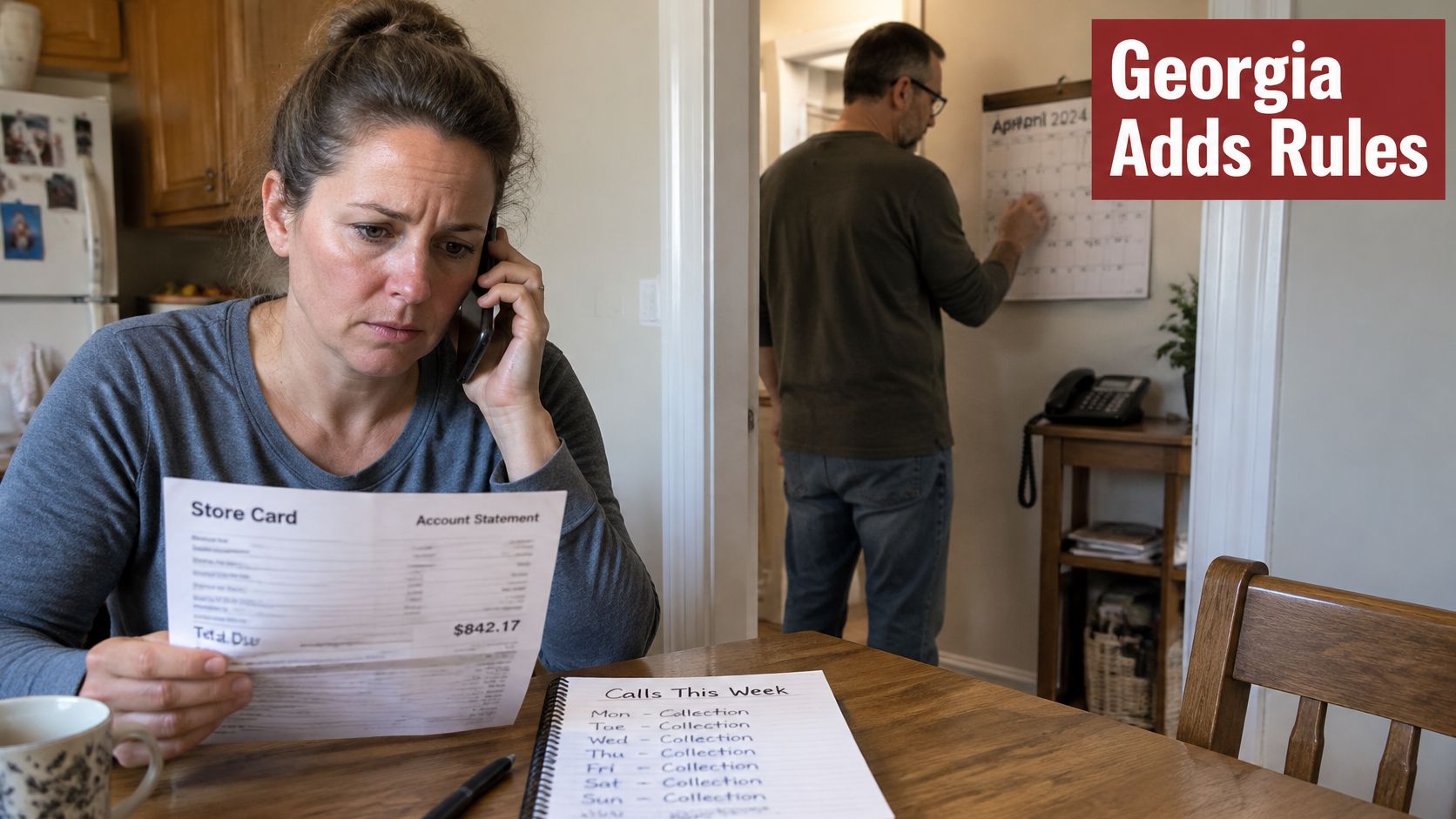
Two accounts, one kitchen phone
A collection agency calls about a store card on Monday and a medical bill on Thursday. Each debt gets its own seven-day count. The family can hear more than seven rings in a week without any single debt crossing the line. If the log only says “the agency called,” you cannot tell which meter moved. Name the account every time, even when the voice sounds identical.
A co-borrower on the medical bill needs a separate note if the agency called that person too. Same company, different person, different row.
An old written contract
In the second house, the calls concern a written contract from several years ago. Most written-contract debts in Georgia have a six-year limit to sue, and oral or open-account debts are commonly four years. An old debt can still be the subject of calls after a lawsuit deadline has passed. Our Georgia debt collection time limits page is the place to match the kind of account to that deadline before you treat a phone demand like a live lawsuit.
Calls on a time-barred debt are not automatically illegal. A payment, or a signed acknowledgment, can restart problems you were trying to leave behind. The safe move on an old account is not to promise money on the call. Ask for the date of the last payment in writing, and do not agree to a “small payment to keep it current” until you know whether the courthouse door is already closed.
Disputes and a bankruptcy filing
If you do not recognize the debt, the useful request is written validation, not a debate on the phone. Say you dispute it, ask them to mail the validation, and stop explaining your budget to a stranger.
A pending bankruptcy changes the picture in a different way. Collection calls about debts in the case are a different violation from ordinary frequency. The next section covers how to stop contact. The bankruptcy process itself is a separate conversation with a lawyer, not something to sort out with the collector.
Match each call to a debt, a caller type, and whether the account is current, disputed, or possibly too old to sue on. That match tells you whether the next step is a stop letter, a validation request, or a harder look at lawsuits and wages.
How to Stop Calls and File a Complaint
Use one procedure. Do not renegotiate the balance while you are still guessing who called.
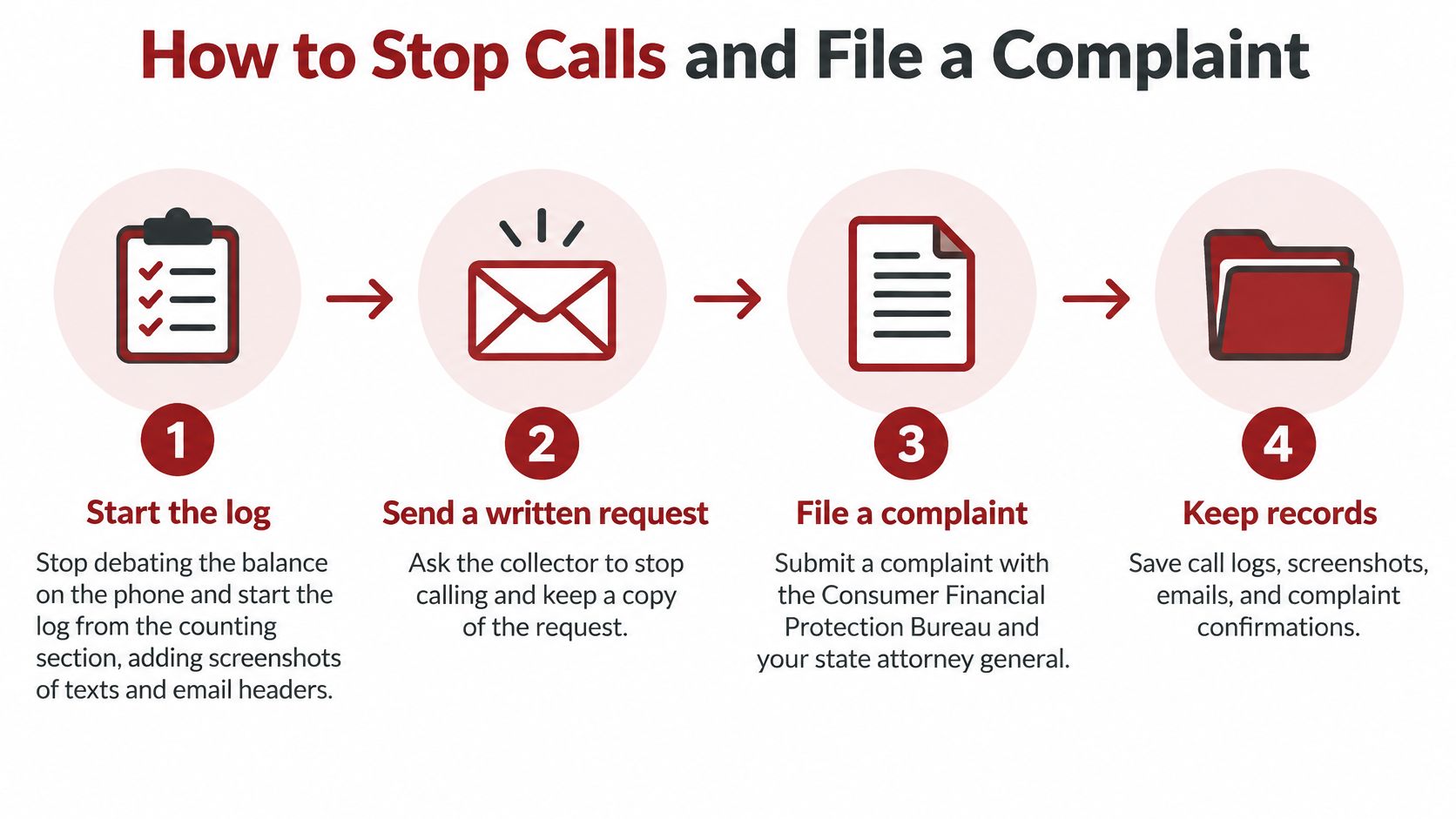
- Start the log and stop the debate. Put the phone down as a negotiating table. Use the seven-day log, and add screenshots of texts plus email headers. Proof to save: dates, numbers, and the account name. What this will not do: a notebook alone does not make the calls stop.
- Say a short script if a debt collector is on the line. State your name, the account, that you want calls to stop, and that you will not discuss the debt on this call. A phone request can help immediately. A letter is the record that matters. Proof to save: the time you said it and the name of the person who heard it. What this will not do: it does not replace a written cease request you can prove you sent. Our page on how to stop debt collectors from calling in Georgia walks through that written request in more detail.
- Mail or otherwise send a written cease-communication request to a debt collector by a method you can prove. Name the collector, the account, and that telephone calls must stop. Keep a copy and the mailing proof. A collector may still send certain legally required notices, so silence is not guaranteed on every letter.
- If the caller is the original creditor, send the same kind of written request and check account settings for call consent you can withdraw. Banks and card issuers often store a phone preference in the online portal. Withdraw it in writing too. Proof to save: the portal screenshot and the letter. What this will not do: it does not put that creditor inside the federal seven-call presumption.
- If calls continue, complain with the log attached. File with the Consumer Financial Protection Bureau and the Federal Trade Commission. Consider the Georgia Attorney General when the conduct looks unfair or deceptive. Proof to save: the complaint confirmation numbers. What this will not do: a complaint is not a court order, and it does not answer a lawsuit that has already been served.
- Treat lawsuits, garnishments, foreclosure, repossession, or calls after a bankruptcy filing as more than a complaint issue. When a bankruptcy case is filed, an automatic stay goes into effect with few exceptions. The stay prevents creditors, including mortgage lenders, from taking any action to collect a debt. While you are under a Chapter 13 plan, you are protected from your creditors, and you cannot be sued, garnished, or harassed about the debts in your plan. Proof to save: the case number and any call that came after the filing. What this will not do: the stay is not a reason to ignore a motion or a hearing.
If the log shows a violation, the debt may be too old, or collection has reached wages or the house, that is the point to talk with a lawyer rather than with the collector.
When to Call a Georgia Debt Attorney
Call a lawyer when any of these is true. Calls continue after a written stop request. The collector threatens suit or garnishment. A foreclosure or repossession notice has arrived. The debt may be past Georgia’s lawsuit deadline. Or the calls are only one part of bills the household cannot pay.
We offer a free consultation for people dealing with a debt collector or with questions about debt collection. When you call (706) 843-2905, you speak with an experienced bankruptcy lawyer and not a paralegal. Servicemembers with debt problems can use 1-800-924-7438 or (706) 752-7089 for a free consultation.
That first conversation is for sorting, not for a speech. We look at which debts are in the call log, whether a written dispute or a bankruptcy stay fits, and whether Chapter 7 or a three-to-five-year Chapter 13 plan is even relevant. We help Athens-area individuals and families gather records and deal with banks and creditors. If a settlement company already took your money, say so at the start. That is a different conversation from a collector who will not stop dialing.
Bring the call log, any letters, and recent pay information. With those three things, we can tell whether the immediate job is stopping contact, answering a lawsuit, or building a broader debt-relief plan.
If collector calls, old debts, or a lawsuit are crowding out the rest of the month, Morgan & Morgan Attorneys at Law P.C. offers a free consultation and hands-on help dealing with banks and creditors for Athens-area families. We can look at your call log, the age of the accounts, and whether stopping contact or a broader debt-relief plan fits. Visit Morgan & Morgan Attorneys at Law P.C. to set up that conversation.

Lee Paulk Morgan
With more than 41 years of experience in the areas of Bankruptcy, Disability, and Workers’ Compensation, Lee Paulk Morgan is one of the most respected Bankruptcy and Disability attorneys in Athens, Georgia. His tireless dedication to serving clients has gained him the reputation of a premier attorney in his areas of practice, as well as the trust and respect of other legal experts, who often refer clients to him.
SHARE
RELATED POSTS

Suing Creditor For Incorrect Reporting (Steps That Work)
Yes, a creditor or furnisher can be sued for incorrect reporting, but usually only after a documented dispute that it failed to investigate reasonably or correct. A damages claim generally needs proof of actual harm…

What Happens If A Creditor Objects To Discharge?
If a creditor objects to your discharge, the creditor must file a formal adversary complaint within 60 days after the first date set for the meeting of creditors, and that filing starts a separate lawsuit…