
Blog

How to Stop Wage Garnishment for Car Loan in Georgia
Your paystub lands and the net pay is short. There's a new line tied to your car loan, rent is due, and payroll says they can't change it without paperwork. That panic is understandable, but the label on that line decides everything. A voluntary payroll deduction you signed for in the loan contract isn't the same as a court-ordered wage garnishment, and the fix for one won't work on the other. Before you file anything or pay anyone twice, sort out which one you're facing. That's the fastest path to learning how to stop wage garnishment for car loan debt in Georgia.
Six Steps to Stop the Next Paycheck Deduction
You're looking at lower take home pay and a withholding you didn't expect this week. Don't wait for the next payday to see if it fixes itself, because it won't. Work through these six steps in order, in writing, this week.
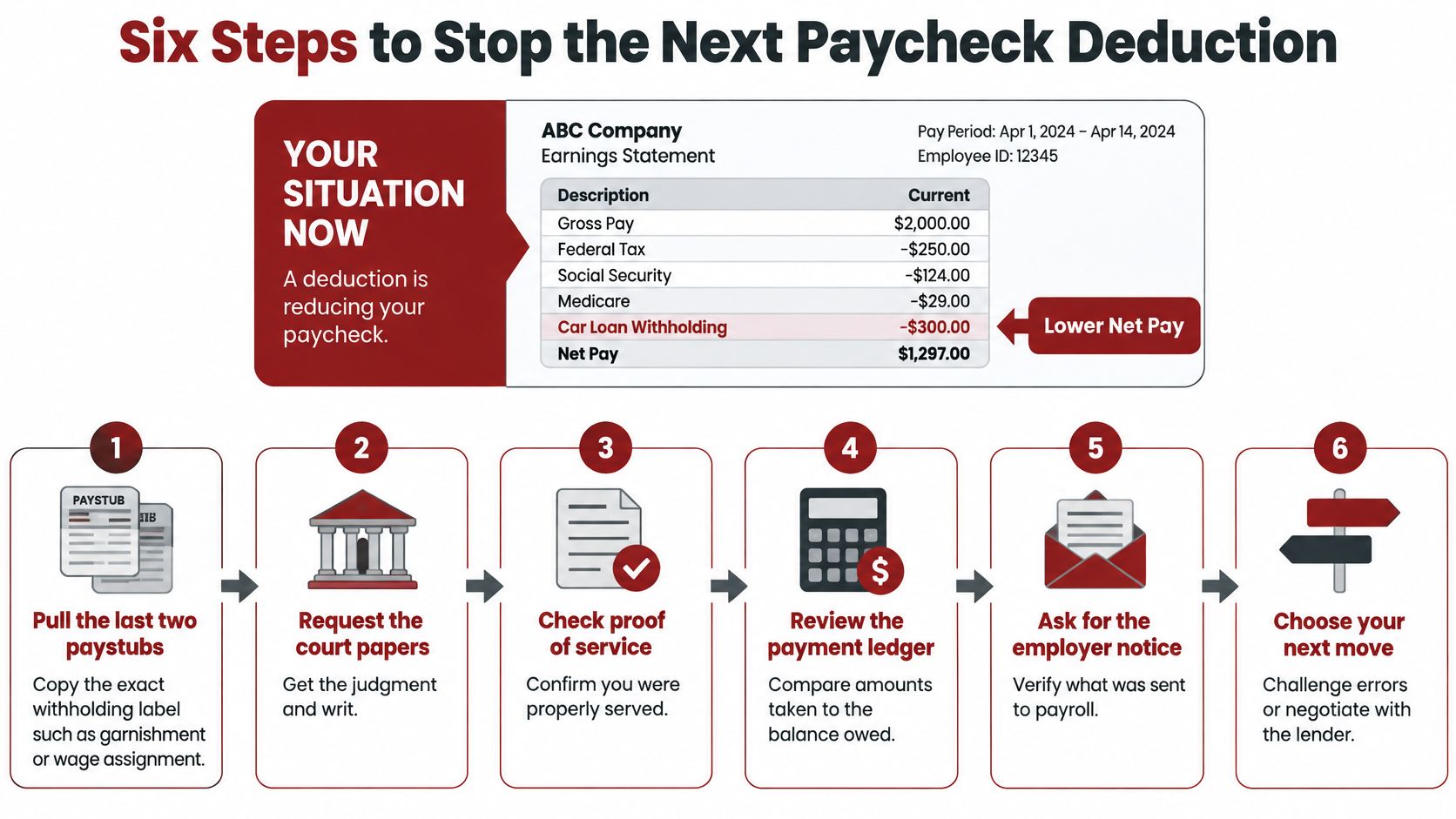
Steps One Through Three
- Pull your last two paystubs and copy the exact withholding label and amount, word for word. The label tells you whether you're dealing with garnishment, wage assignment, or payroll deduction, and each one points to a different remedy.
- Ask HR or payroll in writing for the legal order behind the deduction, the case number, and the name of the agency or lender that sent it. A verbal answer isn't enough because payroll will act on paper, not on a phone call you made.
- Sort the deduction before you respond. If it's a voluntary authorization buried in your loan contract, you can revoke it in writing. If it's a court garnishment, you'll need an objection, an exemption claim, a negotiated deal, or bankruptcy relief instead.
Practical rule: Never pay the lender directly while payroll is still deducting unless you have written confirmation the withholding will stop, or you'll pay twice on the same debt.
Steps Four Through Six
- Calendar every deadline printed on the court papers the day you get them. Objection and response windows in garnishment cases can be short, and missing one can cost you the right to challenge the amount at all.
- Send the lender a written request for an itemized payoff, your full payment history, and confirmation of any pending deductions. You need those records to match what payroll took against what the lender says you owe.
- Act the same week if it's a true garnishment and a deadline is close. Line up the objection, the exemption claim, or a bankruptcy consultation now, because each pay period that passes is money you may struggle to recover later.
Two slips cause most of the damage I would warn you about. The first is waiting for the next payday and hoping payroll corrects it, which lets another deduction go out and burns your objection window. The second is sending the lender a payment on top of the withholding, which creates a double payment that's slow and painful to unwind.
Success is concrete and you can verify it yourself. Your next paystub shows no deduction, or it shows a reduced amount with a written reason from payroll or the court attached to it. If neither happens, you don't have a fix yet, no matter what someone promised you on the phone.
Tell a Real Garnishment From a Payroll Deduction
The most common mix up is trusting the word garnishment itself. In the Consumer Financial Protection Bureau supervisory highlights from July 2023, examiners found some auto servicers used the word "garnishment" to describe voluntary wage deductions, creating the misleading impression workers could not stop them. Under those agreements, consumers could revoke authorization and prevent future deductions. The word on your paystub does not prove a judge ever signed anything.
Check your loan contract, paystub, and employer notice for "voluntary wage assignment," "payroll deduction," or "authorization." Those terms usually mean you agreed to the deduction when you financed the car, and no judgment sits behind it. A genuine garnishment looks different because it comes with court paperwork you can verify through the clerk.
| Document or term | What it usually means | Your next move |
|---|---|---|
| Court judgment and writ of garnishment | Court-ordered garnishment, often on a deficiency judgment | Verify the judgment, check the caps, and object or seek bankruptcy relief before the deadline |
| Payroll authorization or voluntary wage assignment in the loan contract | Contract-based deduction, not a court order | Revoke the authorization in writing and request a payoff and repossession accounting |
| Collector notice with no judgment on record | Garnishment attempt without a visible legal basis | Dispute in writing, ask for proof of the judgment, and keep copies of everything |
| Deficiency balance after the car is sold | Lender may sue for the gap and then garnish | Request the sale price, fee, and interest breakdown before agreeing to any payment |
| Child support or government debt withholding | Follows different rules and is not discharged in bankruptcy | Contact the agency for the payment schedule and any hardship review |
The post repossession trap deserves its own warning. After a car is repossessed and sold, the remaining deficiency balance can lead to a lawsuit, a judgment, and then a real garnishment. The same federal review flagged collection on inflated balances after repossession, so don't agree to repay a deficiency until you have the full payoff, repossession, auction, and deficiency accounting in hand.
The decision rule is simple. Voluntary means revoke in writing, to both the lender and payroll, and keep proof of delivery. Court ordered means move on to checking the legal caps and reviewing your objection rights right away.
How Much Your Employer Can Legally Withhold
Even a valid garnishment has a ceiling, and it starts with disposable earnings. That's the pay left after taxes and legally required deductions, not your gross pay. Payroll sometimes gets this base figure wrong, so check it against your paystub before anything else.
According to the Consumer Financial Protection Bureau guidance on wage garnishment, federal law limits ordinary garnishment to the lesser of 25% of weekly disposable earnings or the amount by which weekly disposable earnings exceed 30 times the federal minimum wage of $7.25 per hour, which equals $217.50 per week. The Bureau also explains that most creditors must first obtain a court judgment, so a lender generally can't garnish you merely because the car loan is delinquent.
Say your weekly disposable earnings are $500. The first test gives $125, since that is 25% of $500. The second test gives $282.50, which is $500 minus $217.50. The lesser figure controls, so your maximum ordinary garnishment is $125 a week, assuming no stricter state protection applies.
| Weekly disposable earnings | 25% of earnings | Earnings above $217.50 | Maximum ordinary garnishment |
|---|---|---|---|
| $217.50 or less | $54.38 or less | $0 | $0 |
| $300 | $75.00 | $82.50 | $75.00 |
| $400 | $100.00 | $182.50 | $100.00 |
| $500 | $125.00 | $282.50 | $125.00 |
| $600 | $150.00 | $382.50 | $150.00 |
Run your own math in two minutes. Take your weekly disposable earnings, multiply by 0.25, then separately subtract $217.50. Your cap is whichever number is smaller, and if you're paid every two weeks, compare the same tests against the pay period figure payroll used.
Two limits on this formula matter. State law may impose tighter caps than federal law, which would lower your number further. Child support, federal student loans, and certain government obligations follow different rules, and some benefit income may be protected entirely. One Georgia figure worth noting for later is that bankruptcy can protect a vehicle with no more than $5,000 of equity, meaning the car's value minus secured debts such as the auto loan, under the exemption framework the Bureau page cites.
If payroll is taking more than your cap, that excess is the first thing to challenge. It's the cleanest objection you have, because it's arithmetic, not argument.
Challenge the Garnishment and Negotiate With the Lender
The most expensive mistake here is negotiating with the auto lender before you've verified the garnishment itself is valid. You can end up agreeing to pay a balance that's inflated, a judgment that was never properly served on you, or a withholding that already exceeds the legal cap. Run the audit first, then talk money.

The Validity and Exemption Audit
The Consumer Financial Protection Bureau debt collection answers explain that garnishments generally require a court judgment, although some government debts may be collected without one, and that federal and state law set limits and exemptions meant to preserve money for basic living expenses. Your audit tests whether the creditor followed those rules.
- Request the full paper trail: Get the judgment, the writ, proof of service, the payment ledger, and the employer withholding notice, because a gap in any one of them can undermine the garnishment.
- Compare the amount to the caps: Match the withholding against the federal limits and any stricter state rule, since an over cap deduction is challengeable on the numbers alone.
- Identify protected income: Flag certain benefits or other exempt income in your household, because money the law shields should not be counted or taken.
- Check identity and conduct: Confirm the collector sued the right person and didn't threaten garnishment it had no legal right to pursue.
- File before the deadline: Submit the objection, exemption claim, or motion to modify your jurisdiction requires, and request a hearing in writing if the papers allow one.
One confusion derails people constantly. A deficiency judgment after the car was sold is an unsecured court judgment, while the original car loan was secured by the vehicle. They carry different rights and different defenses, so don't let a collector blur them into one debt.
Negotiating From a Verified Balance
Once the numbers check out, negotiation becomes a real option. Propose a written payment arrangement or settlement to the lender or collector, with the amount, due dates, and total payoff spelled out. If you're weighing whether to handle that yourself, our guidance on negotiating your own debt settlement in Athens, GA walks through what that involves.
Do not accept any deal that leaves the payroll deduction running at the old rate while you also pay voluntarily. Get the garnishment reduced or released in writing as part of the agreement.
The recurring technical errors are missing a short objection window, failing to claim exemptions affirmatively because courts won't claim them for you, and assuming a creditor can garnish without a valid judgment. Each one is avoidable with the audit above.
Be clear eyed about the ceiling on this route. A successful challenge can reduce or end the withholding without bankruptcy, but it may not stop lawful collection permanently if the underlying judgment stands. It also usually doesn't remove the lender's lien on a car you still have or prevent repossession after a default. And treat advertised success percentages with suspicion, because no authoritative national dataset supplies a reliable success rate for these challenges. Your state law and your exact garnishment documents control the outcome, not a marketing claim.
Chapter 7 or Chapter 13 for a Garnished Car Loan
When a challenge won't move fast enough, bankruptcy is the heavy tool, and its power comes from the automatic stay. Under 11 U.S.C. § 362 as explained in the U.S. Courts Chapter 13 basics, the stay takes effect automatically at filing, without waiting for a judge to issue a separate order, and a Chapter 13 filing can halt lawsuits, wage garnishments, creditor collection calls, and certain actions against the debtor's property. When a bankruptcy case is filed, that stay goes into effect with few exceptions and prevents creditors from taking any action to collect a debt.
The stay isn't absolute, and you should hear that upfront. Federal law lists exceptions, the stay may be temporary in certain repeat filing situations, and a lender can ask the court for relief from the stay to repossess or otherwise proceed. For the full picture of timing, see our overview of whether bankruptcy can stop wage garnishment.
| Feature | Chapter 7 | Chapter 13 |
|---|---|---|
| Stop on wage garnishment | Automatic stay starts at filing | Automatic stay starts at filing |
| Credit card and medical debt | Usually discharged | Typically discharged through the plan |
| Car loan payments | Keep the car by reaffirming or redeeming, if equity fits exemptions | Repay through the plan over the term, often at a reduced cost |
| Past-due car payments | Must be brought current or the lender may seek relief from the stay | Can be cured through the plan |
| Taxes, student loans, child support | Not discharged | Child support not discharged; plan can address taxes; student loans not automatically discharged |
| Typical duration | Several months to discharge | Three to five years |
| Best fit | Low income, little vehicle equity, mostly unsecured debt | Regular income, a car worth keeping, arrears to catch up |
Chapter 7 usually fits a borrower with lower income, little vehicle equity, and mostly unsecured debt. Credit card debt, medical bills, and unsecured loans are typically discharged, while taxes, student loans, and divorce or child support obligations cannot be discharged in Chapter 7. It's faster, but it gives you no structured way to catch up missed car payments.
Chapter 13 usually fits a borrower with regular income, a car worth keeping, and arrears to cure over time. Plans run three to five years, and while you're under a Chapter 13 plan, you're protected from your creditors and cannot be sued, garnished, or harassed about the debts in your plan. That structure is why Chapter 13 is specifically recognized as a way to prevent vehicle repossession while you propose a repayment plan.
Bring the numbers that decide the chapter to any consultation. Gather the garnishment order, your current loan statement, recent paystubs, and a realistic vehicle value, because income, equity, and arrears are what separate a Chapter 7 case from a Chapter 13 case. Without those four items, any recommendation is a guess.
How to Keep Your Car After the Stay Takes Effect
The trap comes right after filing. The stay stops the paycheck deduction, but it does not cancel the lender's lien on your car. According to the Cornell Legal Information Institute explanation of the automatic stay, Chapter 7 may discharge qualifying personal liability but does not eliminate the lender's lien, while Chapter 13 creates a court supervised repayment plan that may address arrears over time. If you stop paying and assume the filing protects the car forever, you'll lose it.
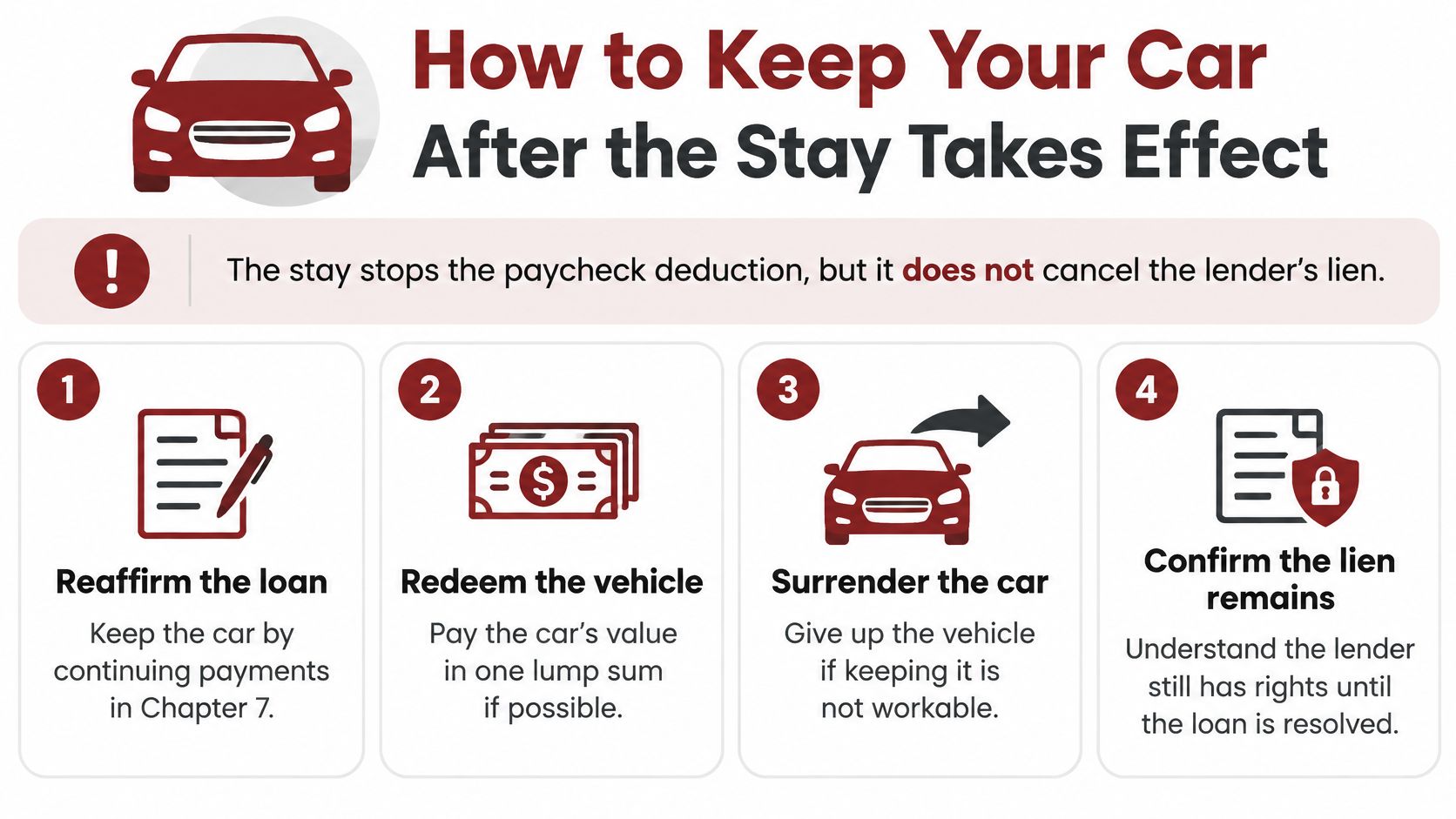
Your Car Options by Chapter
In Chapter 7, you may reaffirm the loan by signing a new agreement and continuing payments, or redeem the car by paying its value in one lump sum. A paid off car is usually kept if its equity fits within your available exemptions, while equity beyond the exemptions may lead to a sale or require a buy back. Our guide on filing for bankruptcy and keeping your car in Georgia covers how those choices play out.
In Chapter 13, you repay the car through the plan, sometimes reducing interest or the crammed down value when eligible. That makes Chapter 13 technically preferable where keeping the vehicle is essential and you're behind. The trade off is committing to plan payments for years.
The Ongoing Checklist
- Keep insurance active: A lapse gives the lender grounds to ask the court for relief from the stay.
- Make required post filing payments on time: Missing them is the most common reason lenders win permission to repossess.
- Keep title and registration current: Paperwork gaps create avoidable disputes about the vehicle.
- Confirm with payroll in writing that the withholding has stopped, and bring any post filing deductions to counsel and the court rather than relying on an informal promise.
Keeping the car depends on those recurring steps, not just the filing date. No federal source establishes a universal success rate for stopping garnishments or keeping a vehicle, since results turn on eligibility, stay exceptions, and creditor motions.
Choose Your Next Move Before the Deadline
Georgia specifics reward moving in the same week, not the same month. The Georgia Department of Revenue bankruptcy FAQ reflects that collection activity usually stops after receiving bankruptcy notice, but exceptions apply, and Georgia Legal Aid similarly notes the stay generally stops an existing garnishment when the case is filed and the creditor receives notice, though the creditor may seek court permission to continue. Notice is the trigger in practice, so it should go out immediately.
Recovery of money already taken is narrower than many people hope. More than $600 garnished during the 90 days before filing may potentially be recoverable, subject to bankruptcy law requirements and exemptions. That's a reason to count back from your first deduction before you decide timing, not a promise you'll get it all back.
So here is the question this decision really turns on. If bankruptcy stops your garnishment, what exact payment and vehicle retention decision must you make next? Stopping the deduction doesn't eliminate the lien or guarantee you'll keep the car. You still have to address missed payments, adequate protection, reaffirmation, surrender, or a Chapter 13 repayment plan, and Chapter 13 can stop a foreclosure, a car repossession, and wage garnishments while letting you deal with debts at a payment level you can afford.
Bring these five items: recent paystubs, the garnishment order or loan contract, a current loan statement, the vehicle's value and proof of insurance, and every deadline printed on your court papers.
We offer wage garnishment services and help clients who have lost a job, can't keep up with medical bills, are behind on a mortgage, or have tax debt. I would have a Georgia consumer debt practitioner at Morgan & Morgan Attorneys at Law P.C. review those five items before your objection or filing deadline passes, so the chapter, payment level, and car retention path match your actual numbers.
If your next paycheck is about to shrink again, don't guess which fix applies to you. Morgan & Morgan Attorneys at Law P.C. offers wage garnishment services in Athens, including reviewing your garnishment documents, checking exemptions, negotiating with creditors, and filing Chapter 7 or Chapter 13 when that's the right move. Visit Morgan & Morgan Attorneys at Law P.C. to schedule a consultation before your objection deadline or another deduction goes out.

Lee Paulk Morgan
With more than 41 years of experience in the areas of Bankruptcy, Disability, and Workers’ Compensation, Lee Paulk Morgan is one of the most respected Bankruptcy and Disability attorneys in Athens, Georgia. His tireless dedication to serving clients has gained him the reputation of a premier attorney in his areas of practice, as well as the trust and respect of other legal experts, who often refer clients to him.
SHARE
RELATED POSTS

Can I Be Jailed For Credit Card Debt? (What Georgia Law Says)
Generally, no: unpaid credit card debt is a civil matter, not a crime. Jail exposure comes from separate conduct around the debt, such as willfully ignoring a lawful court order or committing fraud, not from…

I Am Drowning In Debt (What Are My Options in Georgia)
You’re sitting at the kitchen table after work, opening mail you have put off for days. A credit card statement shows a minimum payment you can’t cover, a medical bill has gone to collections, and…