
Blog

Can Bankruptcy Stop Wage Garnishment in Georgia
Yes, bankruptcy can usually stop a wage garnishment the moment the case is filed because the automatic stay takes effect immediately. But that answer has limits: child support, federal student loans, and certain tax debts may keep coming out of your pay, so the first step is to verify what kind of debt is behind the deduction.
Many readers start looking for this answer after a bad payroll surprise. The direct deposit hits, the amount is off, and the pay stub shows a deduction that wasn’t there before. If that’s where you are, the legal question isn’t abstract. It’s whether your next paycheck will be whole, short again, or tied up while your employer and the garnishment court sort through notices.
In Georgia, I tell people to separate two different problems right away. The first is the garnishment order, which is the collection tool taking money from your check. The second is the underlying debt, which may or may not go away even if the garnishment stops. Bankruptcy can be powerful because it often stops the collection tool fast. It is not magic, and it doesn’t erase every kind of debt.
There’s another issue many articles skip. Sometimes the better question isn’t whether bankruptcy can stop wage garnishment. It’s whether those wages or benefits were legally garnishable in the first place. That matters in Georgia because some income is protected, and some garnishments are excessive or misapplied. If your next paycheck matters, you need the answer in the right order: identify the debt, identify the income source, then decide whether bankruptcy is the right fix.
The Moment Your Paycheck Comes Back Short
The usual call starts the same way. Someone opens a banking app on Friday morning, sees less money than expected, and then checks the pay stub. A line says “garnishment” or “court order.” By lunch, they want one answer: can this be stopped before the next pay period?
Usually, yes. Not always.
What matters first is what kind of debt led to the deduction. If this is an ordinary judgment on a credit card, personal loan, old medical bill, or similar consumer debt, bankruptcy often stops the garnishment. If it’s child support or another carved-out debt, the answer changes fast. That’s why broad promises cause trouble. A worker who files based on the wrong assumption can still watch money leave the next check.
What people usually misunderstand
The first misunderstanding is timing. Many people think protection starts when the bankruptcy is “approved.” That’s not how it works. The legal protection begins when the bankruptcy petition is filed.
The second misunderstanding is scope. Stopping a garnishment doesn’t automatically wipe out the debt behind it. A credit card judgment may be treated very differently from support arrears or a government claim.
Practical rule: If your paycheck is already being hit, your next pay date matters more than a general discussion about “debt relief.”
Why the next two pay cycles matter
In real life, payroll offices don’t operate at courtroom speed. Even when the law changes the moment a case is filed, the paycheck in process may already be moving through payroll. That can mean one more short check if notice doesn’t reach the right people in time.
Focus on these immediate questions:
- What debt is this for: Read the garnishment papers and identify the creditor, court, and case.
- Who is taking the money: It may be a private creditor, a support agency, a tax authority, or another government actor.
- Where is payroll in its cycle: If your employer already processed this week’s payroll, legal relief may affect the following check instead.
The legal tool that usually stops an ordinary garnishment is the automatic stay. Once a bankruptcy case is filed, that stay generally blocks collection on pre-filing debts. For someone living paycheck to paycheck, that isn’t technical language. It’s the difference between catching up on rent and falling further behind.
How the Automatic Stay Stops a Garnishment
The engine behind garnishment relief is the automatic stay under 11 U.S.C. § 362(a). The federal courts explain that filing a bankruptcy petition generally triggers the automatic stay immediately by law and usually prohibits creditors from continuing collection activity on pre-petition debts, including enforcing a judgment through wage garnishment, as described in the federal courts’ Chapter 13 bankruptcy basics.
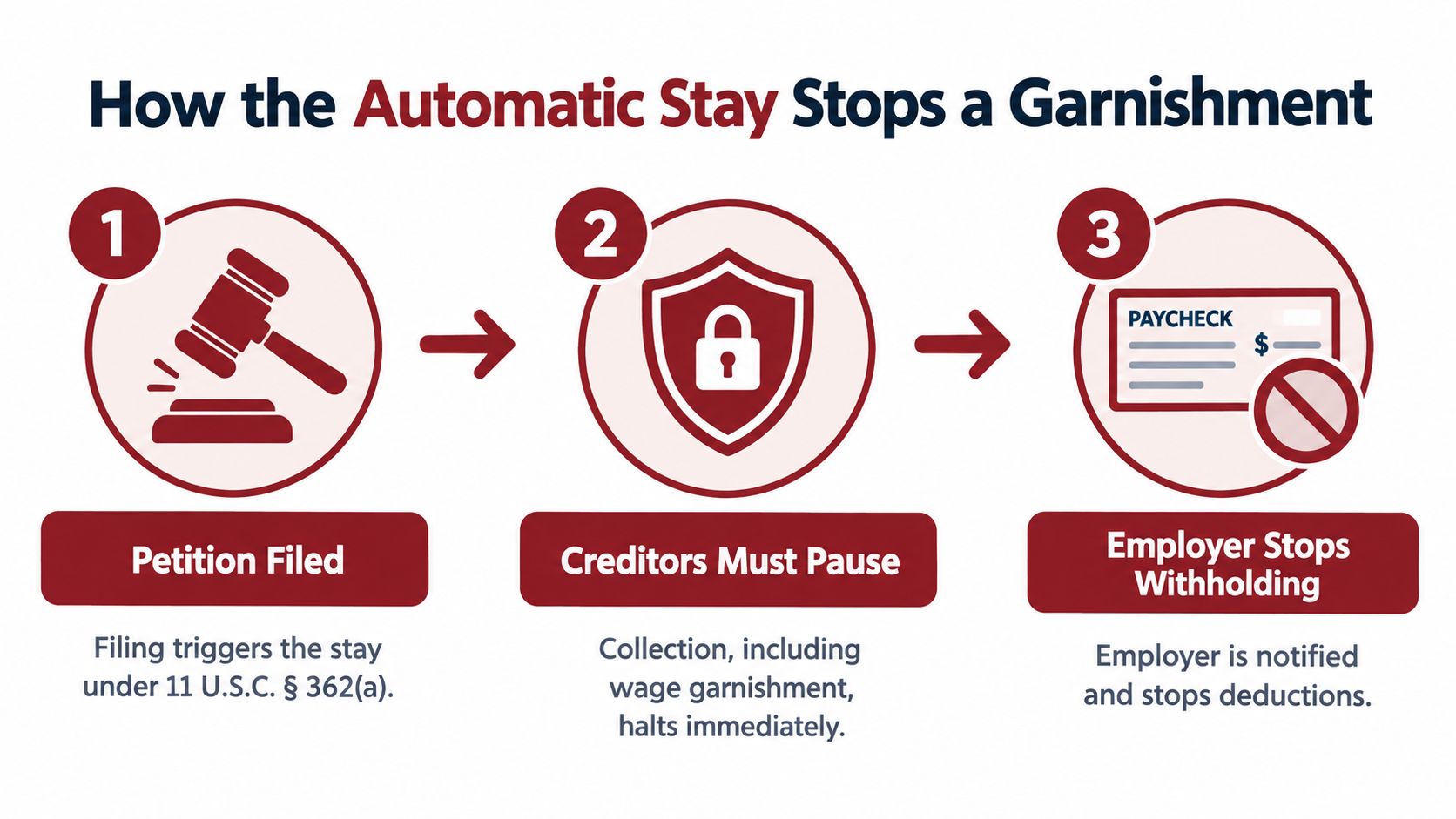
What changes on the filing date
Three things happen in practice.
- The case is filed with the bankruptcy court. That creates the stay.
- Notice has to reach the parties who are acting on the garnishment. That usually means the creditor or creditor’s lawyer, the garnishment court or officer handling the process, and the employer’s payroll or legal department.
- The employer stops sending newly withheld wages once it has reliable notice. That’s the payroll-office moment people care about most.
This is why speed and accuracy matter. A case number without notice doesn’t help much if payroll never receives it. On the other hand, a properly filed case with prompt notice often stops an ordinary garnishment before another full pay cycle passes.
If you want a consumer-friendly primer on how garnishment works before bankruptcy enters the picture, BadCreditMD on garnished wages gives useful background on the process workers usually see from the paycheck side.
What the stay does not do
The automatic stay is procedural relief. It stops collection activity while the stay is in effect. It is not the same thing as a permanent ruling that the debt is gone.
A few practical limits matter:
- Creditors can challenge it: A creditor may ask the bankruptcy court for relief from the stay.
- Cases can end: If the bankruptcy case is dismissed or concluded, the stay can end.
- Payroll timing still matters: A check already in processing may not be fixed in time.
The legal answer and the payroll answer are often a few days apart.
People also need to know where to send information. After filing, provide the case number and filing date quickly to everyone involved in the garnishment chain. Keep your pay stubs. If withholding continues after notice, raise it with counsel immediately. In some situations, further court action may be appropriate to recover money taken after filing.
For a deeper explanation of how this protection works in practice, Morgan’s discussion of how the automatic stay in bankruptcy proceedings can help a filer get back on track is worth reading alongside your own case documents.
Chapter 7 vs Chapter 13 for Garnishment Relief
The chapter you file matters because it affects not just whether the garnishment stops, but what happens to the debt after that. Nationally, consumer filers overwhelmingly use these two chapters. In fiscal year 2023, U.S. Trustee Program districts recorded 408,963 bankruptcy filings, with 241,477 Chapter 7 cases, about 59 percent, and 160,894 Chapter 13 cases, about 39 percent. Together, those consumer chapters made up roughly 98 percent of filings, according to the U.S. Trustee Program fiscal year 2023 data.
The short version
If the debt is dischargeable and the goal is speed, Chapter 7 is often the cleaner tool.
If the household needs time to catch up in an organized way, Chapter 13 may fit better.
Chapter 7 vs Chapter 13 on Wage Garnishment
| Factor | Chapter 7 | Chapter 13 |
|---|---|---|
| How the garnishment stops | The automatic stay can stop an ordinary garnishment when the case is filed | The automatic stay can also stop an ordinary garnishment when the case is filed |
| Main advantage | Faster path when the underlying debt can be discharged | Structured repayment for someone with regular income |
| What happens to many unsecured debts | Many may be discharged if they qualify | They may be addressed through a court-supervised repayment plan |
| Best fit in many cases | Someone needing quick relief from dischargeable judgment debt | Someone who needs time to catch up and keep a plan in place |
| How long the repayment structure lasts | No multi-year plan structure like Chapter 13 | Generally lasts three to five years |
| Weak point for garnishment problems | Doesn’t create a long-term payment framework for debts that won’t go away | Requires plan payments and case compliance over time |
How this plays out in a Georgia household
Chapter 7 is often the answer when someone has an ordinary consumer judgment, limited ability to repay, and a paycheck that can’t absorb more deductions. The relief can be fast, and if the debt is dischargeable, the garnishment issue often ends for a practical reason: the debt itself is no longer collectible.
Chapter 13 solves a different problem. It can stop the garnishment while giving the filer a court-supervised path to deal with broader financial pressure. That’s often useful when the person has regular income but needs a structured window to catch up and stabilize.
When people ask me whether Chapter 7 or Chapter 13 is “better” for garnishment, the real answer is simpler. Better for what?
Choose based on the goal:
- Need the fastest route to stop a dischargeable judgment debt: Chapter 7 is often the first option examined.
- Need breathing room with a repayment framework: Chapter 13 often makes more sense.
- Need to know the trade-offs in Georgia terms: Compare both before filing anything.
A helpful side-by-side resource is Morgan’s guide to the differences between Chapter 7 and Chapter 13 bankruptcy for Georgia filers.
Debts Bankruptcy Does Not Stop
People get burned by oversimplified advice. Bankruptcy usually stops an ordinary wage garnishment. It does not stop every payroll deduction, and it doesn’t protect every kind of debt the same way.
Federal law excludes several categories of collection activity from the automatic stay, including certain criminal proceedings, domestic-support enforcement, some tax matters, and actions to collect debts that are not dischargeable. A creditor may also ask the bankruptcy court to lift the stay, as reflected in 11 U.S.C. provisions available through Cornell’s U.S. Code resource.
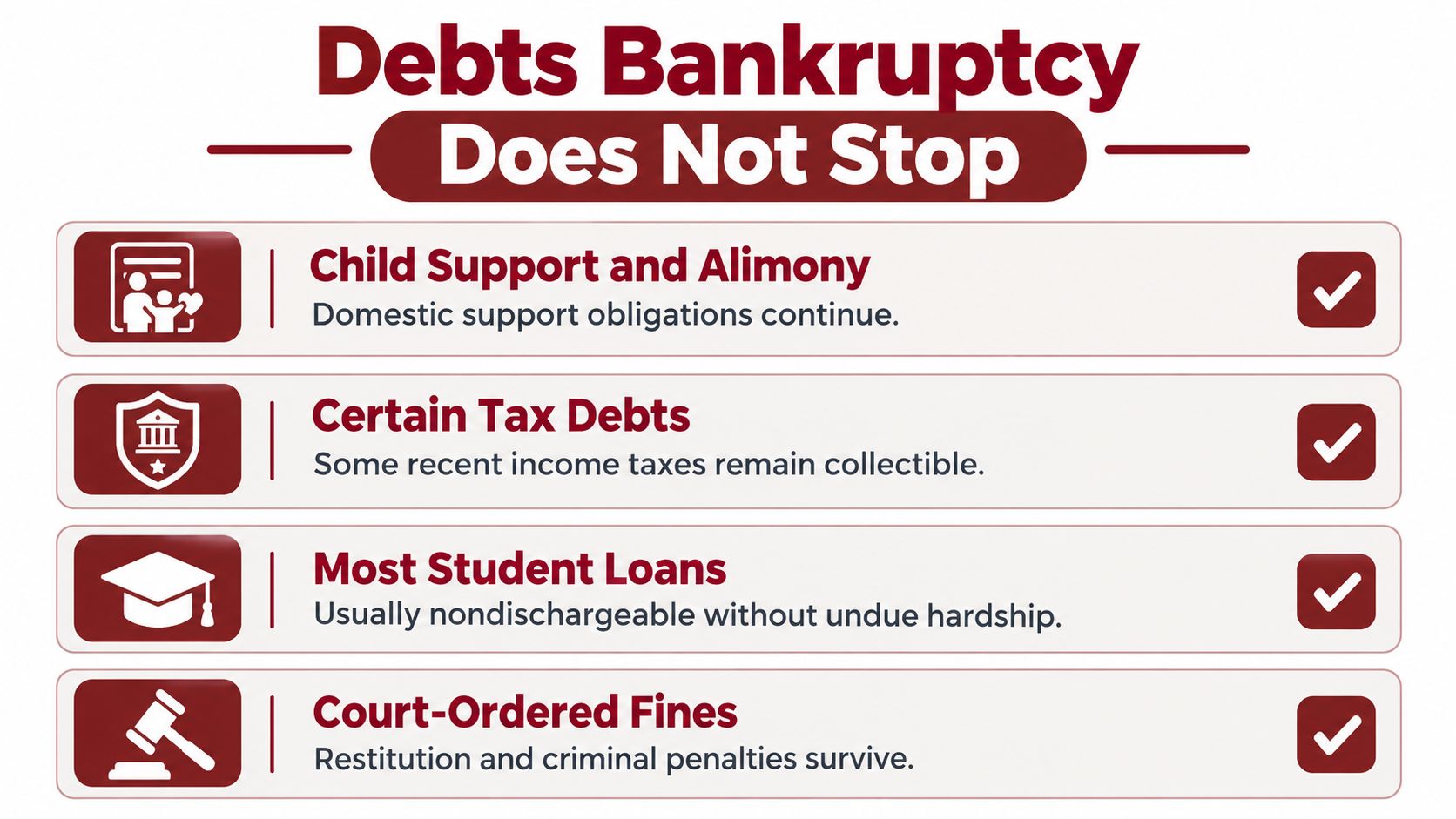
The deductions that often keep going
Start with the garnishment notice. If the debt falls into one of these categories, don’t assume a filing will make the deduction vanish.
- Child support and alimony: Domestic-support obligations are treated differently and generally continue.
- Federal student loans: These are commonly treated as debts that don’t disappear in the ordinary course, and collection may not stop the way people expect.
- Certain tax debts: Tax collection has its own rules, and some tax matters are carved out.
- Criminal fines or restitution: Court-ordered criminal obligations are in a separate category.
Why this distinction matters
People often ask the wrong yes-or-no question. The better question is, “What debt is attached to this deduction, and how does bankruptcy treat that debt?”
If you don’t know whether you’re dealing with a private judgment, support enforcement, student loan collection, or a tax issue, you can’t answer whether bankruptcy can stop wage garnishment in your case. That’s also why broad debt payoff advice sometimes misleads people who are already under court collection pressure. General strategy guides can be useful, and The Money Maniac’s payoff comparison is a decent example for comparing approaches, but a garnishment tied to a legally protected debt usually needs a legal analysis before it needs a budgeting system.
Two more traps
One is the motion for relief from stay. Even where the stay starts in your favor, a creditor can ask the court for permission to proceed.
The other is the repeat-filer problem. Prior bankruptcy cases can affect how long the stay lasts. That issue needs to be screened early because timing matters when payroll is already withholding wages.
For a fuller discussion of obligations that often survive bankruptcy, see Morgan’s guide on debts that are not included when filing bankruptcy.
Were the Wages Even Garnishable in Georgia
Before filing any bankruptcy case, check whether the money being taken was subject to garnishment at all. This is the step that often gets skipped, and sometimes it’s the cheapest mistake in the whole file.
Georgia law generally limits wage garnishment to the lesser of 25 percent of disposable earnings or the amount exceeding 30 times the federal minimum wage, and it protects income such as Social Security, SSI, unemployment, VA benefits, and many workers’ compensation benefits, subject to exceptions, as summarized by Georgia’s garnishment exemption guidance.
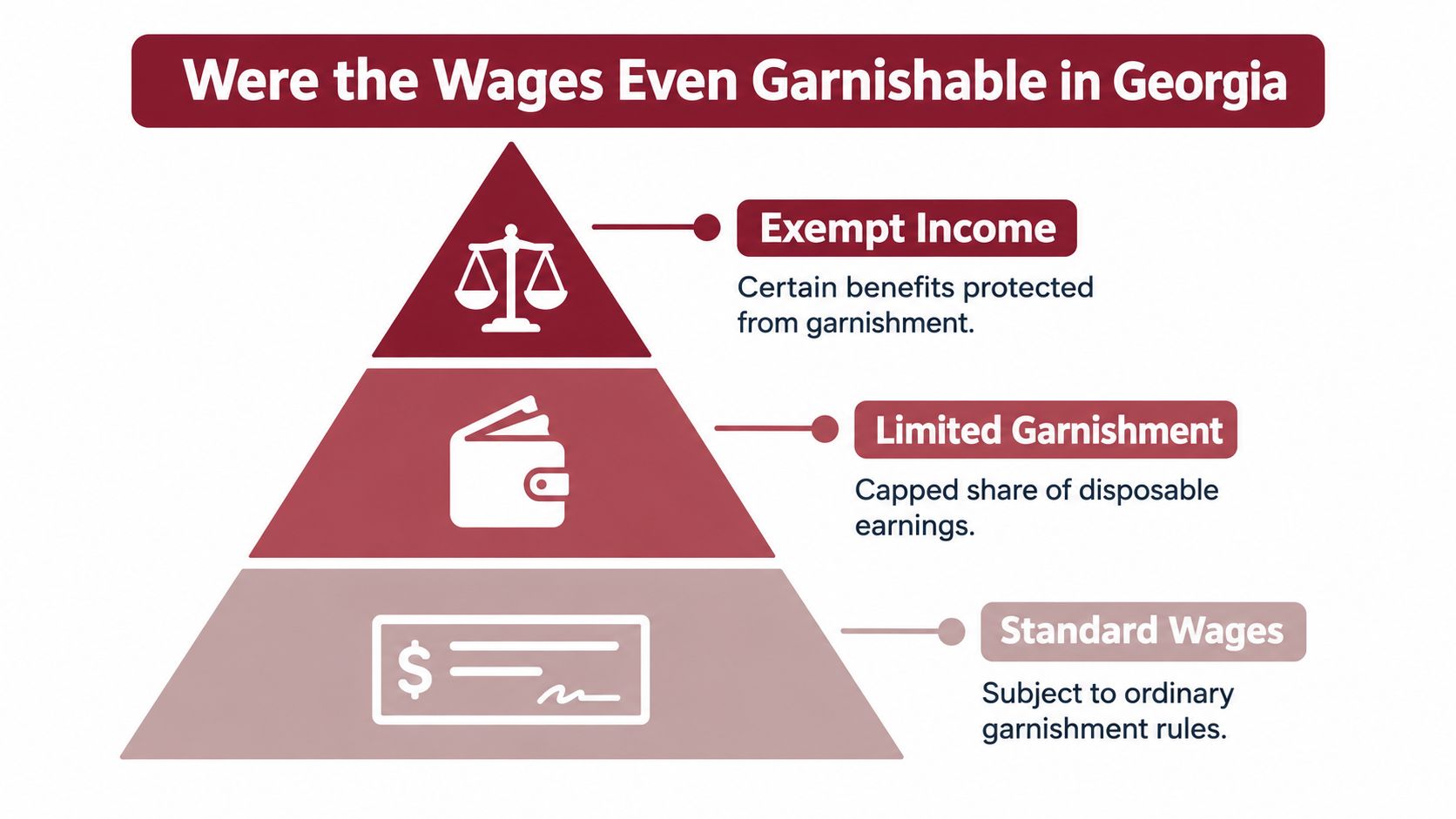
Start with the income source
Not every dollar landing in an account should be treated as ordinary wages. Protected benefits can lose clarity once they’re mixed with other deposits, but the source still matters. If the money being hit comes from Social Security, SSI, unemployment, VA benefits, or many workers’ compensation benefits, the answer may be exemption work rather than bankruptcy.
That is especially important in a firm like Morgan & Morgan Attorneys at Law P.C., where wage garnishment, workers’ compensation, and disability-related income questions often overlap in the same household problem. A person may think they need Chapter 7 or Chapter 13 when the first issue is whether protected funds are being touched.
Use this Georgia sequence
Don’t begin with “Should I file?” Begin here:
- Identify the income source. Is this payroll from current work, disability income, benefits, or mixed funds?
- Check disposable earnings. Garnishment limits are based on disposable earnings, not gross pay.
- Read the garnishment notice carefully. Match the creditor, court, and type of debt.
- Assert exemptions if they apply. If income is protected, challenge the garnishment on that basis.
- Then evaluate bankruptcy. If the income is garnishable and the debt is the kind bankruptcy can address, filing may become the stronger tool.
Sometimes the fastest way to stop the money loss is not a bankruptcy petition. It’s proving the wages should not have been garnished under Georgia law.
What works and what doesn’t
What works is gathering pay stubs, benefit letters, garnishment papers, and bank records that show where the money came from.
What doesn’t work is assuming every deduction labeled “garnishment” is legally valid just because an employer processed it. Employers generally follow orders they receive. They are not deciding exemption disputes for you.
If your income is protected, pushing the exemption issue may solve the immediate payroll problem without taking on the long-term consequences of a bankruptcy filing. If the income is ordinary wages and the debt is an ordinary judgment, then bankruptcy may be the better next move.
What Actually Happens Between Filing and the Next Paycheck
Your check was short on Friday. You file bankruptcy on Monday. By the next payday, many people expect the deduction to disappear automatically. Sometimes it does. Sometimes payroll has already processed one more check, and the money still comes out.

The sequence after filing
A bankruptcy filing creates the automatic stay right away, but the payroll deduction does not stop by magic. The case has to reach the people who can act on it.
In a Georgia wage garnishment, that usually means four separate points of contact:
- The bankruptcy court assigns the case number.
- The state court handling the garnishment needs notice that the collection process is stayed.
- The creditor or the creditor’s lawyer needs notice so collection efforts stop.
- The employer, payroll processor, or legal department needs notice before the next payroll cutoff.
That distinction matters. Bankruptcy can stop the garnishment order from taking more wages. It does not always erase the debt that same day, and it does not reverse a payroll run that closed before notice arrived.
Georgia procedure also matters here. As noted in this Georgia Legal Aid related summary of bankruptcy notice and garnishment procedure, the debtor or attorney should notify the court handling the garnishment, and money already paid into the court registry may be held until there is direction on what happens next.
Why a post-filing paycheck can still be short
The problem is usually timing, not legality.
If payroll locked the file on Tuesday and the bankruptcy was filed on Wednesday, Friday’s check may still show the deduction. In my experience, that is one of the most common sources of confusion. Clients think the stay failed. What happened is more ordinary. Payroll was working off yesterday’s instructions.
That is why I focus on two questions right after filing: who has notice, and has payroll already hit its processing deadline?
If money still comes out after filing, act fast:
- Save each pay stub showing the post-filing deduction.
- Confirm when payroll received notice and who received it.
- Get the documents to your attorney immediately so the issue can be addressed before another pay cycle.
- Ask whether the deducted funds can be recovered if the garnishment continued after proper notice.
The practical takeaway is simple. Filing stops the legal right to keep garnishing in most ordinary debt cases. Stopping the deduction on your next paycheck depends on notice reaching the garnishment court, the creditor, and the payroll office in time to change the next run.
Your Next Seven Days if a Garnishment Just Started
If a garnishment just hit your paycheck, use the next week well. Don’t spend it guessing.
Gather the file first
Bring together:
- Your last two pay stubs
- The garnishment notice
- Any judgment, summons, or court paperwork tied to the debt
- Recent tax returns
- Any letters showing disability, unemployment, Social Security, VA, or workers’ compensation income
Then ask the right questions
In a consultation, focus on practical questions:
- Is this debt dischargeable, or is it one of the carve-outs
- Are these wages even garnishable under Georgia law
- Would Chapter 7 or Chapter 13 fit the actual problem
- How fast can notice reach payroll, the garnishment court, and the creditor’s lawyer after filing
Use the week to protect the next paycheck
If you do file, make sure notice reaches the right places fast. That usually includes payroll, the garnishing court, and the creditor’s attorney. Ask who is responsible for sending what, and when.
Also ask about logistics that matter when money is tight. Free consultations, in-house credit counseling, virtual appointments, help gathering tax records and credit reports, and attorney involvement at hearings can make a real difference when a garnishment case is moving quickly.
Putting It Together for Georgia Households
For most Georgia workers, the answer to can bankruptcy stop wage garnishment is yes, but only after you identify the debt and confirm the income was legally subject to garnishment in the first place. If it’s an ordinary judgment on dischargeable debt, bankruptcy often stops the collection tool quickly. If it’s support, certain taxes, student loans, or another protected category, the paycheck may not change the way you hoped.
If you’re already thinking past filing and worrying about credit cleanup later, early bankruptcy removal steps can help you understand the separate credit-reporting side of the process. But first things first. When a paycheck is on the line, the right order is debt type, income type, chapter choice, and immediate notice to the offices that control the deduction.
If your wages are being garnished, Morgan & Morgan Attorneys at Law P.C. can review the debt type, check whether your income is exempt under Georgia law, and determine whether Chapter 7 or Chapter 13 is the better tool to stop the deduction. The firm works directly with clients on the filing, notice, and court steps that matter when the next paycheck is at risk. To learn more or schedule a consultation, visit Morgan & Morgan Attorneys at Law P.C..

Lee Paulk Morgan
With more than 41 years of experience in the areas of Bankruptcy, Disability, and Workers’ Compensation, Lee Paulk Morgan is one of the most respected Bankruptcy and Disability attorneys in Athens, Georgia. His tireless dedication to serving clients has gained him the reputation of a premier attorney in his areas of practice, as well as the trust and respect of other legal experts, who often refer clients to him.
SHARE
RELATED POSTS

Can I File For Chapter 7 Without A Lawyer In GA?
Yes, you can file for Chapter 7 without a lawyer in the United States, and that’s called filing pro se. The problem is that self-filing comes with a much lower success rate than filing with…

Can I Rent An Apartment After Chapter 7? (Practical Guide)
Yes, you can rent an apartment after Chapter 7, and there’s no legal waiting period. The primary challenge is landlord underwriting, which is where many applicants encounter difficulty. You may be doing everything right legally…