
Blog

Can I Refuse a Nurse Case Manager
Yes, you can generally refuse a nurse case manager, but put that refusal in writing. What stops and what continues after you say no is rarely obvious, especially in a Georgia workers' compensation claim.
The call often comes when you're already dealing with pain, missed work, medical appointments, and an insurance carrier you don't fully trust. A nurse introduces herself, says she wants to help coordinate treatment, and asks whether she can join your next appointment. You may feel as though refusing will jeopardize your claim, while agreeing may give the insurer unwanted access to your doctors and records.
That pressure is understandable. The better question isn't, "Can I refuse a nurse case manager?" It's, "How much participation should I allow, what should I restrict, and what administrative work may continue even if I refuse direct contact?"
Georgia workers have more than a yes-or-no choice. You can cooperate fully, refuse all direct involvement, or use a carefully written limited consent that allows scheduling while protecting private examinations, unrelated records, and attorney communications.
A Phone Call That Changes Everything
You're at home when the phone rings. The caller knows your employer, your injury, and the name of your treating doctor. She says she's the nurse case manager assigned to your workers' compensation claim. She wants to discuss your next appointment and may ask whether she can speak with the doctor afterward.
You haven't hired her. You didn't ask for another person in the treatment process. Yet the call can feel official enough that you assume you have no choice.
That assumption causes many injured workers to sign broad releases or agree to meetings without understanding what they're authorizing. Others react in the opposite direction and send a short message saying, “I refuse everything.” Both responses can create avoidable problems.
The practical answer: You can usually control your direct participation, but refusing the person doesn't necessarily stop every scheduling notice, provider communication, or attorney notification.
Georgia's State Board of Workers' Compensation recognizes a distinction between direct contact with the worker and administrative case coordination. An injured worker may refuse direct contact while the case manager continues notifying the worker's attorney about case-management activities, as explained in the Georgia State Board's medical case-management FAQ.
That distinction changes the decision. You aren't choosing only between surrendering control and shutting down the process. You can decide whether the problem is the individual nurse, the case-management program, a particular record request, attendance at appointments, or all direct communication.
Before responding, identify what made you uncomfortable. Was the nurse pressuring you to change doctors? Did she ask for unrelated medical history? Did she want to sit in during your examination? Or do you prefer that all communications go through counsel?
Those details determine the right boundary.
What a Nurse Case Manager Actually Does
A nurse case manager generally serves as a coordinator between the injured worker, medical providers, employer, insurer, and representative. The role can include arranging appointments, communicating relevant treatment information, tracking follow-up care, and helping move records or authorizations between participants.
That sounds straightforward, but coordination can feel like control when the nurse is connected to the insurance side of the claim. The safest way to understand the role is to separate logistics from medical and legal authority.
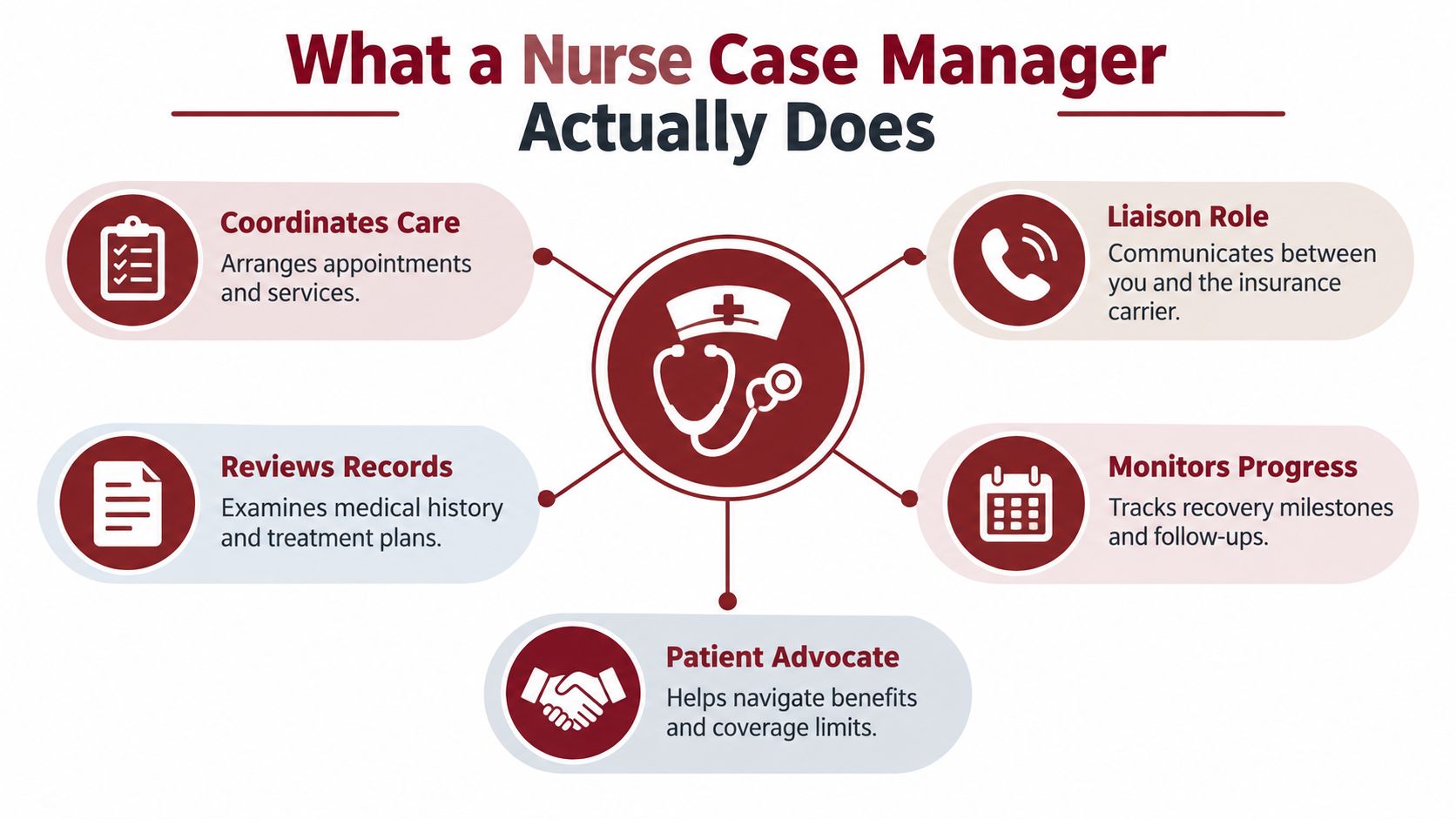
Coordination is not decision-making
A nurse may schedule an appointment, relay treatment information, or ask whether a referral has been completed. That doesn't make the nurse your treating physician or your lawyer.
A nurse case manager's lawful function is generally coordination and rehabilitation, not deciding compensability, determining medical causation, directing treatment, or replacing the treating physician. The distinction is reflected in the discussion of the nurse's liaison role in this workers' compensation decision addressing case-manager limits.
Think of the nurse as a project coordinator. The coordinator may track tasks and communicate with the people doing the work. The coordinator doesn't own the project, decide whether the project is legally covered, or replace the professional responsible for the substantive decision.
That means the nurse generally shouldn't be the person deciding whether your injury is compensable, whether your symptoms came from the workplace, or what treatment your doctor should provide.
What you should clarify immediately
Ask the nurse to explain the assignment in writing. Request the name of the employer or insurer that assigned the nurse, the specific services being requested, the records sought, and the people with whom the nurse intends to communicate.
You can also ask whether the nurse wants to:
- Schedule appointments
- Receive injury-related records
- Speak with your treating provider
- Attend an examination
- Communicate with your attorney
- Discuss work restrictions or treatment progress
If home health or broader care coordination is involved outside the workers' compensation setting, a guide to coordinating senior healthcare at home can help explain how care-management roles differ from direct medical treatment.
The point isn't to treat every nurse as an adversary. It's to understand what access you're being asked to grant before you agree.
Your Federal Right to Refuse Care Coordination
Federal hospital requirements recognize a patient's right to make informed decisions about care. That includes participating in care planning and requesting or refusing treatment, including planning for care after discharge.
The Centers for Medicare & Medicaid Services describes a framework requiring hospitals to explain consequences, document the patient's decision, and offer reasonable alternatives. The relevant CMS interpretive guidance on patient rights and informed refusal provides the federal foundation for that principle.
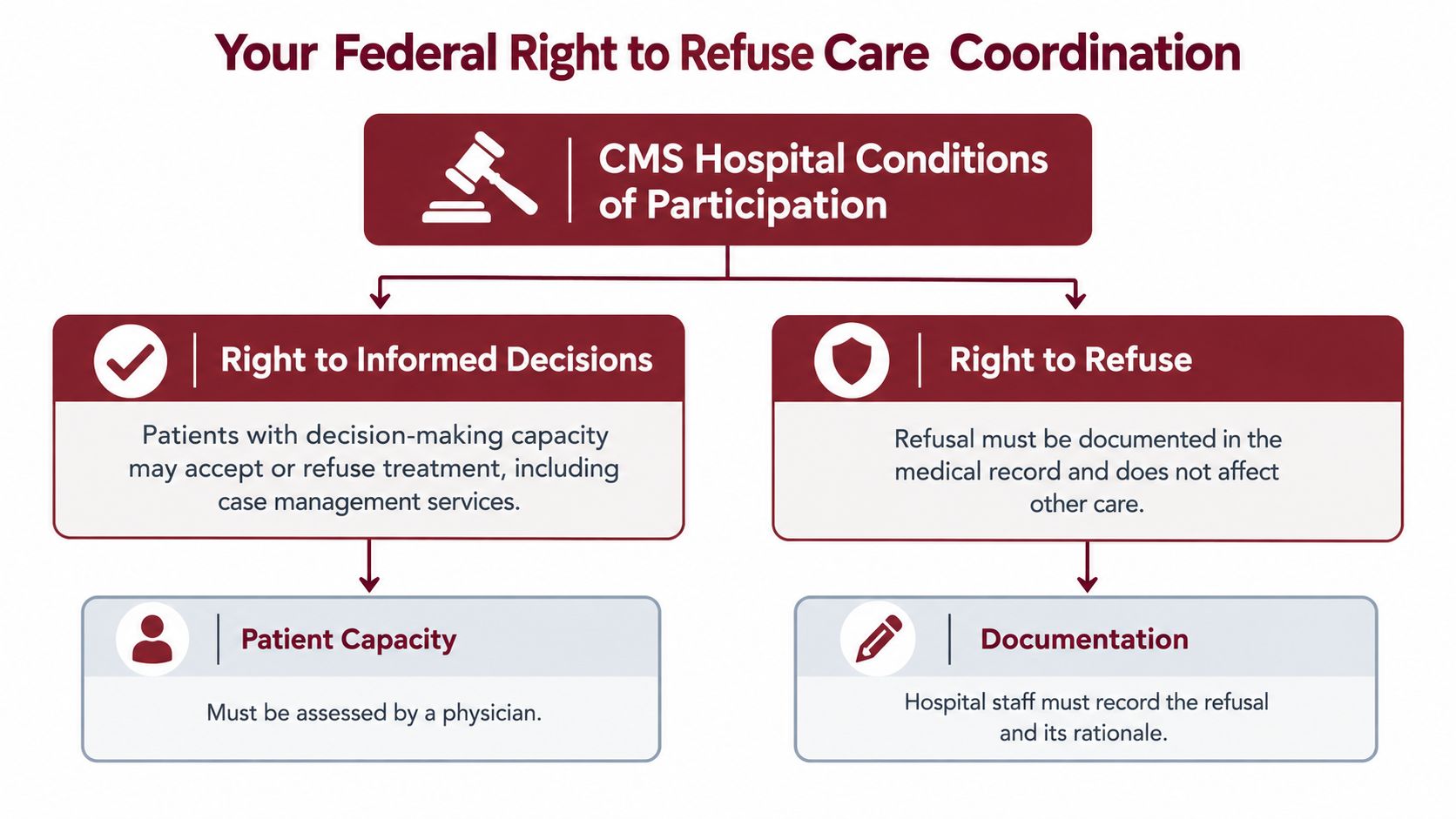
What the right means in practice
If you have decision-making capacity, you can generally decline proposed care-coordination services. If you lack capacity, an authorized representative may act for you under applicable law.
That right doesn't mean you can demand a service a responsible practitioner considers medically unnecessary or inappropriate. It also doesn't mean refusing one service cancels every other form of care.
For example, declining to work directly with a nurse case manager doesn't automatically mean you're refusing treatment from your physician. It may mean you want appointment coordination handled through your attorney, want communications in writing, or don't consent to the nurse attending a private examination.
Hospitals and other responsible participants may still need to explain what your refusal could affect. A refusal may create questions about discharge planning, equipment, home services, follow-up visits, insurance authorization, or continuity of care.
Capacity and documentation matter
The strongest refusal is informed, specific, and documented. It identifies what you're declining and what you're still willing to accept.
CMS guidance also provides a useful model from long-term-care settings. When a person refuses treatment, the facility is expected to assess capacity, identify the exact service being refused, explain likely consequences, discuss alternatives, and continue appropriate services. That framework supports a practical rule for workers' compensation claims: refuse narrowly unless you have a reason to refuse broadly.
You should ask for the refusal and alternatives to be placed in the relevant record. Keep your own copy. If someone says refusal will end your benefits or medical care, ask them to identify the specific rule or order supporting that statement.
How Georgia Workers Comp Treats Refusal
Georgia workers' compensation case management is built around coordination among the employee, representative, employer, insurer, and medical providers. The Georgia State Board's guidance also recognizes that consent controls direct communication with the worker.
That distinction is the central point many injured workers miss. You may decline direct phone calls or meetings while administrative coordination continues. If you have an attorney, the nurse may still provide case-management notifications to counsel.
The Georgia workers' compensation overview from Morgan & Morgan Attorneys at Law P.C. offers additional context about the claim process, but the exact effect of refusal depends on your claim posture, representation, medical treatment, and any Board orders.
Three paths for handling a nurse case manager in Georgia
| Path | What Continues | What Stops | Best For |
|---|---|---|---|
| Full cooperation | Scheduling, treatment coordination, provider communication, and direct updates | Few direct-contact restrictions | Workers who are comfortable with the nurse's role and want logistical help |
| Limited consent | Defined scheduling, injury-related coordination, and specifically approved communications | Unapproved records, private examinations, unrelated history, and direct contact outside the written limits | Workers who want assistance without surrendering broad access |
| Full refusal of direct participation | Required claim communications, attorney notifications, and some administrative coordination may continue | Direct calls, meetings, attendance at examinations, and access not authorized by consent | Workers facing pressure, boundary violations, or an active attorney-managed claim |
The choice should match the actual problem. If the nurse is helpful with scheduling but you don't want her in the examination room, limited consent may be more effective than a blanket refusal.
If the nurse is asking for unrestricted records or trying to communicate with your doctor without you or your lawyer involved, tighten the authorization and route communications through counsel.
Confidentiality is not automatic permission
Georgia guidance requires qualified medical case managers to protect medical-record confidentiality and generally obtain written consent before retrieving records. If you're represented, record-release coordination should occur with your attorney.
Don't assume that agreeing to “care coordination” authorizes access to every medical record or every conversation with every provider. Consent should identify the records, purpose, recipients, and limits.
Writing a Refusal That Actually Protects You
A verbal refusal is easy to misunderstand. A written notice gives the nurse, insurer, provider, attorney, and your own file the same instructions.
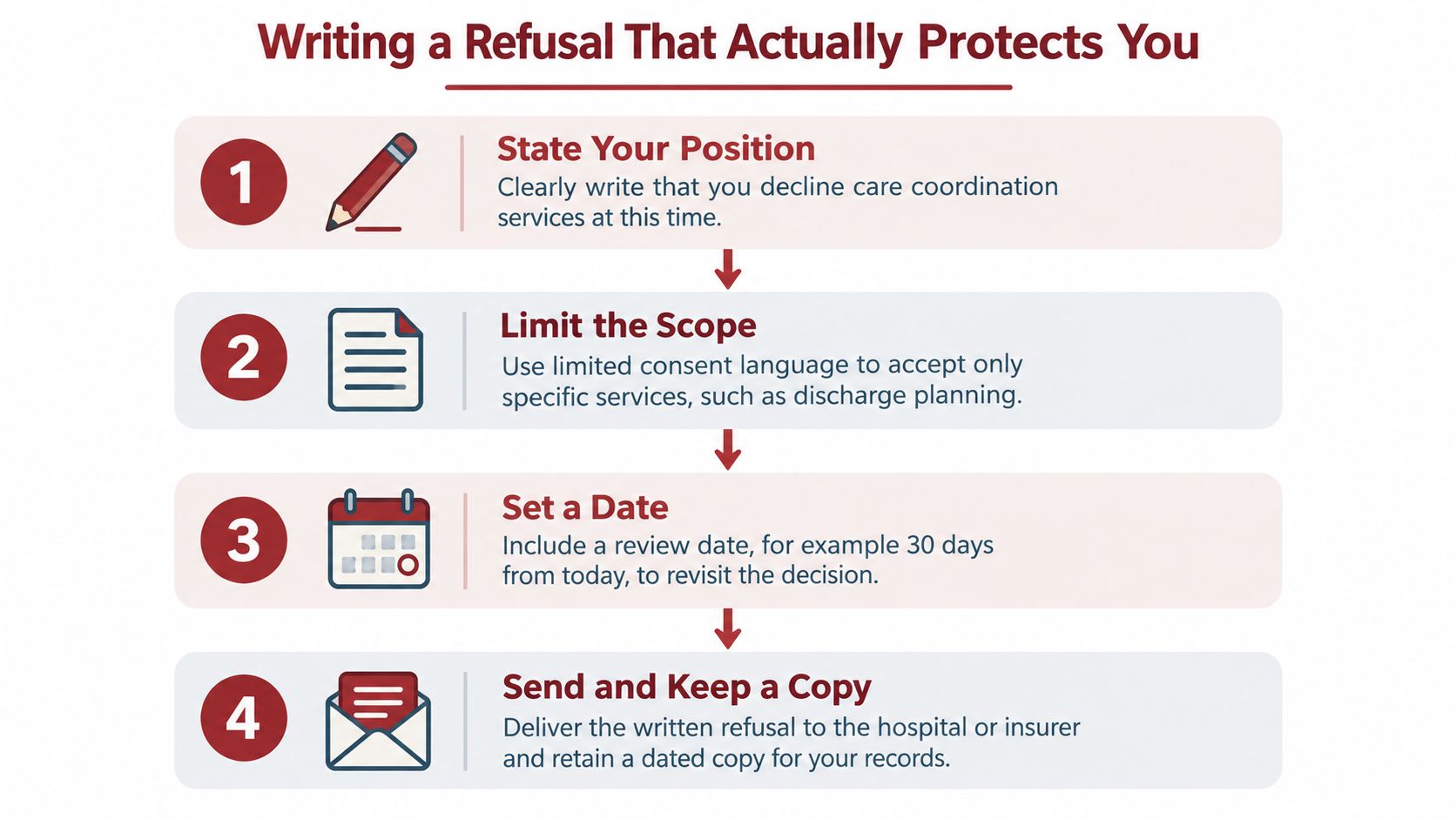
Start by deciding whether you're refusing the person, the program, a specific service, or all post-injury coordination. Most workers should avoid writing “I refuse everything” unless an attorney has reviewed that approach.
The better document often looks like a limited-consent letter.
Put the limits in plain language
You can adapt language such as:
I do not consent to direct telephone or in-person communications with the nurse case manager at this time. Please direct communications through my attorney and provide written notice of proposed appointments, authorizations, and case-management activity. I do not consent to attendance at medical examinations, private discussions with treating providers without me or my counsel present, release of unrelated medical records, or disclosure beyond authorized claim participants. This limitation does not mean I am refusing medically appropriate treatment or authorized appointments.
The wording should reflect your actual position. Don't include restrictions you don't intend to enforce, and don't authorize activities you haven't considered.
Identify the permitted coordination
A limited authorization might allow the nurse to schedule an approved appointment or relay an appointment time while excluding medical discussions. Guidance from the Indiana Workers' Compensation Board illustrates the value of documenting limited consent for scheduling and treatment coordination while excluding attendance at examinations, direct physician discussions without the worker or counsel present, unrelated records, and disclosure beyond authorized parties. You can review that nurse case-manager guideline on limited consent and confidentiality as a practical comparison, while remembering that Georgia rules control your Georgia claim.
Include:
- The specific services you permit
- The specific services you decline
- The providers who may be contacted
- The records that may be released
- The people who may receive information
- Whether communications must be written
- Whether your attorney must be included
Send it to every relevant person
Send the dated notice to the nurse case manager, insurer or adjuster, treating provider, and attorney or representative. Give the medical office a copy before the next appointment and ask staff to place it in the chart.
Use a delivery method that creates proof of receipt. Save the original, attachments, delivery confirmation, replies, and any later changes.
A clear letter also protects you from confusion. If someone later claims you refused all treatment, your document can show that you declined a particular form of access while remaining willing to attend appointments and follow medical instructions.
Risks and Trade-Offs You Should Weigh
Refusal can protect privacy, but it can also create practical friction. If you block every communication without assigning another person to coordinate appointments, scheduling can become slower and messages may pass through several people.
The serious risk isn't usually the loss of a nurse's phone call. It's missing something that affects the claim, such as an authorized appointment, a required evaluation, a treatment deadline, or a document requested by the insurer or Board.
Separate manageable friction from serious exposure
Some consequences are manageable. You may need to call the provider yourself, confirm appointments, request records, and keep a more detailed calendar. Your attorney may need to handle communications that the nurse previously managed.
Other issues deserve immediate attention:
- Missed appointments: Refusing direct contact won't excuse a missed medical visit or evaluation.
- Documentation gaps: If you don't preserve appointment notices and treatment records, the insurer may later characterize the claim history differently.
- Communication disputes: Phone calls can produce disagreements about what was said, especially when no one follows up in writing.
- Claim posture: A carrier may describe broad noncooperation unfavorably, even when the refusal was reasonable.
- Provider confusion: Your treating office may not know whether the nurse can schedule, request records, or speak with staff unless you provide clear instructions.
You can reduce those risks by replacing the nurse's logistical function. Keep a written appointment calendar, confirm every visit, attend required evaluations, follow medical instructions, and send important communications by email or letter.
Do not trade privacy protection for avoidable missed deadlines. Restrict access, but keep control of the dates and tasks that move your claim forward.
If an injury has also created urgent financial or household problems, resources such as 10 key crisis assistance programs may help you identify practical support while the claim is pending. For communication-specific guidance, review what not to say to a nurse case manager before responding to a difficult call.
When to Call a Georgia Attorney Instead
You don't need a lawyer for every scheduling question. You should stop handling the matter alone when the nurse's involvement moves beyond coordination or when a proposed release could affect your privacy and claim.
Call a Georgia workers' compensation attorney if the nurse pressures you to sign a broad medical authorization. The same applies if the nurse seeks unrelated medical history, wants private access to your physician, or insists on attending an examination after you object.

Escalate when the role changes
The following warning signs justify legal review:
- Treatment pressure: The nurse pushes you toward a different treatment path instead of relaying your doctor's plan.
- Work-status pressure: The nurse argues for a return to work that your treating provider hasn't ordered.
- Record expansion: The nurse requests unrelated records or a release with no meaningful limits.
- Private provider contact: The nurse wants to speak with your doctor without you or your attorney present.
- Benefit consequences: Someone tells you that refusing contact automatically ends your medical care or income benefits.
- Adverse action: Treatment is delayed, denied, or changed soon after you object to the nurse's involvement.
- Conflicting instructions: The nurse's statements conflict with your attorney, treating provider, or written claim documents.
Keep every text, email, letter, report, and voicemail. Write down the date, participants, and substance of each important conversation while it's fresh.
A lawyer can send a boundary letter, review proposed consent, communicate with the insurer, and determine whether a dispute needs action before it grows. If you're unsure whether your situation justifies counsel, review whether you need a lawyer for workers' compensation and seek advice based on your actual claim.
A Short Decision Framework to Carry With You
Start with the source of the problem. Are you uncomfortable with the individual nurse, the entire case-management program, a particular record request, attendance at examinations, or direct communication without counsel?
Then choose the narrowest option that solves that problem:
- Identify the boundary. Write down what you don't want to happen.
- Separate services. Decide whether scheduling or written notifications would still help.
- Choose your participation level. Use full cooperation, limited consent, or refusal of direct contact.
- Put it in writing. Name permitted contacts, prohibited access, record limits, and communication rules.
- Protect the claim. Track appointments, attend required evaluations, follow medical instructions, and preserve proof.
- Review after changes. Reconsider the arrangement if treatment changes, representation begins, the insurer disputes care, or the nurse ignores your limits.
You have more control than that first phone call suggests. The strongest response isn't always “yes,” and it usually isn't an unexplained “no.” It's a specific written decision that protects your privacy without creating unnecessary problems for treatment or claim administration.
Morgan & Morgan Attorneys at Law P.C. can review your proposed refusal or limited-consent letter and help you respond to a nurse case manager in a Georgia workers' compensation claim. Visit Morgan & Morgan Attorneys at Law P.C. to request a consultation before signing a release or agreeing to direct access.

Lee Paulk Morgan
With more than 41 years of experience in the areas of Bankruptcy, Disability, and Workers’ Compensation, Lee Paulk Morgan is one of the most respected Bankruptcy and Disability attorneys in Athens, Georgia. His tireless dedication to serving clients has gained him the reputation of a premier attorney in his areas of practice, as well as the trust and respect of other legal experts, who often refer clients to him.
SHARE
RELATED POSTS

Can Bankruptcy Stop Wage Garnishment in Georgia
Yes, bankruptcy can usually stop a wage garnishment the moment the case is filed because the automatic stay takes effect immediately. But that answer has limits: child support, federal student loans, and certain tax debts…

Can I File For Chapter 7 Without A Lawyer In GA?
Yes, you can file for Chapter 7 without a lawyer in the United States, and that’s called filing pro se. The problem is that self-filing comes with a much lower success rate than filing with…