
Blog

When Do Workers Comp Payments Start in Georgia
In Georgia, wage-loss workers' compensation payments generally begin only after you miss more than seven days of work because of a job injury, and the first check should be mailed within 21 days after the first day you missed. Authorized medical care can still be covered during that wait.
You got hurt on the job, the doctor already has you off or on restrictions, and rent is still due. The mailbox is empty. That gap feels like a denial, but it is often just the way Georgia splits medical care from cash. The question when do workers comp payments start has two answers, not one date on a calendar.
When the First Workers Comp Check Usually Arrives
Picture the week after a warehouse or campus job injury in Athens. You have already sat in an exam room. A supervisor took a report. Nobody has mailed a disability check, and the bills have not paused.
When payments start is not a single moment. Medical treatment and wage replacement run on different schedules. Georgia uses a waiting period before lost-wage benefits are payable. A short absence can bring covered medical care and still produce no disability check. A longer disability can produce weekly benefits, and in some cases payment for the early days that were unpaid at first.
Two clocks, not one denial
Keep these clocks separate while you wait.
The payable clock is the point when wage-loss benefits become owed. A quiet first week is not, by itself, proof that the insurer rejected the claim.
The mailbox clock is the deadline for mailing the first check. That mailing date is measured from the start of lost work, not from the day you start asking coworkers what happened to their claims.
Returning to light duty, or missing only scattered days for treatment, can change the count. Families who assume only continuous time off work often misread a partial week as a closed file.
Workers in other states hit the same confusion with different numbers. Florida claim guidance from MedAmerica Rehab Center is a useful contrast if you are comparing a relative's claim, but it does not reset a Georgia file.
A silent first week is not automatically a denied claim. Ask which date was recorded as the first day of lost work, and whether a check has been mailed.
If you want a rough sense of weekly cash once benefits are payable, a workers' comp benefits calculator can help you sketch the wage side. It will not tell you the mailing date. That still depends on the lost-time date in the file.
How Georgia Counts the Waiting Period
Count calendar days, not shifts. In Georgia, workers' compensation wage-loss payments generally begin only after an employee misses more than 7 days because of a job-related injury, according to the Georgia State Board of Workers' Compensation. Weekends and holidays sit inside that week. A Saturday you were not scheduled still counts if you are disabled.
Walk a real June
Say disability begins June 1.
Days 1 through 7 (June 1–7) are the waiting period. You ordinarily get no temporary disability wage benefits for a return inside that window. Medical benefits may still apply.
Day 8 (June 8) is when temporary total disability benefits become payable if you are still unable to do the job.
The mailing rule is separate. The Board states that the first check should be mailed within 21 days after the first day you missed work. That clock starts on the first lost day, not on day eight.
The retroactive rule repairs the early week only if disability lasts more than 21 consecutive days. Those waiting days then become compensable.
If disability runs from June 1 through June 22, you may qualify for weekly benefits and ultimately receive compensation covering June 1–7. If you return on June 8, wage-loss payments generally do not start for that short absence.
Georgia wage-payment timing at a glance
| Timing rule | What it means | Money result |
|---|---|---|
| More than 7 days off | Waiting period ends | Wage benefits can start on day 8 |
| First check mailing | 21 days after the first missed day | Check should be in the mail, not necessarily cashed |
| Disability longer than 21 consecutive days | Waiting days turn compensable | June 1–7 can be paid after the fact |
| Back by day 7 | Short absence | Usually no wage-loss check; medical care may still be covered |
The 21-day mailing deadline is not the same thing as the insurer accepting every dispute. Prompt injury reporting and medical documentation still decide whether the lost-time date is the one you remember.
Practical rule: Write the first missed day on paper the week it happens. Later arguments usually start with that date, not with the accident story.
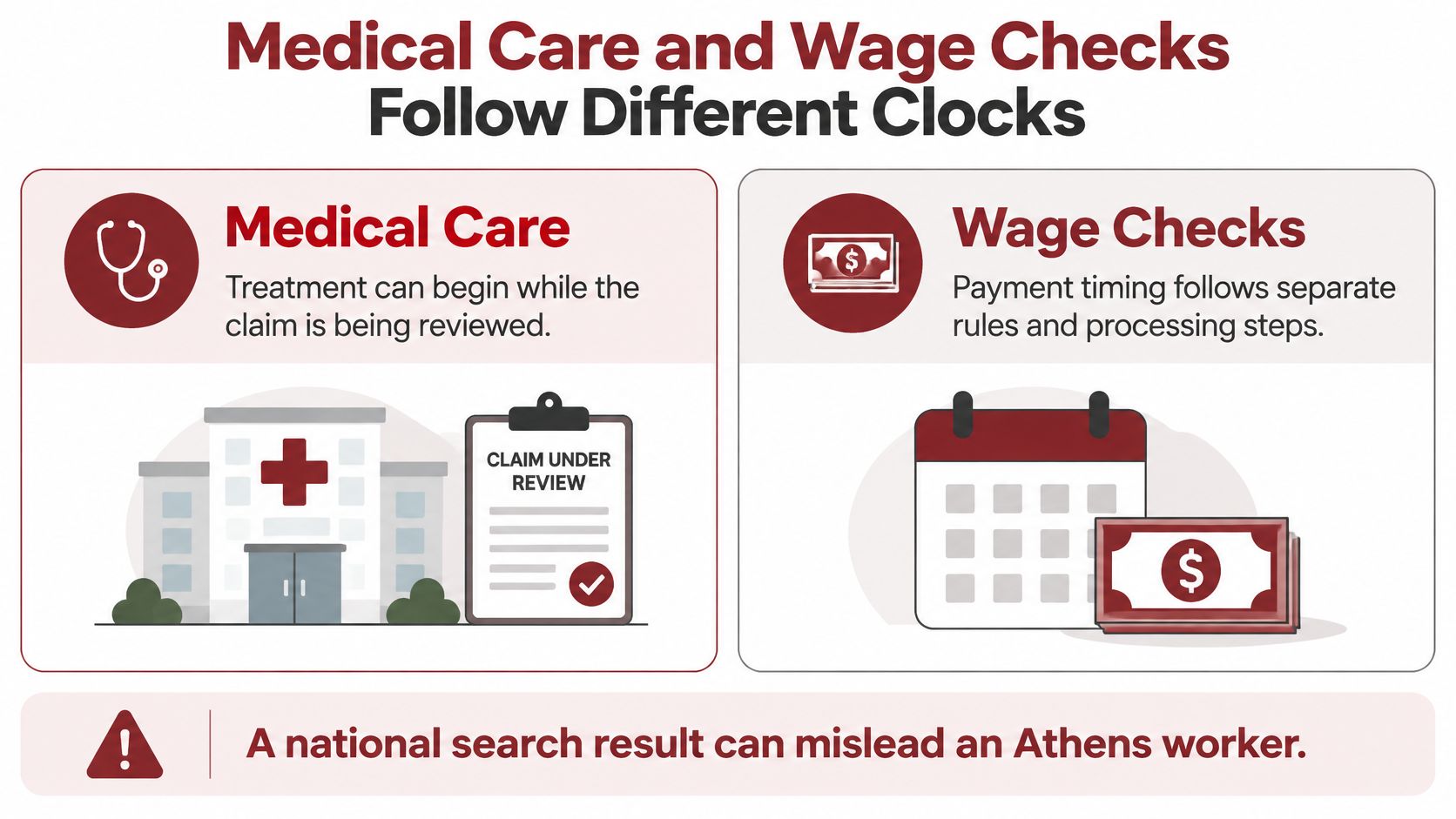
Medical Care and Wage Checks Follow Different Clocks
A national search result will not time an Athens claim. The accident date never answers the question by itself. The governing program, the waiting period, how long the disability lasts, and the claim-processing rule all move the start.
What each clock pays for
Think of two tracks that can run while you are still explaining the injury to a supervisor.
Medical care can move as soon as authorized treatment is needed. Across workers' compensation programs, covered medical costs are generally paid at 100%, while cash benefits address time away from work, according to a Social Security Administration policy overview. A short absence can mean doctor visits, therapy, and prescriptions without a wage check.
Wage checks wait until lost time crosses the statutory threshold. The same SSA overview reports that programs commonly impose a 3-, 4-, 5-, or 7-day waiting period before lost-wage benefits are payable. Georgia sits at the long end of that range, with its own mailing rule layered on top.
Medication is part of the medical track, not a substitute for weekly cash. If a pharmacy bill shows up while you are still inside the waiting week, start with whether workers' comp pays for prescriptions under the authorized treater, not with the wage calendar.
Serious skin breakdown, surgical sites, or slow-healing injuries sometimes need a clinic that can find treatment for complex wounds. That care can be underway while the cash file is still in its waiting period. Do not skip authorized visits because a disability check has not arrived.
Why another state's timetable misleads
Wisconsin is a clean contrast, not a Georgia instruction. Its Department of Workforce Development, as summarized in that SSA overview, says the first payment is generally made within 14 days after the injury or illness, with a 3-day waiting period. Benefits ordinarily begin on the fourth day of lost time, and the first 3 days are paid retroactively if the worker remains disabled for more than 7 calendar days.
Ignore that timetable when Georgia law covers the injury. Borrowing a 14-day mailing expectation, or a 3-day wait, will make a normal Georgia file look late when it is still inside its own rules.
What Changes If You Return Part Time
Continuous time off is only one pattern. Families also live through an early return, a cut in hours, or a string of appointment days. Each pattern can move the start date.

Three ways a week actually looks
Completely off. You stay out past the waiting week. Wage replacement is aimed at that longer disability, and the early days are paid only if the disability runs long enough for the retroactive rule already described. This is the pattern most explainers assume.
Back inside the first week. You return before the waiting period ends. Temporary disability wages generally do not start. Authorized medical care may still be covered. People in this spot often think the whole claim vanished because no check came. The wage side may never have opened.
Partial hours, light duty, or treatment time. The count gets personal here. A waiting-period calculation can turn on partial disability and individual calendar days, not only on whether you are entirely absent. Reduced hours, restricted duties, employer-paid sick leave, and recurring medical visits can change eligibility and timing.
Minnesota shows how another system treats scraps of a day. Its labor department counts even a fraction of a day of disability, and time lost to obtain medical treatment, as a disability day. Benefits ordinarily do not cover the first 3 calendar days unless disability continues for at least 10 days, in which case payment is calculated from day one, per Minnesota's waiting-period guidance. Nationally, waiting periods commonly range from 3 to 7 days, and the wage-loss benefit usually requires medical verification that you cannot perform regular work.
Do not paste Minnesota's 3-day and 10-day figures onto a Georgia claim. Use them as a warning that "completely absent or not" is the wrong question.
What to write down on a partial week
Work restrictions: Keep the doctor's note that lists hours, lifting limits, and sit-stand rules.
Partial wages: Save stubs that show what the employer paid after the injury.
Appointment absences: Note the date and hours you left for authorized treatment.
Sick leave: Record whether the employer used your sick or vacation bank to cover a gap.
Accepting light duty does not automatically end every possible benefit. If restrictions stay in place and wages drop, ask how that partial week was reported. A return to a laptop and a shorter shift can still be lost time in the file, or it can be recorded as a full return. The paperwork decides which.
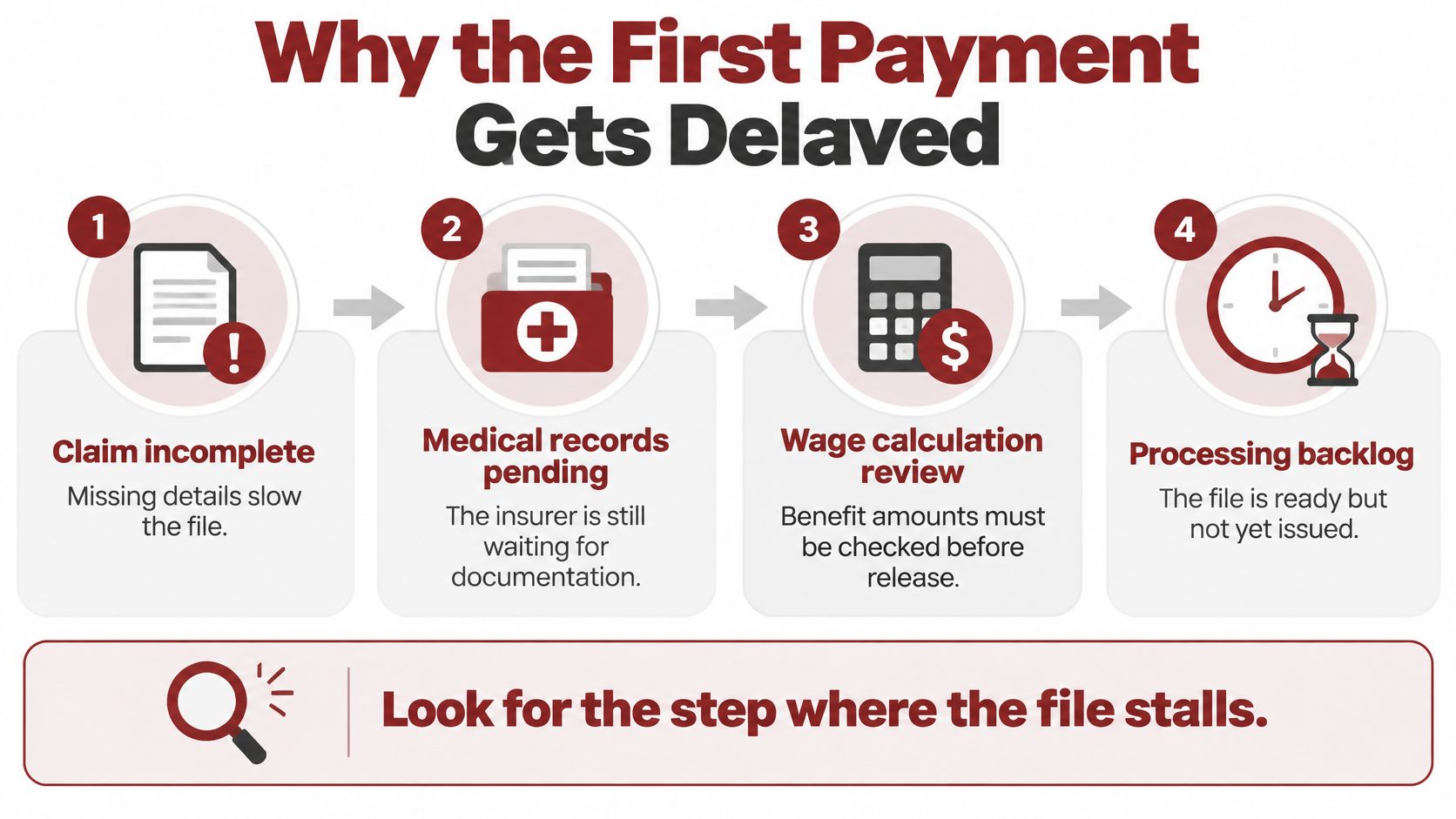
Why the First Payment Gets Delayed
You already know the waiting week and the mailing window. A stalled file is usually a milestone that never lined up, not a mystery about the statute.
Payment timing depends on the recognized lost-time date, not merely the day you remember being hurt. The Georgia employee handbook from the State Board puts the practical point plainly: document the exact disability date, report the injury promptly, preserve work-status restrictions, and verify that the employer or insurer filed the required injury documentation.
Where the file usually sticks
Notice came late. The employer cannot start a lost-time date it does not have. Same-week notice, in writing if you can, keeps the memory from becoming the only record.
Medical limits are missing. The insurer needs documentation that the injury is job-related and that it limits regular work. During the first seven days, authorized medical treatment may still be covered even though wage replacement is not yet payable. Skipping the authorized provider can stall both care and the later wage claim.
The disability date is fuzzy. "I got hurt Tuesday" is not the same as "the doctor took me off Thursday." Benefits follow the recognized date.
The injury report was never filed. Ask whether the employer or insurer submitted the required paperwork, and what first day of lost work is on it.
Why the mailbox stays empty
After the expected mailing window, the usual explanations are ordinary and fixable, or they are a real dispute.
The first missed day was recorded wrong. A Friday injury and a Monday disability start are not the same day.
Weekends were left out of someone's personal count. The waiting period is calendar days. A homemade tally of shifts will look "late" when the statute is not.
Restrictions were never sent. No work-status note often means no wage file, even if you have been home.
The claim is disputed, not unprocessed. Silence after the mailing window can mean a controvert, not a clerk who has not hit print.
A cleaner file is not a promise that every dispute will be paid. It is the difference between a check that can be mailed and a date nobody will own.
How to Choose Help With a Late Claim
Once the lost-time date or the mailing window is the fight, you are choosing who holds the file. Three paths exist. They are not interchangeable.
Follow up yourself
You keep calling the employer and the insurer. You still supply the injury date, medical restrictions, wage information, and copies of notices. Nothing changes hands. This path fits when the recognized date is already correct and someone can tell you the check is in the mail. It fails when each call produces a new person and no date.
Use the State Board once a filing or dispute is clear
You stay in charge of the facts, and you use the Board's process when a form has been filed or benefits have been refused. You still gather the injury date, restrictions, wages, and notices. What changes is the forum: a filing or a hearing request replaces another voicemail. This makes sense when you can already point to a wrong date or a missing check and you are comfortable tracking deadlines.
Hand the file to a workers' compensation lawyer
You still provide the same core records. What changes hands is the communication, the paperwork, and the hearing. Morgan & Morgan Attorneys at Law P.C. is an Athens firm that includes workers' compensation among bankruptcy, debt relief, and Social Security Disability work. Clients speak directly with experienced attorneys. Consultations are free, and appointments can be virtual. The team helps gather records, complete paperwork, communicate with other parties, and attend hearings.
A correctly dated check that is in transit may need a status call, not a retainer conversation. A disputed lost-time date, a light-duty cutoff, or weeks without medical authorization or a mailed check is a reason to get advice. If you are unsure which side of that line you are on, read through whether you need a lawyer for workers' compensation before you decide. The decision point is control of the recognized disability date and the first-payment deadline.
What to Do While You Wait for Benefits
Use this week. Do not reread the statute.
- Confirm the first day missed. Ask the employer and, if you have it, the insurer what date is on the injury report.
- Count seven calendar days from that date before you expect wage replacement. Include the weekend.
- Mark the 21-day mailing point from that same first missed day, and note whether anyone says a check went out.
- Keep medical and restriction records in one folder. Care and cash do not start together, so a visit note can matter before any deposit does.
- Check how a limited-duty return or appointment-only absences were reported. Those facts can change the count even when you are back in the building.
Bring the injury report if you have it, doctor restrictions, wage stubs, and any insurer letters. A first conversation should start with the timeline, not a general retelling of the accident.
If the recognized date is wrong, the check was not mailed in the expected window, or benefits stopped after light duty, schedule a free consultation, including a virtual appointment if travel is hard.
Waiting is sometimes the statutory rule. Waiting without a recorded lost-time date is how a payable week gets lost.
Morgan & Morgan Attorneys at Law P.C. helps Athens-area workers sort the recognized disability date, medical restrictions, and the first-payment deadline on a workers' compensation claim. You can speak directly with an attorney, use a free consultation, and meet virtually if getting across town is hard while you are hurt. When the check has not shown up and the lost-time date is unclear, visit Morgan & Morgan Attorneys at Law P.C. and start with the timeline.

Lee Paulk Morgan
With more than 41 years of experience in the areas of Bankruptcy, Disability, and Workers’ Compensation, Lee Paulk Morgan is one of the most respected Bankruptcy and Disability attorneys in Athens, Georgia. His tireless dedication to serving clients has gained him the reputation of a premier attorney in his areas of practice, as well as the trust and respect of other legal experts, who often refer clients to him.
SHARE
RELATED POSTS

I Am Drowning In Debt (What Are My Options in Georgia)
You’re sitting at the kitchen table after work, opening mail you have put off for days. A credit card statement shows a minimum payment you can’t cover, a medical bill has gone to collections, and…

Can Bankruptcy Stop Wage Garnishment in Georgia
Yes, bankruptcy can usually stop a wage garnishment the moment the case is filed because the automatic stay takes effect immediately. But that answer has limits: child support, federal student loans, and certain tax debts…