
Blog

Is Chapter 13 Bankruptcy Worth It? Georgia Guide for 2026
Chapter 13 bankruptcy is usually worth it when you have steady income, property at risk, and enough room in your budget to cover a repayment plan plus current bills for three to five years. It's usually not worth it when you have mostly unsecured debt, nothing to protect, and qualify for Chapter 7.
You may be opening mortgage letters at the kitchen table, trying to decide which bill can wait until payday. If a foreclosure notice has arrived, the immediate instinct is to do anything that stops the sale.
That urgency is understandable. But for a Georgia homeowner, the right question isn't just whether bankruptcy can stop the lender. It's whether you can afford the house after you file, while also paying what the court requires.
Short Answer and How Chapter 13 Differs from Chapter 7
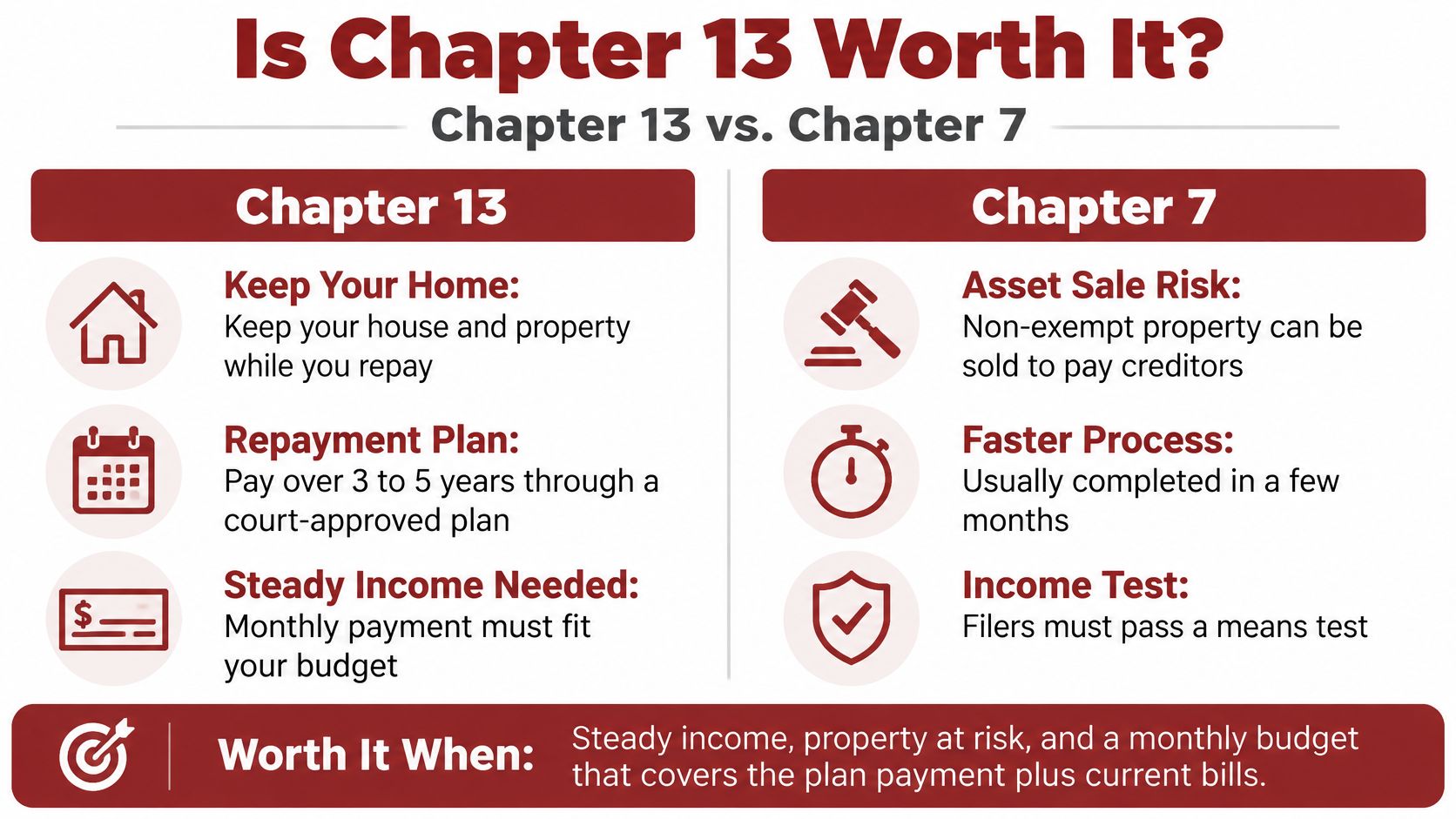
Choose Chapter 13 for a protection problem you can afford to solve, not because your debt feels overwhelming. Its strongest use is giving a household with dependable income time to address missed payments while keeping essential property.
Chapter 7 serves a different purpose. It generally eliminates qualifying unsecured debt without a long repayment plan, but it doesn't give you a lasting mechanism to catch up on a delinquent mortgage.
Chapter 13 versus Chapter 7 on the factors that decide the choice
| Factor | Chapter 13 | Chapter 7 |
|---|---|---|
| Core idea | Repay some or all covered debts through a court-approved plan | Trustee can sell nonexempt assets; qualifying unsecured debts are discharged |
| Typical length | A multiyear repayment commitment | Generally much shorter, without a repayment plan |
| Keep home or car while behind | Possible with an adequate plan and continued required payments | No built-in arrears cure; keeping property requires resolving payment and exemption issues |
| Stop foreclosure | Automatic stay can stop the sale while qualifying arrears are addressed | Stay can provide temporary relief, but doesn't cure the default |
| When debts are discharged | After successful plan completion and other requirements | Generally earlier, after discharge requirements are satisfied |
| Income requirement | Regular income sufficient to fund the plan | Means-test rules apply to most consumer filers |
| Cosigner protection | A co-debtor stay can protect eligible consumer-debt cosigners | No general co-debtor stay |
| Credit report duration | A lasting credit-report consequence | Also a lasting credit-report consequence; generally reported longer |
The U.S. Courts' Judicial Business report recorded 286,027 Chapter 13 filings, approximately 37% of all bankruptcy cases, in the federal fiscal year ending September 30, 2019. That establishes Chapter 13 as a major bankruptcy pathway, not a guarantee that it's right for your household.
The questions that decide the choice
- Income: Do I have dependable income, rather than hoped-for overtime or a possible new job?
- Property: Am I protecting something worth the cost of the plan?
- Endurance: Can I afford the required payments through ordinary bad months?
If you can't answer the last question confidently, don't treat filing as the solution yet. Ask for a Chapter 7 comparison and a realistic discussion about keeping or leaving the property.
How a Chapter 13 Plan Works Month to Month
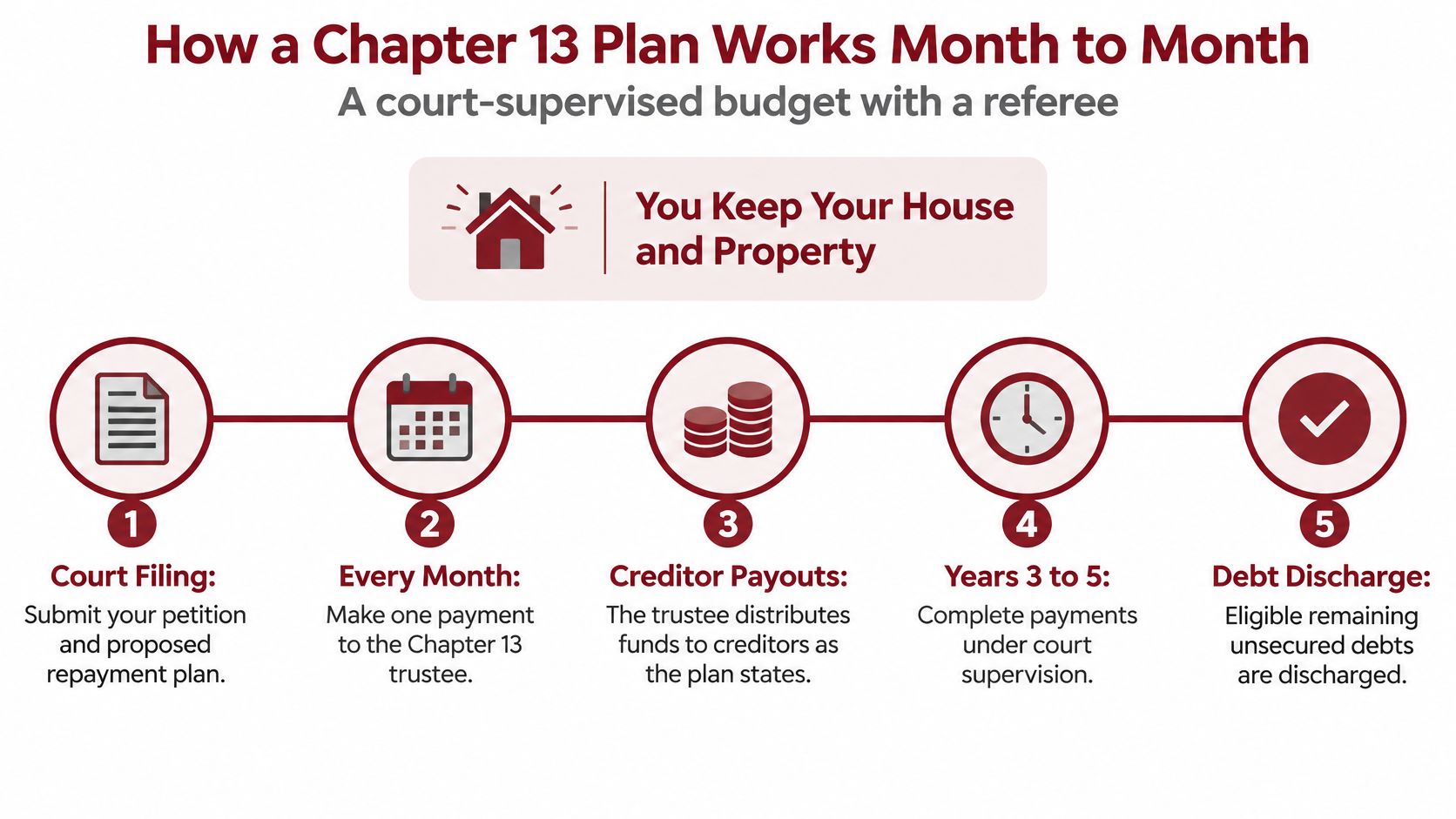
Think of Chapter 13 as a court-supervised budget with a referee. The trustee administers payments under the plan, but you remain responsible for making the household budget work.
For a homeowner, there are separate obligations to track: the old mortgage default and the housing expenses that keep coming due. Bankruptcy can create a way to address the first. It doesn't make the second disappear.
From filing to an approved plan
Filing ordinarily triggers the automatic stay, which stops many collection actions. The U.S. Courts' Chapter 13 Bankruptcy Basics guide explains that plans generally last three to five years, with below-median-income debtors typically using a three-year plan and above-median-income debtors generally facing a five-year commitment.
Your attorney prepares a proposed plan using your income, expenses, property, and debts. You begin making required payments while the court considers confirmation, rather than treating the confirmation hearing as permission to start budgeting later.
The court then evaluates whether the proposed treatment of creditors satisfies bankruptcy requirements. The trustee distributes plan funds according to the approved terms, including the treatment of secured, priority, and unsecured claims.
What your monthly payment actually means
Don't mistake the amount needed to catch up the mortgage for the entire trustee payment. The plan may also need to account for vehicle obligations, priority debts, administrative expenses, and required payments to unsecured creditors.
Likewise, a trustee payment isn't automatically a replacement for your regular mortgage payment. Payment routing can differ by case and local practice, so get written instructions identifying who receives each payment, when it's due, and what it covers.
Practical rule: Before filing, be able to explain your payment schedule without guessing. Know which payment keeps the mortgage current and which payment addresses the bankruptcy plan.
Keep the trustee's payment records, mortgage statements, and bank confirmations together. If the mortgage servicer reports a discrepancy, your attorney needs evidence of what you paid, not just your recollection.
After successful completion and satisfaction of the discharge requirements, eligible remaining debts can be discharged. Until then, missing the current mortgage obligation or the plan payment can expose you to dismissal or renewed foreclosure proceedings. The protection depends on continued performance.
Who Qualifies for Chapter 13
Regular income is the starting point, not an automatic approval. Wages, self-employment earnings, pensions, and qualifying benefits can support a plan, but the amount available after necessary expenses must be sufficient.
A delivery driver doesn't need a conventional salary to have a potentially workable case. The important evidence is a dependable earnings pattern after fuel, maintenance, insurance, taxes, and other business costs, not the gross deposits appearing in a banking app.
Chapter 13 eligibility requirements and red flags
| Requirement | What counts | Red flag |
|---|---|---|
| Regular income | Documented income that can support required payments | Income is absent or too unpredictable |
| Debt limits | Secured and unsecured debts fall within the limits applicable when filing | Debt exceeds eligibility limits and requires another approach |
| Credit counseling | Required briefing from an approved provider within the applicable filing window | Briefing skipped or certificate timing is incorrect |
| Prior Chapter 7 discharge | Attorney checks the prior case and applicable waiting rules | A prior discharge prevents a new discharge |
| Prior Chapter 13 discharge | Attorney checks prior filing and discharge history | The applicable waiting period hasn't expired |
| Tax returns | Required returns are filed and available for review | Missing returns interfere with the case |
| Domestic support | Ongoing support stays current and arrears receive proper treatment | Budget ignores support obligations |
| Plan feasibility | Available income supports the legally required payment | Required payment exceeds the household's capacity |
The issues that need an attorney's review
Debt limits and prior-bankruptcy rules aren't good places to rely on an old search result. Give the attorney your balances, debt types, and prior case documents so eligibility and discharge restrictions can be checked against the rules in effect when you file.
Also distinguish eligibility to file from eligibility for a discharge. A previous bankruptcy can affect the relief available even when another filing is legally possible.
Use the firm's explanation of income and debt qualifications for Chapter 13 bankruptcy in Georgia to organize questions before a consultation. Bring records showing actual earnings and expenses, especially if commissions, seasonal work, or business income affect your budget.
Don't clean up the budget by leaving out inconvenient obligations. Support payments, tax withholding, and business expenses still exist after filing, and your attorney needs them to evaluate feasibility.
Qualifying on paper doesn't establish that Chapter 13 is worth it. A household can satisfy eligibility rules and still be unable to carry the required plan without falling behind again.
Costs, Timeline and Credit Impact
Chapter 13 is cheap to start and expensive to carry. Filing takes a single court payment. Carrying the case takes a trustee payment every month for three to five years, stacked on top of your mortgage and household bills. Judge the decision by that monthly total, not by what it takes to open the case.
Chapter 13 costs, timing and credit items
| Item | Typical amount or timing | Notes |
|---|---|---|
| Filing fee | A single payment due when the petition is filed | Court-approved installments may be available |
| Attorney fee | Part upfront, with remaining fees often paid through the plan | Get a written fee agreement listing included work and possible added charges |
| Trustee fee | A court-set percentage deducted from each plan payment | Ask how the percentage changes your monthly payment |
| Plan length | Three to five years | Income and legal requirements set where you land in that range |
| Confirmation hearing | Held in the months after filing | Plan payments are usually due before the judge approves the plan |
| Ongoing mortgage payment | Every month, starting when the case is filed | Confirm whether payment goes to the servicer or through the trustee |
| Mortgage arrears | Cured across the plan term | Base the number on the lender's claim and supporting records |
| Discharge | After the final plan payment and required completion steps | Finishing the payments is not the only requirement |
| Credit report | Reportable for up to seven years after filing | Check each entry for accuracy after the case closes |
The real cost is the monthly total
Ask for a written estimate that separates the ongoing mortgage, the trustee payment, upfront costs, and anything you still pay outside the plan. Then ask what could push it higher: a creditor filing a claim larger than expected, or a mortgage escrow adjustment that raises the housing line.
Multiplying the proposed payment by the plan term gives you a useful number. Much of that money repays obligations you already owe, so calling the total a bankruptcy cost overstates what filing adds.
The comparison that counts is practical: What will I pay each month, what property will I keep, and what obligations remain afterward? Run that answer against Chapter 7, a mortgage workout, and selling the property.
Then add the mortgage, the trustee payment, and living costs together. A household that cannot carry all three after filing is headed for a failed plan, whatever the upfront fee was.
A low advertised payment isn't a complete plan estimate. Ask what it includes and what still comes out of your checking account.
Treat credit rebuilding as a separate task
A Chapter 13 stays on your credit report for years, and that fact alone should not push you into a repayment plan your income cannot support. No responsible attorney will promise a specific score increase or recovery date.
Once the budget is stable, work on accurate reporting, on-time payments, and avoiding new debt you cannot carry. ThriveXDNA's guide can help you find ways to boost your credit. Discuss any borrowing during an active case with your attorney before applying.
Stability comes first. Credit scores recover faster when you are no longer choosing between the mortgage and groceries.
Stress-Testing Whether You Can Keep Paying
The biggest risk isn't that Chapter 13 sounds complicated. It's that the proposed plan requires money your household won't consistently have.
The U.S. Courts' 2025 bankruptcy report recorded 101,709 dismissals and 82,099 discharges after plan completion among Chapter 13 consumer cases closed by dismissal or completion; failure to make plan payments was cited in 50% of dismissals. These are outcomes for cases closed during the reporting year, not the success rate of everyone who filed that year.

Build the budget from records
Use bank statements and pay records instead of estimates based on a good month. If formal records are needed to document income, BankStatementWizard explains how to request certified bank statements.
- Start with take-home income: Separate dependable earnings from overtime, bonuses, and irregular deposits.
- Subtract housing and the plan: Include the mortgage, trustee payment, taxes, insurance, and association obligations without double-counting escrowed expenses.
- Include ordinary living costs: Food, utilities, transportation, phone service, prescriptions, and childcare belong in the budget.
- Account for irregular expenses: Vehicle maintenance, school expenses, and insurance renewals don't stop because you filed.
- Leave a reserve: A budget that uses every available dollar has no practical cushion.
Review how a Chapter 13 bankruptcy payment plan is calculated in Georgia alongside your records. A legally required payment and an affordable payment aren't necessarily the same amount.
Test a bad month before committing
Suppose your budget works only while overtime continues. Remove that overtime and add a necessary car repair. If you must miss the mortgage, use new credit, or borrow from family to cover the difference, the plan needs more scrutiny.
Budget test: If keeping the house requires every month to go well, don't call the plan affordable.
Ask your attorney what happens after reduced hours, an income interruption, or a major medical expense. A modification may be available in some cases, but it requires legal review and isn't guaranteed to solve an underlying income shortage.
Contact counsel as soon as trouble becomes foreseeable, preferably before a payment is missed. Don't assume you can lower or skip payments yourself while waiting for the court to approve a change.
Scenarios Where Chapter 13 Wins or Loses
A Georgia homeowner with a foreclosure notice and dependable wages faces a different decision from a renter whose debts are mostly credit cards. The homeowner may need time to repair a temporary default; the renter may need a discharge without an unnecessary repayment commitment.
The U.S. Courts' bankruptcy filings announcement recorded 219,116 Chapter 13 filings compared with 391,386 Chapter 7 filings in the year ending September 30, 2026. Those totals show use of both approaches, not which chapter will work for a particular household.
Verdict by common Chapter 13 situation
| Situation | Chapter 13 fit | Verdict |
|---|---|---|
| Mortgage behind, sale not yet held, steady income | Strong potential to address arrears | Worth considering if the complete payment is affordable |
| Foreclosure sale already completed | The cure opportunity may be lost | Obtain immediate advice about remaining options |
| Cosigner on a car loan or credit card | Eligible consumer debts may receive co-debtor protection | Review the loan and proposed repayment treatment |
| Recent income tax debt that is a priority claim | Plan can structure payment of priority obligations | Compare required repayment with other available remedies |
| Wholly underwater second mortgage on a Georgia home | Requires lien-specific legal analysis | Don't assume it must remain or can automatically be removed |
| Irregular or self-employed income | Possible with reliable documentation | Use net earnings and a conservative income pattern |
| Large nonexempt equity in property | Property retention may require substantial creditor payments | Compare the plan cost with the equity protected |
| Mostly unsecured debt, no property at risk | Often a weaker reason to choose repayment | Evaluate Chapter 7 first |
Don't buy a plan for the wrong problem
A temporary income disruption followed by restored earnings is a stronger starting point than a permanent gap between income and housing costs. Chapter 13 can provide time, but time alone won't make an unaffordable mortgage sustainable.
Be especially careful about junior mortgage advice. Rules governing lien treatment differ between bankruptcy chapters, and a categorical claim that an underwater second mortgage can never be stripped in Chapter 13 is not a sound basis for deciding.
Before committing, compare these alternatives:
- Mortgage assistance: Ask the servicer about modification, forbearance, and available loss-mitigation review. Don't assume an application postpones a sale.
- Debt management: A nonprofit credit counseling agency may help with unsecured credit cards when the housing payment is otherwise manageable.
- Property exit: Selling or surrendering the home may be financially better than committing to payments you can't sustain.
- Chapter 7: Consider liquidation relief if eligible and if property consequences are acceptable.
Timing changes the decision. If a sale is approaching, review how long Chapter 13 can delay foreclosure and have an attorney verify the actual deadline rather than relying on negotiations with the lender.
Georgia Rules That Change the Math
Georgia property exemptions, foreclosure procedure, and local bankruptcy practice affect whether retaining your home is financially realistic. Don't calculate your plan using a national exemption chart or a neighbor's case.
Georgia generally requires eligible residents to use its state bankruptcy exemptions rather than choosing the federal bankruptcy exemption list. Your attorney should verify which exemption system applies to you, particularly if you moved between states.

Equity changes the required payment
Home equity isn't the home's sale price. Start with a supportable value and subtract relevant liens; your attorney then evaluates exemptions and the liquidation analysis.
Nonexempt equity can increase what unsecured creditors must receive through a plan. A homeowner can therefore have modest income but still face a substantial required payment because of property value.
- Verify ownership: Bring the deed and identify everyone who holds an interest.
- Document liens: Include mortgage balances, junior loans, judgments, and tax liens.
- Support the value: Give counsel recent valuation information and explain condition issues that affect marketability.
- Check exemptions: Have the attorney apply current law to your ownership, residency, and filing circumstances.
The foreclosure notice is a deadline document
Georgia lenders commonly use nonjudicial foreclosure procedures. That makes it dangerous to wait for a court hearing or lawsuit that may never arrive before the sale.
Give your attorney the complete notice, including the advertised sale information and the party handling foreclosure. Filing after a completed sale may not restore the opportunity you were trying to preserve.
Local administration also matters. Athens–Clarke County cases are handled in the Middle District of Georgia, and counsel should confirm trustee requirements, payment routing, and how mortgage information must be supplied.
Ask about wage garnishment if it's reducing your available income. The automatic stay generally stops many collection actions, but support-related collection and other exceptions require individual review.
The useful Georgia-specific question is not merely, “Can I keep my house?” Ask instead: “After applying the correct exemptions, lien treatment, and local payment requirements, what must I pay to keep it?”
Decide Whether to Book a Chapter 13 Consultation
If a foreclosure sale is approaching, confirm the sale date before spending more time comparing general bankruptcy information. Call a bankruptcy attorney promptly and state that deadline at the beginning of the conversation.
A consultation is worthwhile when you need a concrete payment estimate, an exemption analysis, or an answer about whether the home can still be protected. It doesn't obligate you to file.
Gather the records that make advice useful
Bring tax returns, recent pay statements or income records, mortgage statements, and every foreclosure notice. Include a debt list showing balances, collateral, and cosigners, plus a current credit report and a realistic household budget.
For self-employment, bring business expenses as well as deposits. For an adjusted mortgage payment, bring the escrow analysis or notice explaining the change.
Follow an ordered decision process
- Verify the property deadline. Have counsel establish whether the sale has occurred and what filing timing would be required.
- Confirm counseling requirements. Ask which approved briefing you need and when to complete it.
- Prepare the cash-flow test. Use actual records and identify expenses you've been postponing.
- Request competing options. Ask for a proposed Chapter 13 payment, a Chapter 7 comparison, and any realistic non-bankruptcy route.
- Get the remaining obligations in writing. Understand what you must pay outside the plan and what could change after filing.
Ask direct questions during the appointment: Does the estimate include all known claims? What happens if the mortgage payment increases? What property could be at risk under Chapter 7? What would make you advise against Chapter 13?
You should leave understanding the recommendation, not just knowing that filing is available. If the budget fails, a different route may protect your household better than an ambitious plan that ends in dismissal.
Is Chapter 13 bankruptcy worth it? Yes, when it buys a sustainable way to protect something important. No, when it merely postpones a financial problem your future income can't solve.
Morgan & Morgan Attorneys at Law P.C. offers free consultations, direct access to attorneys, virtual appointments, and help gathering bankruptcy records. Visit Morgan & Morgan Attorneys at Law P.C. to request a review of your mortgage deadline, household budget, and Chapter 13 options, including whether Chapter 7 or a non-bankruptcy solution makes more sense.

Lee Paulk Morgan
With more than 41 years of experience in the areas of Bankruptcy, Disability, and Workers’ Compensation, Lee Paulk Morgan is one of the most respected Bankruptcy and Disability attorneys in Athens, Georgia. His tireless dedication to serving clients has gained him the reputation of a premier attorney in his areas of practice, as well as the trust and respect of other legal experts, who often refer clients to him.
SHARE
RELATED POSTS

I Am Drowning In Debt (What Are My Options in Georgia)
You’re sitting at the kitchen table after work, opening mail you have put off for days. A credit card statement shows a minimum payment you can’t cover, a medical bill has gone to collections, and…

Can Bankruptcy Stop Wage Garnishment in Georgia
Yes, bankruptcy can usually stop a wage garnishment the moment the case is filed because the automatic stay takes effect immediately. But that answer has limits: child support, federal student loans, and certain tax debts…