
Blog

Can I Be Jailed for Credit Card Debt? What Georgia Law Says
Generally, no: unpaid credit card debt is a civil matter, not a crime. Jail exposure comes from separate conduct around the debt, such as willfully ignoring a lawful court order or committing fraud, not from being unable to pay.
But the familiar advice that you can't go to jail for debt leaves out the paperwork that matters most. For an Athens–Clarke County household, the more immediate danger is often an unanswered lawsuit becoming a judgment that allows a creditor to reach eligible wages or bank funds.
The Short Answer on Jail and Credit Card Debt
A missed card payment doesn't authorize a creditor to send police to your home. A credit card account creates a contractual obligation, and a creditor generally must use civil collection procedures to enforce it.
That distinction doesn't make the balance harmless. Interest, late fees, collection activity and credit damage can strain a household before anyone files a lawsuit. If a creditor obtains a judgment, additional collection methods may become available under applicable law.
The crucial distinction: Owing money is different from disobeying a court order or deliberately deceiving someone to obtain money.
Say you used a card for groceries and car repairs, then lost your job. You can't make the payment, even though you intended to repay the purchases. That's a financial hardship involving a civil debt, not proof of a crime.
Now consider a different situation: someone opens an account using another person's identity. The resulting balance may appear on a credit card statement, but prosecutors would be concerned with the identity theft or deception, not merely the unpaid bill.
Civil consequences deserve attention
For consumers asking, “Can I be jailed for credit card debt?” reassurance should come with a practical next step: identify whether you're dealing with an account problem, a lawsuit or an actual court order. Those documents call for different responses.
Bankruptcy is also a formal legal option, not an admission of criminal wrongdoing. According to the U.S. Courts' bankruptcy report, nonbusiness bankruptcy filings reached 533,337 in the 12 months ending September 30, 2025, about 96% of all U.S. bankruptcy petitions.

You don't need to solve the whole balance before opening an envelope. Start by separating collection requests from court papers, and keep every page, including envelopes and attachments. A lack of money doesn't prevent you from checking a deadline, attending a required hearing or asking for legal help.
Which Situations Can Lead to Jail
Credit card situations and whether jail is possible
| Situation | Legal category | Jail possible? | Main practical risk |
|---|---|---|---|
| Missed or late card payments | Civil contract debt | No, not for nonpayment alone | Interest, fees, collections and possible lawsuit |
| Ignoring a lawsuit summons | Civil procedure | Not for the debt itself | Default judgment and garnishment |
| Ignoring a court order to attend a debtor examination | Contempt of court | Yes, possible | Contempt proceedings for willful refusal after a lawful order |
| Using a card with knowingly false information | Possible fraud | Yes, if prosecuted and the offense is proved | Criminal charges based on deception |
| Knowingly issuing payments that will bounce | Possible criminal offense | Possible where criminal law covers the conduct and intent is proved | Charges based on intent to deceive |
| Collector threatens arrest over the balance alone | Unlawful threat | No, not because the collector demands it | Pressure to pay; preserve and report the messages |
The first and last rows can feel equally frightening, but they describe different actors. In the first, a consumer hasn't paid a contractual obligation. In the last, a collector is using a threat that doesn't create lawful arrest authority.
The Federal Trade Commission's debt-collection guidance states that debt collectors cannot have consumers arrested because of consumer debt. An aggressive voice, an official-sounding title or a demand for immediate payment doesn't change that rule.
A failed payment isn't automatically fraud
A payment can fail because a paycheck arrived late, a deposit was reversed or the consumer miscalculated the available balance. Those facts aren't interchangeable with intentionally issuing a worthless payment to deceive someone.
Similarly, an account becoming unaffordable doesn't establish that the application was fraudulent. A criminal allegation requires separate misconduct and proof of the relevant offense. Don't accept a collector's accusation as a legal finding.
Classify the conduct before reacting
Ask what the person contacting you claims happened:
- Money is owed. That ordinarily describes a civil collection dispute.
- A required court appearance was missed. Find the actual order and contact the court or an attorney promptly.
- Someone alleges deception. Preserve the application, account records and communications, and get legal advice before giving a detailed statement.
- A caller demands payment to prevent arrest. Verify the caller independently rather than paying under pressure.
A summons also shouldn't be confused with an arrest warrant. It ordinarily notifies you of a civil case and tells you how to respond. Ignoring it can create serious financial consequences without turning ordinary nonpayment into a crime.
Save threatening voicemails, screenshots, letters and payment instructions. Record the caller's claimed name and company, then report threats about arrest for nonpayment alone to regulators. Don't delete a message just because it's upsetting.
Georgia Law on Debt, Contempt and Ability to Pay
Georgia's constitutional protection against imprisonment for debt separates an unpaid obligation from independent wrongdoing. It doesn't give someone immunity for fraud when the fraud also produces a debt.
The Georgia Supreme Court's decision addressing the imprisonment-for-debt distinction explains that the protection bars prosecution based solely on failure to repay, but doesn't prevent punishment for criminal conduct such as obtaining money through fraud. The unpaid balance and the alleged deception are legally different issues.
Ability and willfulness answer different questions
Ability to comply concerns what someone can do. Willfulness concerns whether they deliberately refused to do something the court lawfully required.
The type of order matters. Someone who has no money may be unable to make a payment but still able to attend a hearing, answer financial questions or provide records. Financial hardship doesn't excuse every obligation connected with a case.
Court-ordered support illustrates why these categories must stay separate. Refusing support despite having the ability to comply can raise contempt concerns, but a support obligation isn't an ordinary credit card contract. That example doesn't authorize a creditor to imprison a consumer who lacks money to pay a card judgment.
Poverty and deliberate disobedience aren't the same thing. Explain an inability to comply through the court process rather than assuming silence will communicate it.
The same judgment, different conduct
Consider Georgia residents with comparable credit card judgments.
One has lost employment and receives an order to attend a financial examination. They attend, answer truthfully, and bring records showing their income and necessary expenses. Their inability to pay doesn't become intentional defiance merely because the creditor remains unpaid.
The other receives a lawful examination order, understands it, and deliberately refuses to attend. Even if that person has money, the immediate contempt concern is the refusal to obey the appearance order, not the existence of the judgment.
These examples don't predict a particular court's decision. Service, the wording of the order, the person's circumstances and the procedure used all matter.
Prepare a practical document packet:
- Income records. Bring pay statements, benefit information or evidence of unemployment.
- Necessary expenses. List housing, utilities, food, transportation and dependent-care costs.
- Hardship evidence. Include relevant medical expenses, termination notices or other records explaining changed circumstances.
- The court papers. Keep the complete order, notices and any written request for accommodation or rescheduling.
A valid, properly served court order is a point where the legal analysis changes. Read what it requires. If compliance is impossible, seek instructions or relief promptly rather than choosing not to appear.
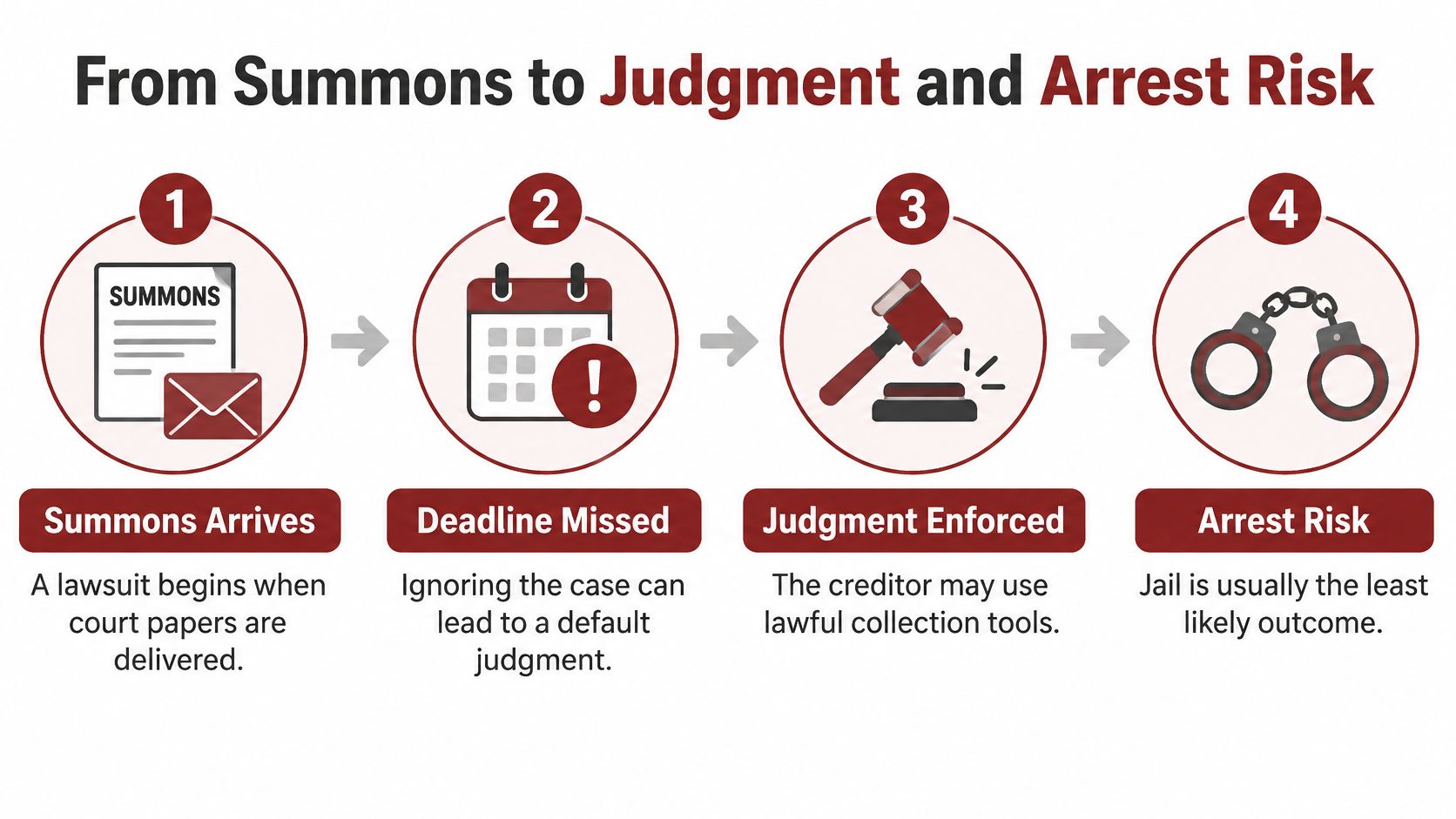
From Summons to Judgment and Arrest Risk
Jail is usually the least likely outcome of an ordinary card default. An unnoticed lawsuit becoming an enforceable judgment is the more immediate financial concern.
Collection litigation isn't limited to accounts consumers consider substantial. WGBH reported that Massachusetts consumer-debt cases reached about 146,000 filings in 2025, more than 60% above the level two years earlier. That's a Massachusetts court trend, not a measure of Georgia filings, but it illustrates why assuming a creditor won't sue is unsafe.
How the process can escalate
- A lawsuit is filed and papers are served. The complaint states the claim; the summons gives instructions for responding. Putting them aside doesn't stop the case.
- The response deadline arrives. A timely response preserves the opportunity to contest the claim. Silence risks a default judgment.
- The court enters judgment. A creditor may then pursue lawful enforcement, including garnishment of eligible wages or bank funds. Applicable protections and exemptions still matter.
- Financial disclosure may be required. The creditor may seek a court order requiring an examination or information about assets and income. This is a separate obligation from paying the balance.
- The debtor attends or seeks court-approved relief. If attendance is impossible, request rescheduling promptly and confirm whether the request was granted. A payment discussion with the creditor doesn't automatically excuse attendance.
- Willful disregard can lead to contempt proceedings. A warrant may become possible through that process. It isn't an automatic consequence of losing the lawsuit.
Goodwin's debt-collection review discusses alleged collection schemes involving arrest threats and other pressure tactics. A collector's warning isn't proof that any of these court stages has occurred.
Identify the document before choosing a response
A collection letter requests payment or communicates about an account. A summons concerns a filed lawsuit. A subpoena may require testimony or documents, while an examination order directs participation in a court-authorized financial inquiry.
Check the court name, case number, parties and filing information. Look up the docket through the court's official resources or contact the clerk using independently verified contact information. Don't rely exclusively on the telephone number supplied by an unfamiliar caller.
For practical response preparation, use our guide to responding to a debt-collection lawsuit in Georgia.
Georgia limitation periods for suing on debt
| Debt type | Typical Georgia limit to sue | What it means for you |
|---|---|---|
| Written contract | Six years for most written-contract debts | Keep the agreement and statements; have the correct classification checked |
| Open account or oral agreement | Commonly four years | Don't assume a credit card claim belongs in this category |
| Judgment after a lawsuit | Separate judgment-enforcement rules apply | Review the judgment and enforcement history |
The contract category matters, especially for credit cards. Don't assume an account is legally an open account just because you used revolving credit.
A limitation defense generally needs to be raised through the proper procedure. Before responding, identify which document requires action, what to do if you can't attend and whether the court has approved rescheduling.
Your Consumer Rights When a Collector Calls
A collection call doesn't require you to accept the claimed balance or disclose bank information immediately. Start by identifying who's collecting and requesting written account information.
Keep control of the conversation
- Request the validation information. Review the creditor's identity, the amount claimed and the notice's instructions for disputing the debt.
- Use the stated dispute procedure promptly. Request verification in writing and keep proof of delivery. Don't substitute a telephone argument for a documented dispute.
- Consider a written stop-contact request. It can limit collection communications, but it doesn't erase the debt or prevent a lawful lawsuit.
- Document misrepresentations. Record claims about the caller's authority, your balance or supposed legal consequences.
- Keep a contact log. Save dates, times, names, messages and copies of your replies.
The Fair Debt Collection Practices Act generally governs third-party debt collectors; an original creditor collecting its own account may fall under different rules. Identify the company's role rather than assuming every caller has the same obligations.
A dispute and a court response are separate tasks
Sending a verification request doesn't replace an answer to a lawsuit. If court papers arrive during a dispute, handle the court deadline independently.
Our guidance on legally stopping debt-collector calls in Georgia explains practical communication options. For unwanted texts more broadly, Gini Help's spam text law guide for older adults provides additional context; a spam complaint isn't a substitute for responding to genuine court papers.
Report unlawful collection conduct to the FTC and Georgia's attorney general. A clear record of what was said, by whom and when makes a complaint more useful than a general description of harassment.
Bankruptcy and Defenses That Stop Collection
Bankruptcy and defense options compared
| Option | Stops collection? | Credit card outcome | Key limit |
|---|---|---|---|
| Chapter 7 liquidation | An automatic stay generally stops most collection, subject to exceptions | Eligible credit card debt is typically discharged | Discharge exceptions apply; nonexempt assets may be sold |
| Chapter 13 repayment plan | Can stop garnishment, foreclosure and repossession | Eligible remaining unsecured debt may be discharged after successful completion | Required payments must be maintained; falling behind can prompt a dismissal motion |
| Negotiated settlement | No automatic stop | Partial payoff or other agreed resolution | Creditor must agree; obtain written terms |
| Responding to a lawsuit | Can prevent default based on failure to answer | Outcome turns on the claim, evidence and defenses | Filing a response doesn't automatically defeat the claim or stop all proceedings |
Match the remedy to the problem
Bankruptcy addresses more than a single collection letter. Filing generally triggers an automatic stay, which restricts most collection activity, subject to exceptions. A stay pauses collection; a discharge determines which qualifying obligations no longer have to be paid.
In Chapter 7, credit card debt, medical bills and unsecured loans are typically discharged. Nonexempt property may be available to pay creditors, so asset review belongs before filing, not afterward.
Don't assume all debts receive the same treatment. Support obligations remain payable, and taxes and student loans have special discharge rules that require individual analysis. Alleged fraud can also complicate whether a particular card balance is dischargeable.
Chapter 13 uses an income-based repayment structure. It can address threats to a home, vehicle or paycheck while the filer deals with debts through the plan. It can also provide time to catch up on support, but it doesn't discharge child support.
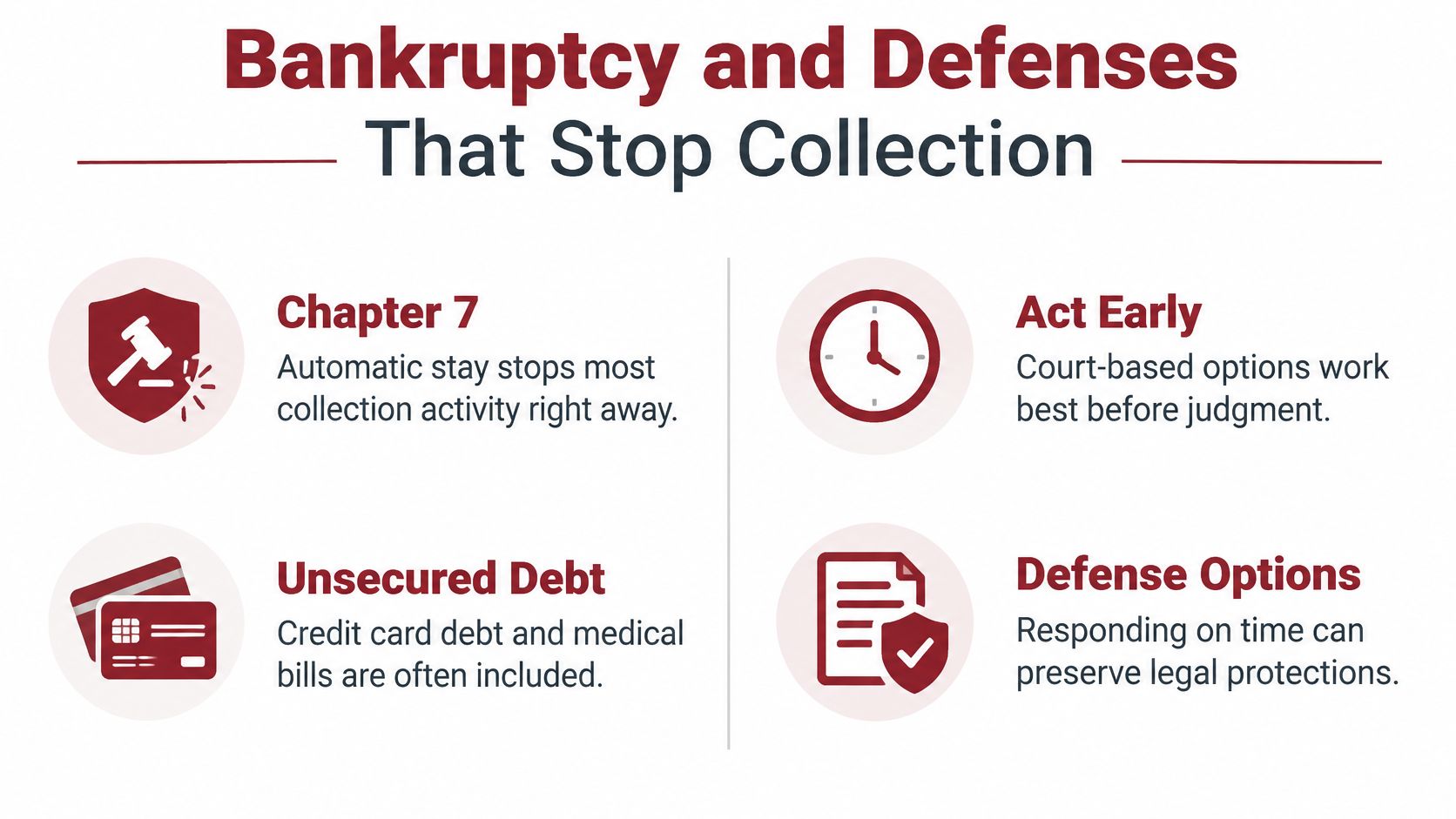
Defending a claim and resolving a balance aren't identical
A lawsuit response lets you address whether the plaintiff can prove ownership of the account, the amount requested and its right to recover. Relevant records include statements, payment confirmations, account agreements and documents identifying any debt buyer.
A written settlement serves a different purpose. It resolves an obligation by agreement rather than asking the court to reject the claim. Before paying, confirm the amount, payment schedule, treatment of the remaining balance and what will happen to any pending lawsuit or judgment.
Before signing: Make sure the written agreement describes the result you expect. A payment receipt alone may not establish that the entire account is settled.
For bankruptcy-specific questions, our explanation of whether credit card lawsuits can be discharged in bankruptcy can help you prepare for an attorney discussion.
An organizational tool such as LegesGPT's AI legal assistant may help you turn your documents into a question list. Don't use generated answers to calculate a filing deadline or decide whether a court order can be ignored.
Bankruptcy isn't a cure-all, and filing merely to rebuild credit is rarely a sound reason. A disputed account may call for a defense; an affordable isolated debt may suit negotiation; widespread unmanageable debt may justify a broader bankruptcy review.
Confirm Your Court Deadlines and Call an Attorney
Check the court papers before negotiating with a caller. An attorney can evaluate options more effectively when you bring the actual documents rather than a recollection of what someone said.
Prepare for the conversation
- Collect every court paper. Identify the court name, case number and response or appearance instructions.
- Calendar the obligations. Include hearings and document-production requirements, not just payment dates.
- Arrange a timely response. Disputing the account doesn't excuse missing the court's procedure.
- Gather financial records. Bring income, expenses, account statements and collection messages.
- Flag urgent complications. Mention garnishment, an examination order, arrest threats, joint or co-signed debt, support obligations and any pending foreclosure.
What a consultation can clarify
At Morgan & Morgan Attorneys at Law P.C. in Athens, Georgia, we offer a free consultation for people dealing with collectors or questions about debt collection. That conversation can clarify what a document requires, which defenses need review and whether bankruptcy deserves consideration.
Our FAQ describes a bankruptcy process involving a free consultation, a first credit counseling course, a second credit counseling course and a next appointment. Course timing and your next steps should be confirmed for your case; we also offer in-house credit counseling.

This article provides general information, not legal advice for your circumstances. Bring any served summons or court order to an attorney promptly, particularly if a deadline is approaching.
Morgan & Morgan Attorneys at Law P.C. offers free consultations about debt collection and helps consumers evaluate debt relief options. If you're worried about a credit card lawsuit, garnishment or a threatening collector, visit Morgan & Morgan Attorneys at Law P.C. to discuss your papers and the next step for your situation.

Lee Paulk Morgan
With more than 41 years of experience in the areas of Bankruptcy, Disability, and Workers’ Compensation, Lee Paulk Morgan is one of the most respected Bankruptcy and Disability attorneys in Athens, Georgia. His tireless dedication to serving clients has gained him the reputation of a premier attorney in his areas of practice, as well as the trust and respect of other legal experts, who often refer clients to him.
SHARE
RELATED POSTS

I Am Drowning In Debt (What Are My Options in Georgia)
You’re sitting at the kitchen table after work, opening mail you have put off for days. A credit card statement shows a minimum payment you can’t cover, a medical bill has gone to collections, and…

Can Bankruptcy Stop Wage Garnishment in Georgia
Yes, bankruptcy can usually stop a wage garnishment the moment the case is filed because the automatic stay takes effect immediately. But that answer has limits: child support, federal student loans, and certain tax debts…