
Blog

Do Wage Garnishments Show On Credit Report in 2026
A wage garnishment generally doesn’t appear as its own item on Equifax, Experian, or TransUnion credit reports. The comparison table below separates the paycheck deduction from the debt records that may still appear.
If there’s no garnishment entry, why is your employer still taking money out? Because your credit file and the legal authority to collect a debt are different records. A clean-looking report isn’t a release of the order your payroll department received.
Do Wage Garnishments Show on a Credit Report
What shows on a credit report when wages are garnished
| Record | On Equifax, Experian, and TransUnion | Typical reporting period | Enforceable if missing from the report |
|---|---|---|---|
| Wage garnishment order | No separate tradeline | Not reported as its own item | Yes, withholding can continue |
| Civil judgment | Generally absent under current public-record practices | Removed under public-record standards | Yes, subject to applicable enforcement rules |
| Tax lien | Generally absent from standard consumer reports | Not an account-reporting timeline | The lien can remain legally effective |
| Collection account | May appear | Account-reporting rules control | Absence alone doesn’t cancel collection authority |
| Charge-off | May appear | Delinquency-reporting rules control | Charging off an account doesn’t itself forgive it |
| Late payments on the original account | May appear | Payment-history reporting rules control | The debt can still be collected if legally enforceable |
| Chapter 7 bankruptcy | May appear | Bankruptcy-reporting rules control | A discharge eliminates eligible debts |
| Chapter 13 bankruptcy | May appear | Bankruptcy-reporting rules control | The plan, court orders, and discharge control collection |
Think of a credit report as an account ledger, not a copy of your paycheck. Creditors and collectors supply information about accounts, balances, and payment status. Your employer’s deduction is a collection step, not normally another credit account.
The public-record rules also changed. Beginning July 1, 2017, stricter matching standards took effect, and the Consumer Financial Protection Bureau’s review of public-record removals reported that all civil judgments and nearly half of tax liens were removed after those standards began.
That change explains why someone searching a credit report may not find the judgment connected to an active garnishment. It doesn’t mean the court vacated the judgment, the creditor forgave the balance, or payroll received permission to stop withholding.
Separate the deduction from the account
The original creditor’s account may show missed payments or a charge-off. A collector may report a collection account associated with that debt. Those are the entries to inspect when you’re trying to understand the credit consequences.
The CFPB’s explanation of payday-loan garnishment describes garnishment as a legal collection process involving wages or a bank account. That process requires a different response from correcting an account entry.
Practical rule: Don’t ask only whether the garnishment appears. Ask which account is being reported and which order authorizes the deduction.
A missing judgment entry can be especially confusing when a collector still demands payment. Our explanation of civil judgments and credit reports in Georgia addresses why credit-report visibility isn’t the same as responsibility for a judgment.
What to search for instead
Obtain your reports from Equifax, Experian, and TransUnion, then compare the account details rather than searching only for the word garnishment.
- Creditor and collector names: Identify the original account and any company now collecting it.
- Balance and status: Check whether the account is shown as unpaid, paid, settled, or otherwise resolved.
- Dates and ownership: Look for unfamiliar accounts, conflicting dates, and information belonging to someone else.
Keep copies of what you find. They’ll help you distinguish an account-reporting problem from a problem with the withholding order.
How the Debt Judgment and Paycheck Fit Together and How Long They Last
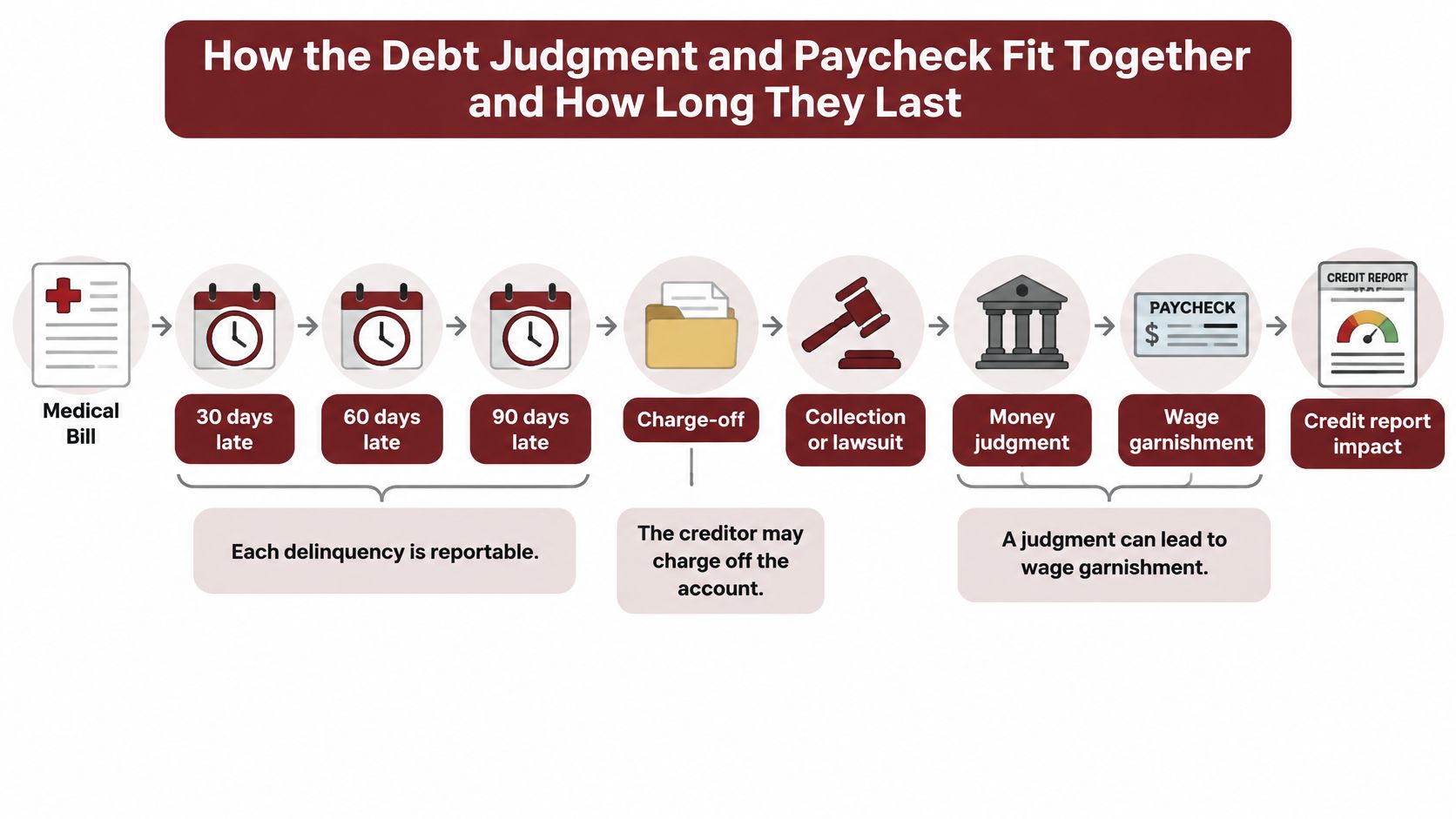
Say you receive a medical bill you can’t afford. You question the insurance adjustment, put the bill aside, and later receive a collection notice. Eventually, a lawsuit arrives.
That sequence can produce separate records with different purposes. The account records what the provider says you owe. The judgment records what a court decides. The garnishment directs collection from earnings. None should be treated as a substitute for the others.
Follow the bill through the legal process
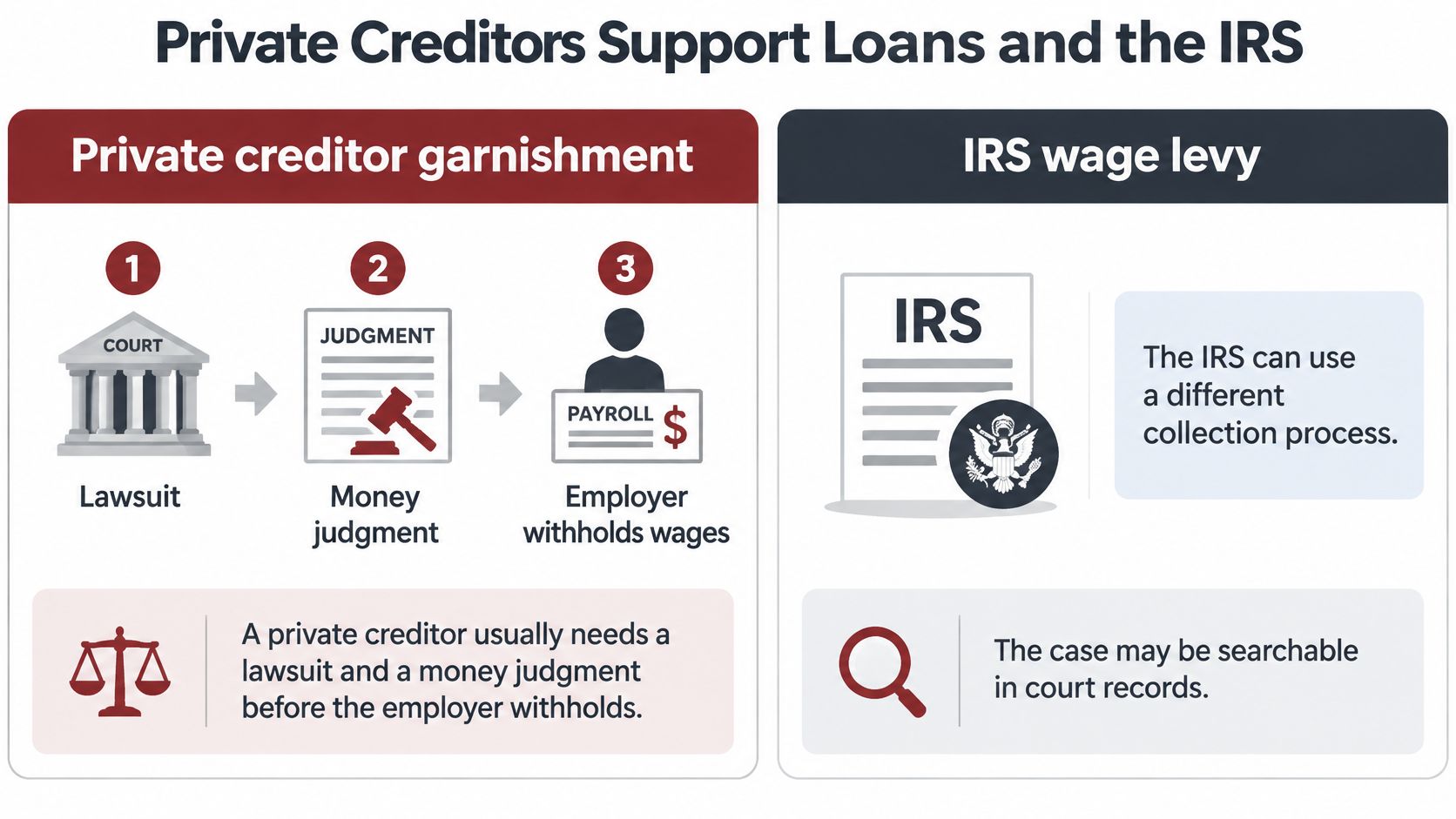
An unpaid bill doesn’t automatically become a garnishment. For an ordinary private debt, the creditor generally must bring a lawsuit, obtain a money judgment, and pursue the legal process that reaches your employer.
A charge-off is different. It describes the creditor’s accounting treatment of an unpaid account, not a court finding that the debt is valid or an announcement that the debt has disappeared. Sending the account to a collector is another collection step, not itself permission to take wages.
Medical bills also require care when reviewing credit information. Don’t assume every unpaid medical bill, or every stage shown in a general debt timeline, necessarily appears on a consumer report. Inspect the actual entry and determine whether it should be reported.
Once a court enters a judgment, the creditor may pursue authorized enforcement. A lien against property and an order withholding wages aren’t interchangeable, either. Ask for the document that explains the action being taken.
The reporting clock isn’t the collection clock
For reportable negative account information, the LegalClarity guide to locating garnishment records explains that late payments, charge-offs, and collections generally remain for up to seven years from the original delinquency date. That reporting period doesn’t establish how long a particular judgment remains enforceable.
Paying an account can change its balance and status without automatically removing accurate historical information. Likewise, an account aging off a report doesn’t itself establish that a court order has expired.
A credit-report deadline tells you about reporting. It isn’t a payroll instruction and isn’t a court order.
A lender reviewing an application may also examine documents beyond the credit report. A paystub showing a deduction can raise questions about available income even when the report contains no corresponding public-record entry. Court records may answer questions the credit file can’t.
Match the records without assuming they’ll look identical
Put the creditor’s account statement, any collection notice, and the court paperwork beside your credit reports. Names may differ because a collector or debt buyer is involved, but you should be able to trace which obligation the documents concern.
Use a simple checklist:
- Account identity: Does the original creditor match the bill you recognize?
- Balance explanation: Can the creditor explain payments, interest, fees, and the amount still claimed?
- Case connection: Does the judgment identify the obligation now being collected?
- Payroll connection: Does the withholding paperwork identify that case or an issuing agency?
If account information is inaccurate, Experian’s credit-dispute guidance provides a route for challenging the credit entry. Send supporting documents and describe the specific error rather than asking to remove everything associated with the garnishment.
Keep the court or agency issue separate. A successful reporting dispute doesn’t, by itself, direct your employer to release withheld wages.
Private Creditors Support Loans and the IRS
Start with the sender’s name on the payroll paperwork. A credit card collector, a support agency, a federal student-loan holder, and the IRS don’t necessarily use the same process.
That difference matters more immediately than whether a deduction appears on your report. The issuing authority determines where you object, which protections apply, and what paperwork can change the withholding.
Garnishment source, credit visibility, and where to respond
| Source | Usual path | Credit-report visibility | Ordinary cap | Where to respond |
|---|---|---|---|---|
| Private creditor | Lawsuit, judgment, then employer order | Order and judgment usually absent; the underlying account may show | Ordinary creditor limits based on disposable earnings and a protected earnings threshold | Issuing court and payroll |
| Child support | Court or support-agency order | Withholding isn’t an ordinary credit-account entry | Support-specific withholding rules | Support agency or court |
| Federal student loans | Administrative collection may proceed without a new lawsuit | A civil judgment isn’t necessarily required; account information may show | Applicable federal administrative garnishment rules | Holder or agency identified in the notice |
| IRS | Administrative wage levy | Payroll withholding isn’t a normal tradeline | IRS levy exemptions and applicable tables | IRS contact and appeal process stated in the notice |
The Crowned Credit discussion of garnishment processes distinguishes court-based collection from federal administrative collection. For Georgia workers facing ordinary creditor garnishment, it describes the general maximum as the lesser of 25% of disposable earnings or the amount above the applicable statutory threshold.
Don’t apply that ordinary-creditor limit to every deduction. Support obligations and federal collections require their own review.
Choose the response that matches the notice
A state-court objection won’t necessarily address an IRS levy. Searching county court records may also fail to explain an administrative student-loan deduction because the agency may not have obtained a new civil judgment.
For a student-loan notice, Omni Tax Help’s resource on protecting paychecks from student loan collections can help you identify issues to discuss before choosing a response. Confirm the holder, the collection authority, and the hearing instructions in your own paperwork.
The immediate harm may be cash flow, not a new credit entry. A smaller paycheck can leave you short for groceries, rent, utilities, or another bill. A bank-account levy can create a separate problem that needs separate attention.
Before sending money or filing a form, ask payroll for the complete notice. Identify the issuing court or agency, the reference number, the amount requested, and the response instructions. Don’t assume that every deduction labeled garnishment follows the same rules.
Georgia Paycheck Limits and Where the Case Is Filed
Suppose your weekly disposable earnings are $500. To test the deduction, payroll must compare the ordinary percentage limit with the amount available above the protected earnings threshold. Your gross salary alone won’t tell you whether the calculation is correct.
Disposable earnings means earnings remaining after legally required deductions. That isn’t necessarily the amount deposited into your account after every voluntary benefit election or other payroll deduction.
Check the calculation before accepting the result
Ask payroll to show the earnings figure it used and the deductions it treated as legally required. Then ask how it applied the protected earnings threshold and whether other withholding orders affected the calculation.
In this hypothetical paycheck review, you’re checking the method, not assuming that a particular deduction is lawful. You also need to know whether the order concerns an ordinary private debt, support, or a federal collection.
- Start with earnings: Use the pay period covered by the actual withholding.
- Check required deductions: Don’t substitute gross wages or the final direct-deposit amount without reviewing the payroll detail.
- Identify the order type: Different collection authorities can require different calculations.
- Request the worksheet: A clear calculation makes an error easier to identify and explain.
Our guide to Georgia wage garnishment laws provides additional context for reviewing a paycheck deduction. If payroll can’t explain the amount, obtain legal advice rather than guessing which figure applies.
Find the case named in the paperwork
Ask payroll for the serving documents, not just the line description on your paystub. The paperwork should help identify the creditor, issuing court, case number, and instructions connected to the withholding.
Use the court and county named in those documents. Don’t assume the case must be in Athens–Clarke County because that’s where you now live or work.
Request the judgment and garnishment filings from the identified court. Read the summons and notices for response deadlines and instructions for asserting an exemption or challenging the proceeding. A phone call to the collector isn’t a substitute for a required court filing.
Keep the paperwork together: Save the summons, the deduction-bearing paystubs, and the account records in the same folder, but label them separately.
A frozen bank account requires its own review. Tell the attorney or court staff that the problem involves deposited funds, not merely future wages, and obtain the paperwork authorizing that action.
Before seeking help, gather the summons, recent paystubs, and your credit reports. Include any payment receipts or earlier orders that could explain why the claimed balance is wrong.
Disputes Exemptions and Ways to Stop the Deduction
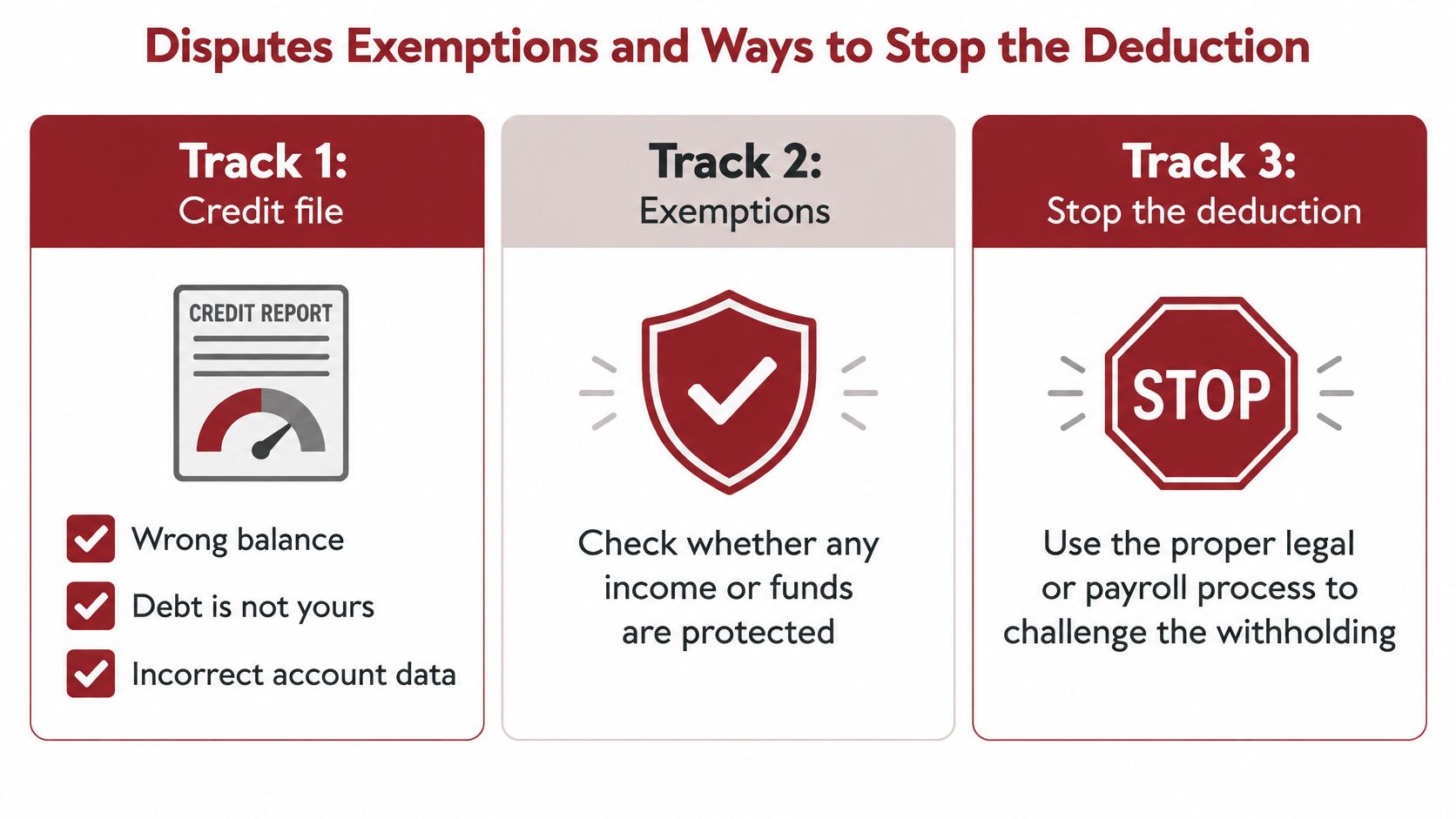
Treat this as separate jobs with separate decision-makers. The credit bureau reviews reporting, the court or agency handles objections to collection, and payroll follows legally effective instructions.
Sending the same general complaint to everyone can leave the urgent issue unresolved. Match each request to the person or institution with authority to act.
Track one concerns the credit file
Dispute specific inaccurate information with the credit bureau and the company furnishing it. Examples include an account that isn’t yours, a balance that fails to reflect a payment, or incorrect account status.
Attach relevant statements, receipts, or orders. Identify the account and explain the correction you’re requesting. Don’t dispute the absence of a garnishment entry, because that absence ordinarily isn’t an error.
Keep copies of the submission and response. A vague request to fix your credit gives the reviewer less useful information than a documented explanation of what’s wrong.
Track two concerns exemptions and withholding
Read the notice for the procedure to claim protected income or challenge the amount. For a Georgia court matter, determine which claim, objection, or traverse is appropriate and when it must be filed.
An agency collection requires the agency’s process instead. Identify hearing or appeal instructions before completing a state-court form that may not apply.
- Protected funds: Document where the money came from and why you believe it’s exempt.
- Incorrect amount: Obtain the payroll calculation and compare it with the applicable order.
- Wrong obligation: Preserve proof of payment, mistaken identity, or other documents supporting your objection.
Don’t tell payroll to ignore the order. Ask what legally sufficient release, amended instruction, or court document it needs.
Track three concerns ending collection authority
A payoff or settlement needs clear written terms addressing the balance and release of the garnishment. Confirm how the creditor will communicate with the court and employer, and keep the final release.
Bankruptcy requires a broader review of income, assets, debts, and prior filings. An automatic stay generally takes effect when a bankruptcy case is filed, with exceptions, and prevents most collection activity. Understanding whether bankruptcy can stop wage garnishment means examining the particular obligation and the protection available in that case.
Chapter 13 can stop wage garnishments, foreclosure, and car repossession while allowing debts to be addressed at an affordable payment level. Protection concerning debts in the plan is different from an immediate promise that every obligation disappears.
Chapter 7 typically discharges credit card debt, medical bills, and unsecured loans. Don’t assume taxes, student loans, or divorce-related obligations will be erased; those require individual legal review. Child support remains owed, although addressing other debts may make staying current more manageable.
Finally, distinguish a dismissal from a discharge. Dismissal ends the case without wiping out debts and can allow collection to resume. A discharge is the court order that permanently eliminates eligible debts, not a promise to erase accurate credit history overnight.
When to Call a Georgia Debt Attorney
If your only problem is an incorrect account balance and no collection deadline is pending, a documented credit dispute may be a sensible starting point. You don’t need to treat every reporting error as an emergency lawsuit.
Get legal help promptly when your wages or essential funds are at risk. The need for advice comes from the paperwork, the deadline, and the effect on your household, not from whether a credit-monitoring app sends an alert.
Situations that call for prompt review
- A deadline is approaching: You’ve received a summons or agency notice and aren’t sure how to respond.
- The deduction looks wrong: Payroll’s explanation doesn’t match the order or the type of debt.
- Your bank account is frozen: You need to identify the action and any protected funds.
- Different obligations overlap: Support, taxes, student loans, or private debts are being collected at the same time.
- Basic expenses are at risk: The reduced paycheck won’t cover housing, food, utilities, or necessary transportation.
Seek advice before agreeing to a settlement you can’t sustain. A payment arrangement should be evaluated alongside your other obligations, not only against the collector’s demand.
Bring documents that answer different questions
Bring the garnishment summons or agency notice, recent paystubs, tax returns, bank statements, and a list of debts. Include settlement correspondence and payment records if you’ve already tried to resolve the account.
We obtain the client’s credit report as part of reviewing the financial picture. That helps distinguish reported account information from the legal documents directing collection.
Be ready to explain what you need immediately. Avoiding a missed rent payment, recovering access to protected funds, and evaluating long-term debt relief may require different priorities.
This information is educational, not advice about a particular case. Don’t wait for a credit-report change to solve a paycheck problem. The appropriate next step is a review of the actual order and the response options it provides.
Morgan & Morgan Attorneys at Law P.C. offers wage garnishment assistance and a free consultation for people dealing with debt collectors or questions about debt collection. Bring your notice and recent paystubs so we can help separate the collection order from the credit-report issue. Visit Morgan & Morgan Attorneys at Law P.C. to request a consultation and discuss your next step.

Lee Paulk Morgan
With more than 41 years of experience in the areas of Bankruptcy, Disability, and Workers’ Compensation, Lee Paulk Morgan is one of the most respected Bankruptcy and Disability attorneys in Athens, Georgia. His tireless dedication to serving clients has gained him the reputation of a premier attorney in his areas of practice, as well as the trust and respect of other legal experts, who often refer clients to him.
SHARE
RELATED POSTS

Should I Hire an Attorney for Debt Settlement? (2026 Georgia Guide)
You should hire an attorney for debt settlement if you have been sued, your wages are being garnished, you owe more than roughly $10,000, or a creditor is threatening legal action. For a single small…

Credit Card Debt Relief For Nurses (Practical Action Plan)
You’re working a double shift, checking your phone between patients, and there it is again, another credit card reminder you’ve been ignoring because you were too tired to deal with it. One card is close…