
Blog

Does Workers Comp Pay For Prescriptions in Georgia
Yes, Georgia workers’ comp pays for prescriptions tied to a covered on-the-job injury when they’re medically necessary and authorized, but payment depends on the claims administrator’s pharmacy process and generic-substitution rules. Coverage doesn’t automatically mean you’ll pay nothing at the pharmacy counter.
You’ve left an urgent-care appointment in Athens with a prescription, a sore arm, and instructions to start treatment. Then the pharmacist asks for payment because the workers’ compensation information hasn’t gone through. The immediate question isn’t just whether the medication is covered. It’s who needs to approve it, what information is missing, and how you get the medicine without creating a reimbursement dispute.
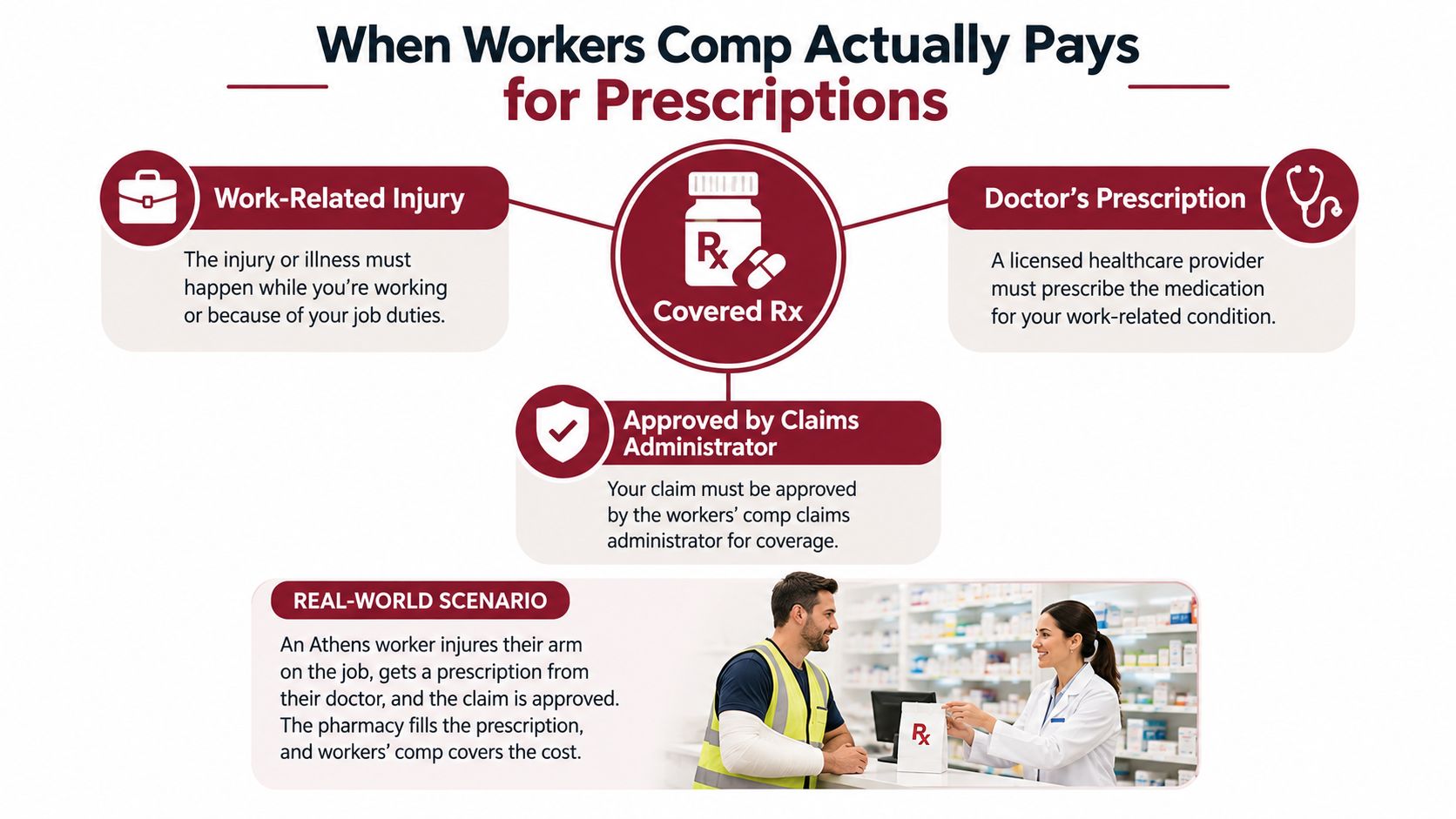
When Workers Comp Actually Pays for Prescriptions
A prescription must fit the workers’ compensation claim, not merely follow the accident. Georgia’s State Board of Workers’ Compensation employee handbook identifies prescriptions as covered medical expenses when the injury resulted from a workplace accident.
For the Athens worker leaving urgent care, that means the prescription is the beginning of the payment process, not proof that every coverage requirement has been satisfied. Don’t assume the employer’s knowledge of the accident means the pharmacy already has everything it needs.
The conditions behind coverage
Use these questions to separate a covered treatment expense from an unresolved billing request:
- Is the injury work-related and accepted? A medication for an unrelated condition doesn’t become a workers’ compensation expense because you need it during recovery. If the underlying claim is disputed, prescription payment may also remain disputed.
- Is the medication medically necessary? The treating physician should connect the medication to treatment of the workplace injury.
- Did it come through authorized medical care? Confirm that the prescriber is authorized for your claim rather than assuming every doctor you visit has that status.
- Has the pharmacy process been followed? The claims administrator needs the prescription submitted through the applicable billing and approval arrangement.
These conditions explain why workers receiving the same medication can have different experiences at pickup. One pharmacy may already have the claim information and approval, while another is still trying to identify the responsible administrator.
Getting a prescription and getting payment are separate tasks
For general background on obtaining a prescription, the Midwest Pain & Wellness prescription guide is a separate resource to consult. It shouldn’t replace confirmation that your prescriber and pharmacy arrangement are authorized for your Georgia claim.
The practical question to ask the doctor’s office is whether the prescription has been connected to your workplace injury and sent through the appropriate process. Ask the claims administrator separately whether anything remains outstanding before dispensing.
Practical rule: Treat the doctor’s treatment decision and the administrator’s payment confirmation as separate matters to verify.
That distinction isn’t an invitation to let administrative staff make medical decisions. It’s a way to identify which person needs to resolve the obstacle.
Why a Valid Prescription Is Not the Same as a Paid One
A restaurant gift card can be valid yet unusable at a location that doesn’t participate. A prescription has a similar administrative limitation: the doctor may legitimately prescribe it, but the payer still evaluates whether it qualifies under the claim’s payment rules.
Medical validity and administrative approval answer different questions. The prescriber determines the treatment being requested. The claims administrator evaluates whether the workers’ compensation claim and pharmacy program will pay for that request.
Identify the restriction before trying to fix it
The terms used at the pharmacy aren’t interchangeable:
| Term | What to ask |
|---|---|
| Formulary | Is this medication included in the applicable approved-drug list? |
| Pharmacy network | Can this location bill the program for my claim? |
| Prior authorization | Does someone need to approve this prescription before dispensing? |
| Generic substitution | Does the requested brand require additional prescriber documentation? |
These restrictions vary by jurisdiction and program. For example, New York’s medication authorization guidance allows formulary medications without prior authorization but requires approval for specified categories, including non-formulary drugs and certain brands when a generic exists. That’s a New York rule, not proof that Georgia applies the same formulary.
For a Georgia claim, ask the administrator to identify the actual restriction rather than accepting an unexplained statement that the drug isn’t covered. A pharmacy-network problem calls for a different response than a dispute about medical necessity.
Don’t substitute a shopping decision for a treatment decision
When a prescription won’t process, buying something else can feel like the fastest solution. Resources such as MEDISTIK on OTC lidocaine options can help you prepare questions about nonprescription products, but they don’t establish that an alternative is appropriate for your injury or reimbursable under your claim.
Ask your authorized treating physician before changing the treatment plan. A cheaper product isn’t necessarily the medically appropriate substitute, and an available product isn’t necessarily an approved expense.
If the problem continues beyond an isolated billing rejection, guidance on workers’ comp dragging out medical treatment can help you recognize when to seek legal advice. Keep the focus on the missing decision: who must act, what information they need, and whether the delay is interfering with prescribed care.
How Prescription Coverage Actually Works in Georgia
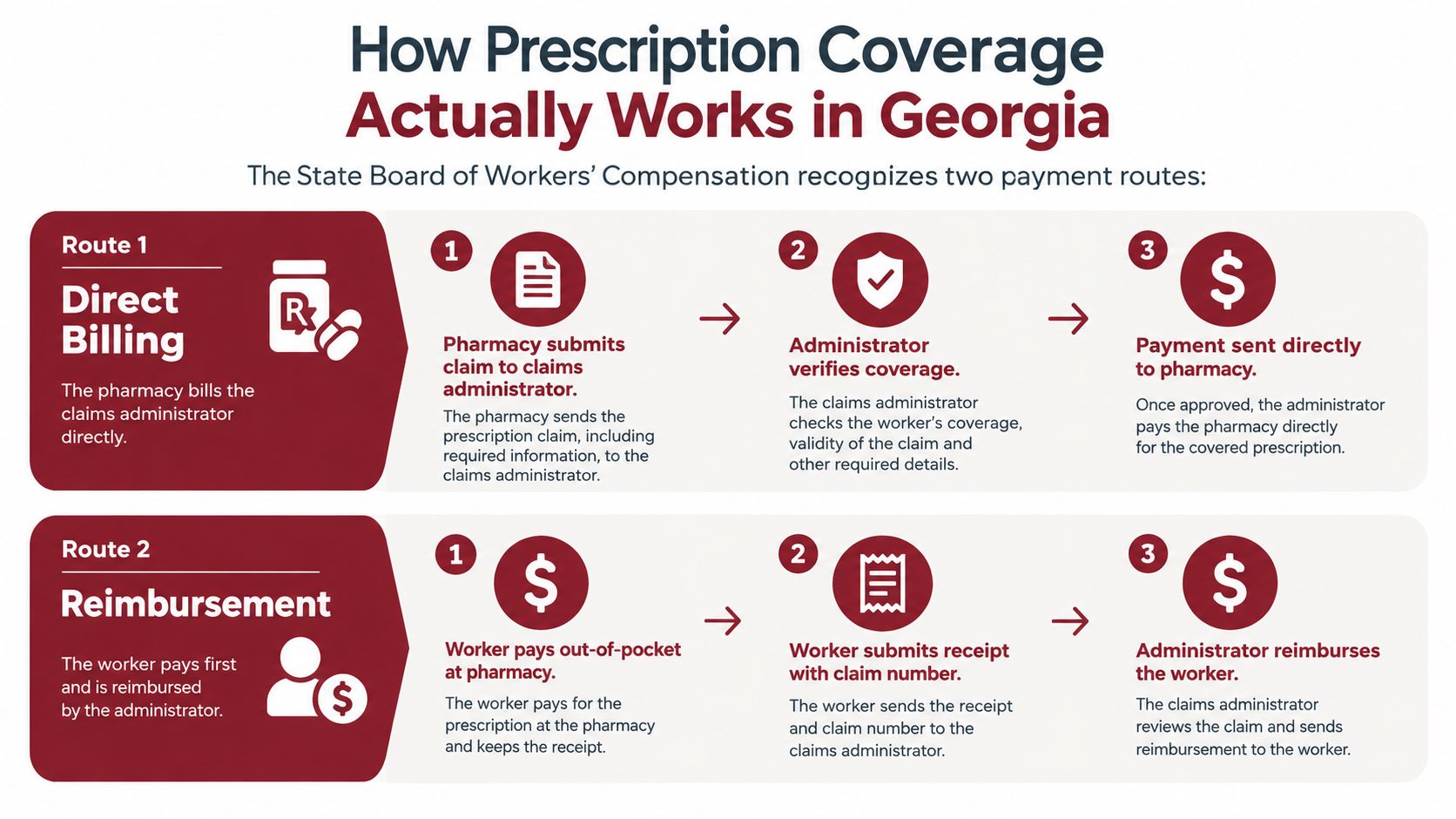
Georgia recognizes direct pharmacy billing and payment followed by reimbursement. The Georgia employee handbook’s prescription-payment guidance explains that an employer or claims administrator may arrange pharmacy billing, while an injured employee may otherwise need to pay initially and submit a receipt.
The difference matters when you’re recovering and trying to manage household expenses. A covered prescription can still create an immediate cash-flow problem if nobody has arranged direct billing.
Direct billing versus reimbursement
With direct billing, the pharmacy submits the prescription expense through the employer’s or claims administrator’s approved arrangement. When that arrangement is confirmed and the prescription qualifies, you may avoid an out-of-pocket charge.
With reimbursement, you advance the money and then request repayment. That route requires you to preserve proof of the purchase and follow the administrator’s submission instructions. Paying first doesn’t resolve a dispute about whether the expense qualifies.
Before choosing the reimbursement route, get clear answers:
- Submission destination: Ask where to send the receipt and whether a particular form is required.
- Supporting information: Confirm what claim and prescription details the administrator needs.
- Payment status: Ask whether the expense has been approved or whether reimbursement remains under review.
Direct billing avoids advancing the purchase price. Reimbursement leaves you carrying that expense while the request is processed.
What national spending figures do and don’t explain
Prescription drugs represented approximately 7% of workers’ compensation medical costs nationwide; average drug payments per claim fell about 2.6% annually from 2012 through 2021, or roughly 21% overall, even as prescription prices rose about 3.7% annually, according to NCCI’s analysis of workers’ compensation prescription spending.
Those figures describe spending, not your individual entitlement to a medication. They don’t establish that your prescription should be denied, that your treatment costs too much, or that every claim uses identical approval rules.
The practical lesson is narrower: prescription benefits operate within a system that scrutinizes drug selection and utilization. You’re better served by obtaining a specific payment arrangement than by relying on a general assurance that workers’ compensation covers medicine.
If you can’t afford to advance the cost, tell the administrator before paying. Ask whether an approved direct-billing option can be arranged, and tell the treating physician if the payment problem is preventing you from starting treatment.
Steps to Get Your Prescription Paid Without Hassle
The most useful preparation happens before the pharmacist tries to process the prescription. Have the claim details available, know whom to contact, and make sure the doctor’s office understands that the medication belongs to a workers’ compensation treatment plan.
Don’t settle for being told that someone will handle it. Identify who is responsible for the next action and how you’ll confirm it happened.
Use this checklist before pickup
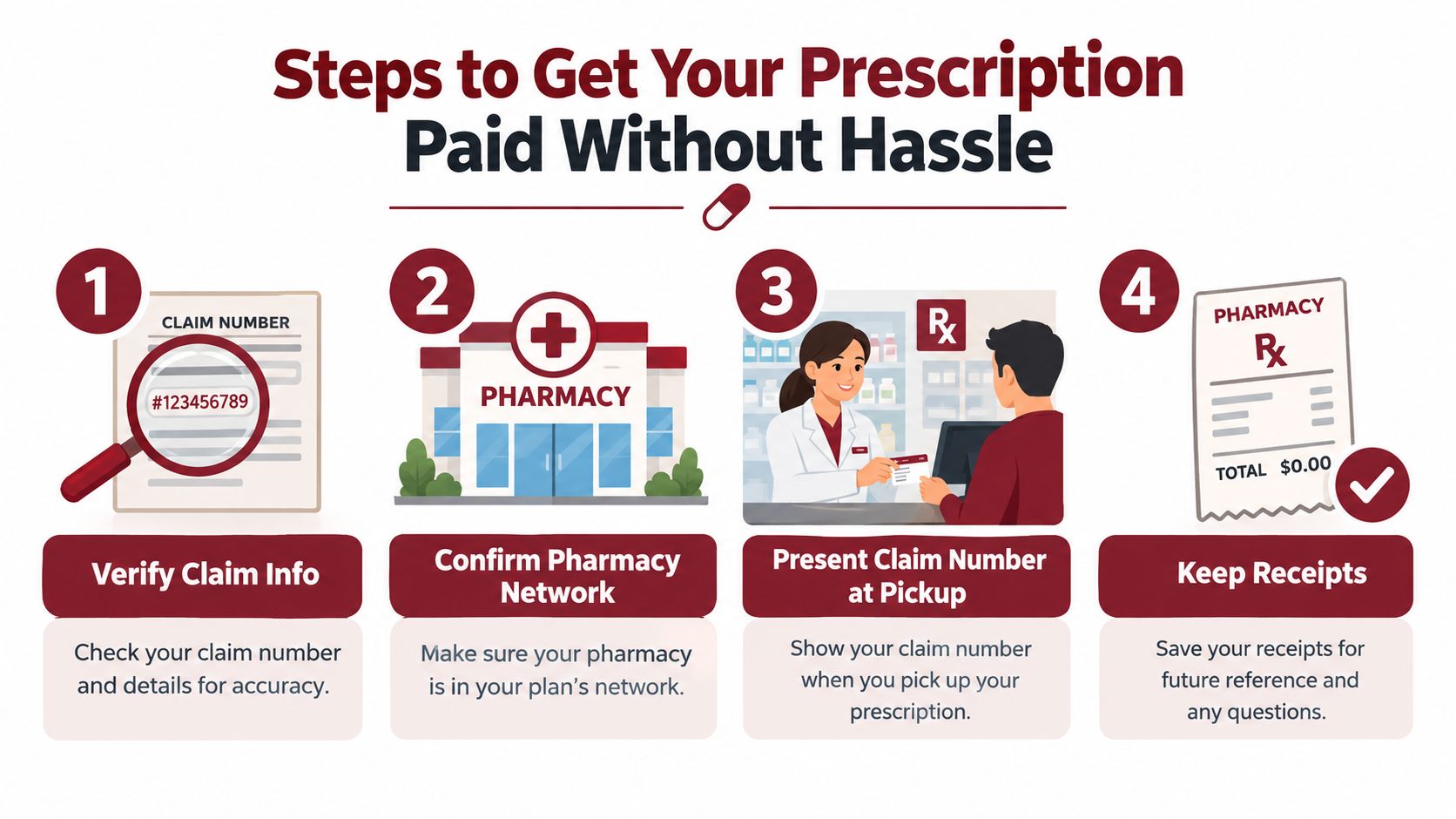
- Verify the claim information before leaving the doctor’s office. Have your claim number, employer information, and claims administrator’s contact details accessible. If you haven’t received a claim number, ask the administrator how the pharmacy should identify the pending claim.
- Confirm the pharmacy arrangement. Ask whether you need a designated pharmacy, prescription card, or other billing information. Give that information to the pharmacy before it attempts payment rather than assuming your ordinary health-insurance details will work.
- Connect the prescription to the workplace injury. Ask the prescriber’s office to identify the medication as workers’ compensation-related and provide any requested supporting documentation. At pickup, make clear which claim the pharmacy should bill.
- Keep a complete record. Save the itemized pharmacy receipt, proof of payment, prescription information, relevant medical notes, and written rejection messages. Ask for billing documentation that identifies the dispensed product, including its National Drug Code when needed.
Make the pharmacy conversation specific
If the transaction fails, ask the pharmacist what the rejection says. An incorrect claim identifier, a request for approval, and a medication exclusion require different follow-up.
Record the date, the person you spoke with, and the action they agreed to take. For example, note whether the pharmacist will contact the administrator or whether the doctor’s office must send medical information. Don’t leave responsibility unassigned between those offices.
A simple folder on your phone or in paper form can hold:
- Claim records: Administrator contact details and pharmacy-program instructions.
- Purchase records: Itemized receipts and any reimbursement submissions.
- Communication records: Emails, rejection notices, and notes from calls.
Good documentation doesn’t guarantee approval. It does let you show what was prescribed, what you paid, what you submitted, and what remains unanswered without reconstructing the history from memory.
For refills, confirm whether the existing arrangement still applies before you run out. If the pharmacy identifies a new approval requirement, notify the prescriber rather than assuming the previous fill guarantees the next one will process.
Georgia Reimbursement Rules That Catch Workers Off Guard
The drug selected and the information on the bill can affect payment even when the treatment itself is covered. Georgia’s pharmaceutical reimbursement guidance addresses therapeutic-equivalent generics, brand-name medical necessity, reimbursement calculations, and product identification.
These are technical requirements for prescribers, pharmacies, and payers to work through. You don’t need to calculate the pharmacy’s bill, but you should know which questions can prevent an avoidable dispute.
Georgia Pharmacy Reimbursement at a Glance
| Component | Rule | Practical Impact |
|---|---|---|
| Generic selection | Use an Orange Book therapeutic-equivalent generic when available, subject to the documented medical-necessity exception. | Ask whether the dispensed product satisfies the substitution requirement. |
| Brand exception | The prescribing physician must document on the prescription that the brand is medically necessary. | A patient’s preference alone doesn’t supply the required documentation. |
| Price calculation | Reimbursement uses published average wholesale price plus the applicable dispensing fee. | The retail purchase price and scheduled reimbursement aren’t interchangeable concepts. |
| National Drug Code | Submitted bills must include the product’s NDC. | Ask the pharmacy to provide an appropriately itemized bill. |
The 2008 schedule listed dispensing fees of $6.53 for generic drugs and $4.36 for brand-name drugs in the pharmaceutical reimbursement guidance cited above. Those are historical schedule amounts, not a representation of today’s applicable payment figures; the pharmacy or administrator should confirm the schedule governing the bill.
Resolve brand requests with the prescriber
If your doctor wants a brand-name medication despite an available therapeutic-equivalent generic, ask whether the prescription contains the required medical-necessity documentation. Don’t assume a conversation during the appointment supplied what the pharmacy needs in writing.
Likewise, don’t assume the administrator will absorb a price difference because the pharmacy dispensed the requested brand. Clarify approval before purchase when possible, and ask the prescriber to address the medical reason for the exception.
Before you pay: A billing dispute about the product or its documentation should be identified explicitly, not reduced to an unexplained request for cash.
The National Drug Code, or NDC, identifies the specific dispensed product. A receipt showing only that you made a purchase may not provide the information needed to evaluate the prescription bill.
Ask the pharmacy for an itemized record rather than trying to supply or correct a product code yourself. If the administrator says the bill is incomplete, request the missing field in writing and pass that request to the pharmacy. That keeps the correction with the party able to verify the dispensing details.
What to Do When a Prescription Claim Is Denied
Appealing isn’t a single action that fits every rejection. First determine whether the pharmacy transaction failed administratively, the administrator refused the medication, or the insurer disputes the underlying injury claim.
Ask for the reason in writing. A verbal statement that workers’ comp won’t pay doesn’t tell your doctor what medical evidence to provide or tell an attorney what dispute needs to be addressed.
Match the response to the reason
- The claim is disputed: Ask whether the refusal concerns the workplace injury itself rather than this particular medication. Guidance on a denial of a workers’ compensation claim can help you prepare for a broader legal review.
- The drug is outside an applicable formulary: Ask the administrator to identify the rule being applied and the exception process. Have the prescriber explain why the requested treatment is necessary.
- Prior authorization is missing: Determine who must submit the request, what records are required, and whether it has been received.
If the administrator proposes an alternative, send that information to your physician. The worker shouldn’t be left deciding whether a substitute is medically appropriate.
Medical urgency needs a separate conversation
Ordinary reconsideration and urgent review aren’t the same. Tennessee’s workers’ compensation drug-formulary guidance permits expedited appeal when withholding medication could create an unreasonable risk of medical emergency or substitution is medically inappropriate, with the prescriber or pharmacy able to request review.
That Tennessee procedure isn’t a Georgia deadline or entitlement. Its practical relevance is that medical urgency must be identified and documented, not buried inside a routine payment complaint.
For a Georgia denial, tell the authorized treating physician immediately if you can’t obtain the medication. Ask the physician to document the medical necessity, the consequences of interruption, and whether prompt action is needed; then ask the administrator or your attorney which Georgia review procedure applies.
Don’t pay and assume reimbursement is guaranteed. Don’t stop or change prescribed medication without medical advice, either. If you must pay to obtain treatment, preserve the records and continue addressing the denial.
When the administrator maintains its refusal despite supporting medical information, the dispute may require legal action rather than another call to the pharmacy.
When a Workers Comp Attorney Becomes Worth the Call
Consider a hypothetical Georgia back-injury claim in which the pharmacy says a prescribed muscle relaxant was rejected as off-formulary. The doctor provides supporting information, but the administrator then says the prescriber wasn’t authorized or the injury itself isn’t accepted.
That isn’t just a pharmacy problem anymore. An attorney can evaluate whether the disagreement concerns missing paperwork, treatment authorization, or the underlying right to benefits, and whether the dispute needs to move toward a contested hearing. A hearing isn’t automatically the first or necessary response.
Use the pattern of refusal as your decision point
Consider seeking advice when you encounter:
- Repeated refusals: The same prescription problem returns despite attempts to correct it.
- Unexplained treatment restrictions: The administrator won’t clarify what is required to evaluate the doctor’s request.
- A broader claim dispute: Payment depends on contested work-relatedness or authorization.
If you’re deciding whether you need a lawyer for workers’ compensation, bring the prescription, rejection notice, medical support, and communication history. Those records help counsel identify the actual issue.
For an Athens-area worker, direct attorney contact can make it easier to understand who will address the dispute and what the next step requires. Ask who will communicate with you from the initial consultation through resolution.
Morgan & Morgan Attorneys at Law P.C. offers free consultations and direct access to experienced attorneys for Georgia workers’ compensation questions, including prescription-payment disputes. Visit Morgan & Morgan Attorneys at Law P.C. to discuss your denial, reimbursement records, and next steps for obtaining covered treatment.

Lee Paulk Morgan
With more than 41 years of experience in the areas of Bankruptcy, Disability, and Workers’ Compensation, Lee Paulk Morgan is one of the most respected Bankruptcy and Disability attorneys in Athens, Georgia. His tireless dedication to serving clients has gained him the reputation of a premier attorney in his areas of practice, as well as the trust and respect of other legal experts, who often refer clients to him.
SHARE
RELATED POSTS

Can I Refuse A Nurse Case Manager
Yes, you can generally refuse a nurse case manager, but put that refusal in writing. What stops and what continues after you say no is rarely obvious, especially in a Georgia workers’ compensation claim. The…

Do You Get Drug Tested For Workers Comp in Georgia
No, you are not automatically drug tested after a workplace injury in Georgia. An employer with a qualifying drug-free workplace program can require testing after a lost-time injury, and the result can create a rebuttable…