
Blog

I Am Drowning In Debt (What Are My Options in Georgia)
You’re sitting at the kitchen table after work, opening mail you have put off for days. A credit card statement shows a minimum payment you can’t cover, a medical bill has gone to collections, and your phone has lit up all afternoon with numbers you don’t recognize. If you’re thinking, I am drowning in debt, what are my options in Georgia, you’re not asking for abstract legal theory. You’re asking what to do before the next paycheck, the next court paper, or the next missed mortgage payment. The honest answer is that Georgia households have several paths, and the right one depends on what kind of debt you owe, what income you have coming in, what property you need to protect, and whether a legal deadline is already moving.
Understand Your Debt Situation First
Consider an Athens-Clarke County household where one parent lost overtime hours, the other picked up extra shifts, and the bills still don’t line up. The mortgage is current, but two credit cards are three months behind, a hospital bill is with a collector, and the car payment is due Friday. They aren’t facing one problem. They’re facing several problems that may need different responses at different speeds.
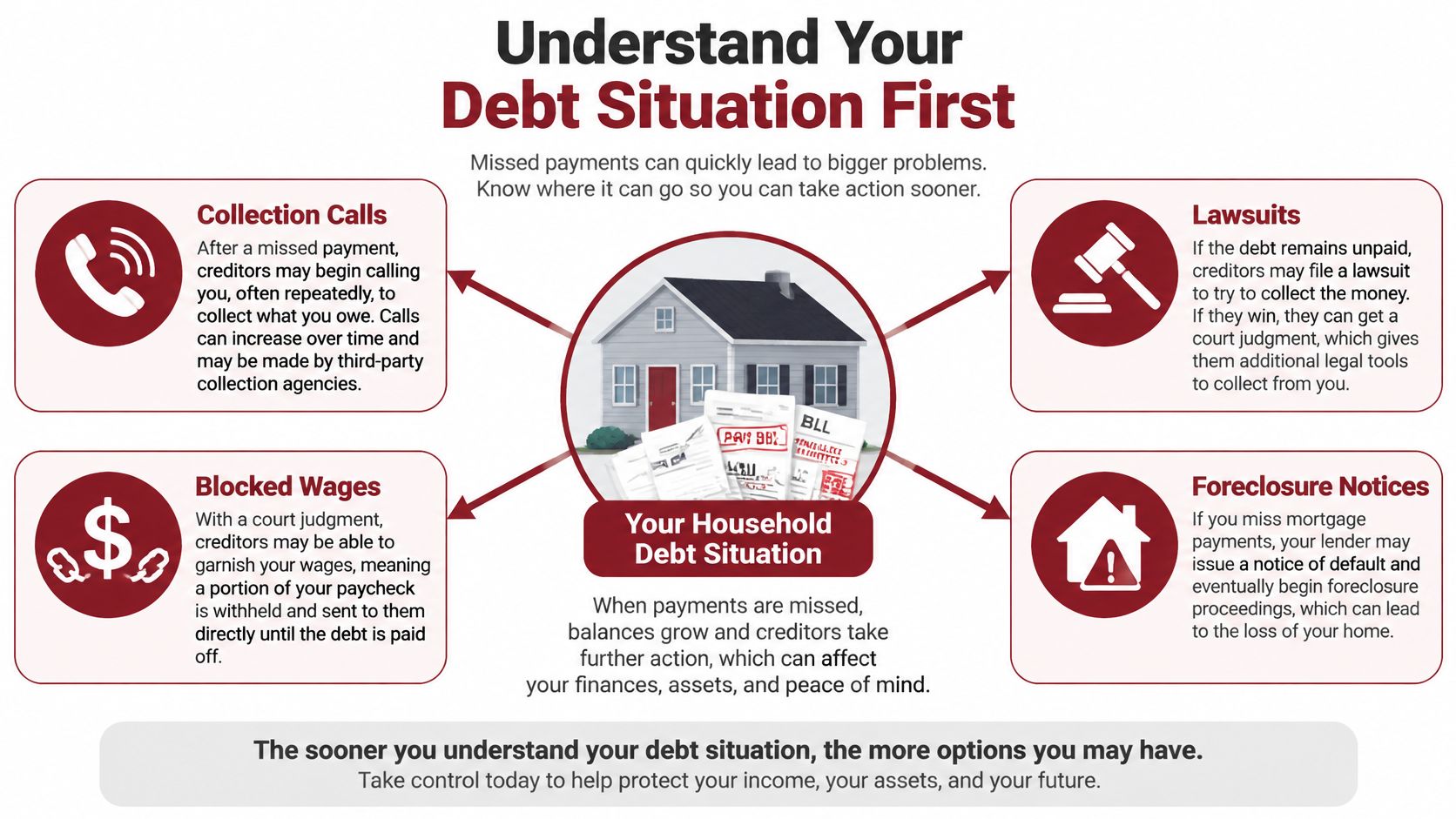
Start by sorting what you owe into four piles, because total debt alone doesn’t identify the best remedy.
- Unsecured debt: Credit cards, medical bills, and personal loans that aren’t tied to specific property. Creditors can’t take something back, but they can call, report missed payments, assign the account to collections, and sue.
- Secured debt: Mortgages and vehicle loans tied to collateral. Missed payments put the home or car itself at risk, not just your credit.
- Income and assets: Paychecks, benefits, bank balances, vehicles, and home equity. These facts shape which options are even available to you.
- Urgent legal deadlines: Lawsuit papers, garnishment notices, or foreclosure documents. These move on a court’s schedule whether you’re ready or not.
Why the categories matter more than the total
Two households can owe the same amount and need opposite plans. A renter with mostly credit card balances and no regular income is in a different position from a homeowner with steady pay, missed mortgage payments, and a car loan. The second household may care less about wiping out a card balance quickly and more about keeping a roof and reliable transportation to work.
You’re also not unusual for considering formal help. The Southern District of Georgia reported 3,620 bankruptcy cases during the 12-month period ending December 31, 2024, showing that thousands of Georgia individuals and businesses use court-supervised relief each year. That doesn’t mean bankruptcy fits everyone. It means you’re evaluating a real legal system, not admitting defeat.
Before you choose anything, get the full picture reviewed. An attorney or counselor needs to see income, assets, debt types, and collection status together, because a path that handles unsecured balances may do nothing for a mortgage that’s falling behind.
Compare Debt Relief Options in Georgia
Georgia debt relief isn’t a single ladder from mild to serious. It’s a set of tools, and each tool solves a particular pressure point. Some are voluntary arrangements with creditors. Others involve a federal court, a trustee, and rules that bind creditors whether they agree or not.
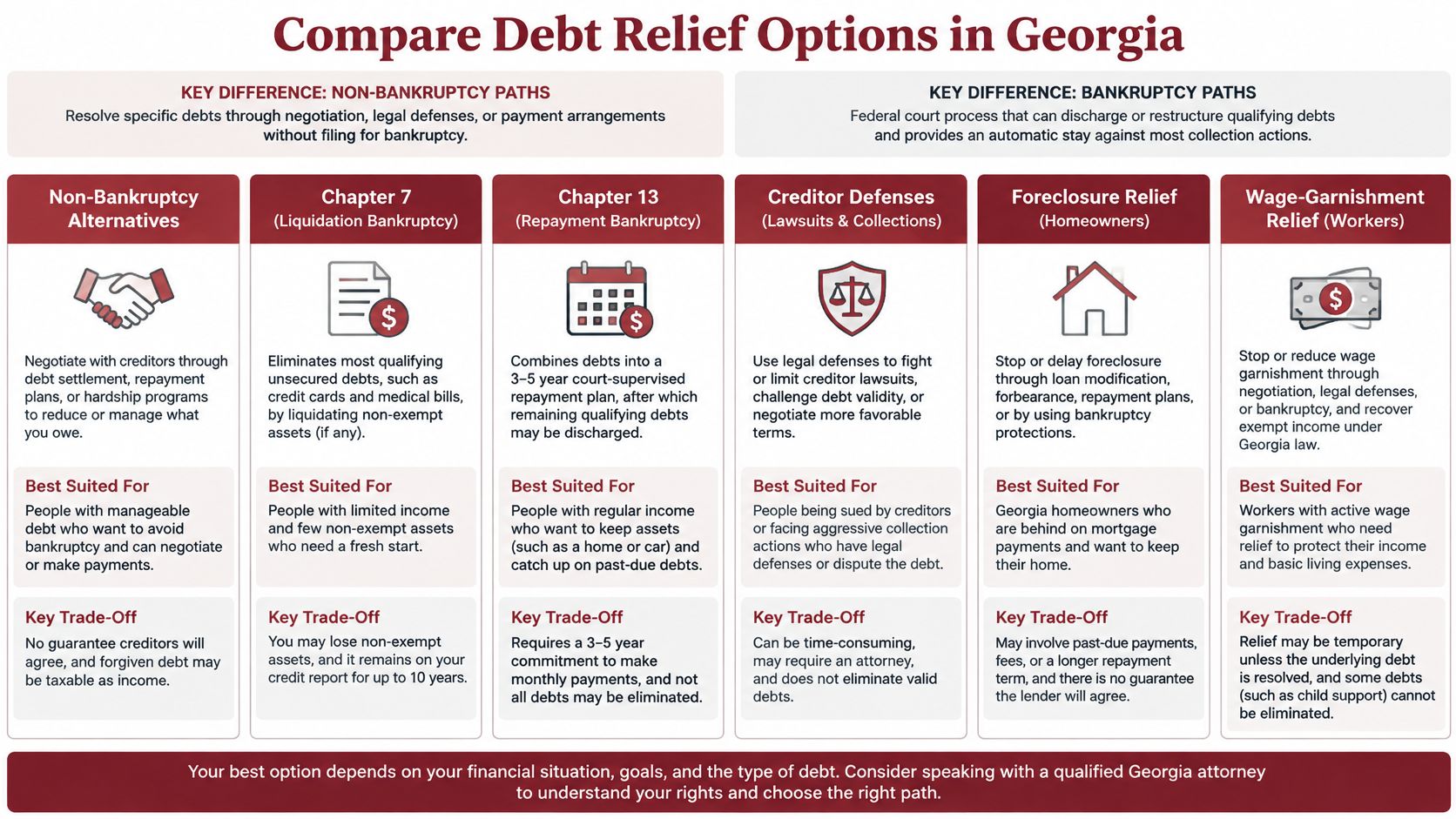
For a Georgia resident overwhelmed by unsecured debt, the federal courts describe Chapter 7 and Chapter 13 as the two primary individual bankruptcy paths, with Chapter 7 working as a court-supervised liquidation process and Chapter 13 using a repayment plan that typically lasts three to five years. Non-bankruptcy routes sit alongside those options, and they shouldn’t be dismissed automatically. Negotiating directly with a creditor, entering a structured management plan, or defending a collection lawsuit can make sense when the debt is limited, disputed, or still manageable with adjusted payments.
The trade-off is control. A voluntary arrangement only works while the creditor participates. A bankruptcy filing, by contrast, brings court oversight and legal protection from most collection activity while the case is in effect. If you’re trying to lower your mortgage and loans through restructuring or better repayment terms, that outside perspective can help you compare payment strategies, but it can’t substitute for a review of Georgia court deadlines, liens, and garnishment exposure.
A practical decision map
| Option | Problem it may address | Possible benefit | Central limitation | Key facts to review |
|---|---|---|---|---|
| Non-bankruptcy negotiation | Isolated balances, temporary shortfalls | Adjusted payments without a court case | Creditor participation is voluntary | Written terms, fees, ability to finish |
| Chapter 7 | Heavy unsecured debt, limited nonexempt assets | Court-supervised liquidation and fresh start | Nonexempt property may be sold | Income, exemptions, secured loans |
| Chapter 13 | Mortgage or vehicle arrears with regular income | Repayment plan while usually keeping property | Requires steady payments for years | Disposable income, arrears, plan feasibility |
| Creditor defenses | Collection lawsuit or disputed account | Challenge errors or improper claims | Addresses one case, not overall finances | Court papers, account records, deadlines |
| Foreclosure relief | Missed mortgage payments, sale risk | Time to address arrears | Mortgage obligation doesn’t disappear | Notice stage, equity, future payment ability |
| Wage-garnishment relief | Paycheck deductions after judgment | Review exemptions, errors, or filing options | Depends on order type and income source | Garnishment paperwork, pay records |
The question isn’t which option sounds strongest in the abstract. It’s which pressure is hurting you first, and which tool actually reaches that pressure.
A solution that protects a home may be a poor fit for someone whose real problem is unsecured balances. A fast fresh start may not fit a household with valuable property at risk. That mismatch is exactly why the same debt total can lead different Athens households down very different roads.
Choose Between Chapter 7 and Chapter 13
Neither chapter is automatically the better chapter. They’re different legal processes built for different financial shapes, and your income, property, and secured loans do most of the deciding before personal preference enters the picture.
In Chapter 7, a trustee reviews your property, sells nonexempt assets when necessary, and distributes proceeds to creditors. You may keep property protected by applicable exemptions, which is why an accurate asset list matters so much at the start. Secured creditors generally retain their rights in collateral such as a home or vehicle, so Chapter 7 doesn’t turn a mortgage into free housing. If you want to keep secured property, the underlying loan still has to be addressed.
Chapter 13 works differently. It’s structured for an individual with regular income who needs time to catch up on overdue obligations rather than liquidate assets. You propose a repayment plan, payments generally go through the trustee, and you usually remain in possession of your property during the case. Federal courts note that this chapter can be preferable when someone needs to protect a valuable asset, such as a house, or doesn’t qualify for Chapter 7. Discharge generally comes only after required plan payments are completed, so the relief is earned over time, not granted at the start.
The means test is the first real filter
Georgia consumers often assume the choice is theirs alone. It isn’t. Individual debtors must file a Statement of Current Monthly Income, and some must complete additional calculations using personal income and expense records plus standardized Census Bureau and IRS data, as explained in this guide on what the means test involves. The first screening compares household income with the applicable state median. For cases filed May 15 to October 31, 2025, the Northern District of Georgia listed medians of $62,401 for one person, $81,309 for two people, and $98,564 for three people.
Income above the applicable median doesn’t automatically disqualify you from Chapter 7. It triggers a more detailed disposable income and abuse analysis. Irregular overtime, bonuses, self-employment revenue, contributions from others in the household, and recent job loss can all change the calculation, which is why online eligibility estimates often miss the mark. A sound review also separates secured payments, priority taxes or support obligations, and unsecured consumer debt, because Chapter 13 feasibility depends on projected disposable income and required plan payments, not just creditor balances. If tax debt is part of your stack, the Allied Tax Advisors bankruptcy guide offers useful background on how bankruptcy and taxes interact before you get case-specific advice.
| Question | Chapter 7 | Chapter 13 |
|---|---|---|
| How does it work | Trustee liquidates nonexempt assets for creditors | Debtor repays through a court plan over time |
| Who is it built for | Debtors who pass eligibility screening, often with limited nonexempt property | Individuals with regular income who need to catch up on arrears |
| What happens to property | Exempt property may be kept; nonexempt property may be sold | Debtor usually remains in possession during the plan |
| How are secured loans treated | Secured creditors retain rights in collateral | Arrears can be addressed through plan payments |
| When does relief complete | After the liquidation process for qualifying debts | Generally after required plan payments are finished |
Not every debt goes away
Filing doesn’t automatically eliminate every obligation. Certain tax liabilities, domestic support obligations, and other nondischargeable debts may survive depending on the specific case and applicable law. A household whose largest balances can’t be discharged may need a very different strategy from one buried in credit cards. That’s the point where precise legal analysis matters more than a calculator, because the label on the debt can matter as much as the amount.
Respond to Foreclosure and Wage Garnishment
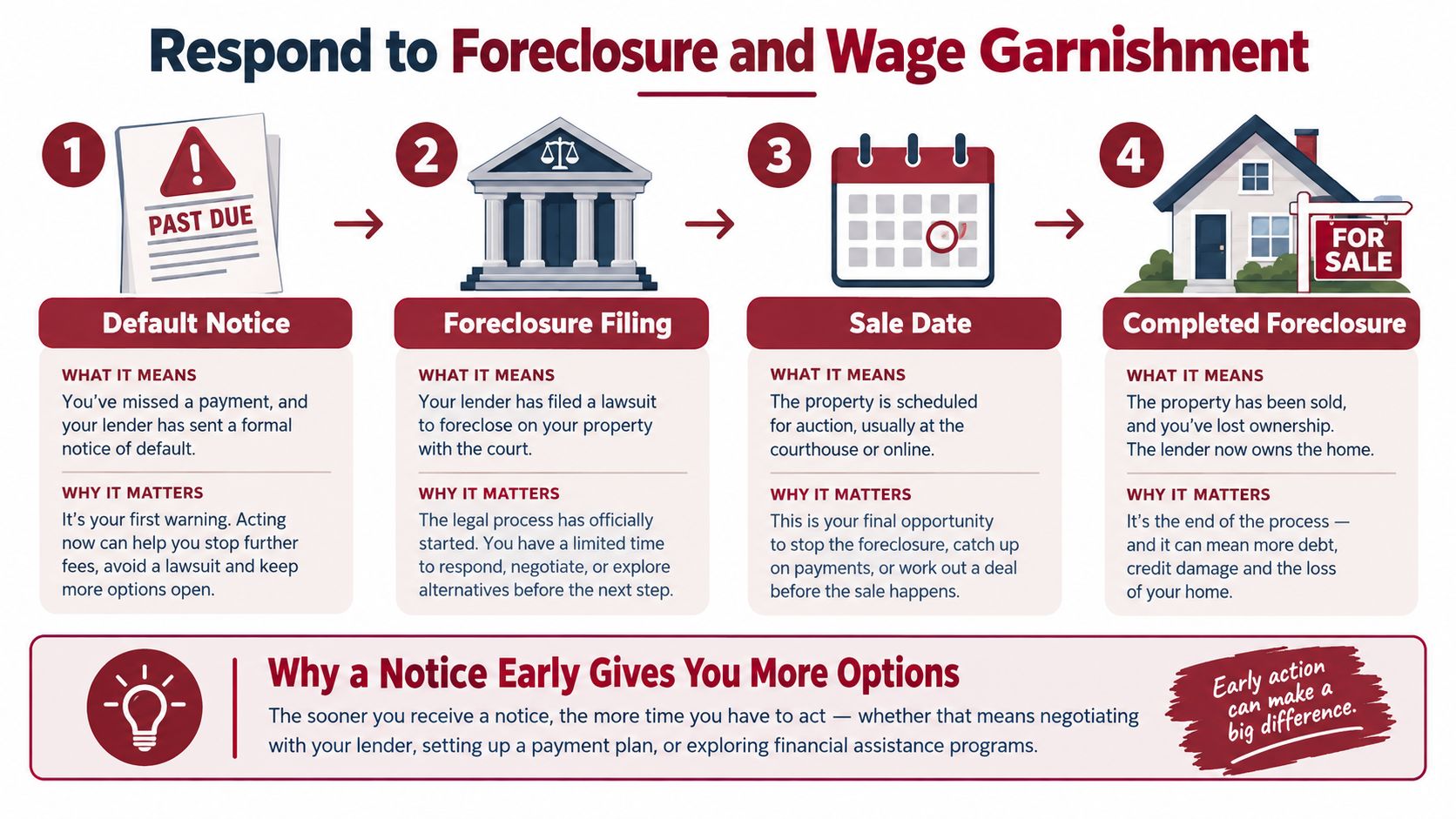
Many people assume a foreclosure notice means the home is already gone. That assumption causes costly delays. A notice is serious, but it is a stage in a process, and the stage you’re in determines what can still be done.
Georgia’s numbers show how common this pressure has become. The state recorded 4,356 foreclosure starts in the first quarter of 2026, and 8,433 properties had foreclosure filings during the first half of 2026, up 52.41% from the first half of 2025. Those figures count filings and starts, not only completed losses, and that distinction matters for your decisions.
Know which milestone you are facing
- Default notice: The lender is formally warning you that payments are behind. This is the widest window for reviewing reinstatement, assistance options, or bankruptcy timing.
- Foreclosure filing: The process has escalated into formal action. Paperwork, dates, and responses now carry deadlines.
- Sale date: A specific day is scheduled. Waiting until this point compresses every option and raises the cost of any mistake.
- Completed foreclosure: The sale has happened. The conversation shifts from saving the home to addressing any remaining obligations.
A bankruptcy filing may bring an automatic stay, which pauses many collection actions, lawsuits, and garnishments while the case remains in effect. For a homeowner with regular income, Chapter 13 can provide a structure for addressing missed mortgage payments while remaining in possession of the home. But here’s the nuance people miss: a stay buys time, it doesn’t erase the mortgage. You still need a realistic way to make future payments, and unresolved mortgage-assistance issues or multiple liens can complicate the picture. Filing the week before a sale without a workable payment plan is a pause, not a cure.
A hard truth worth hearing early: Bankruptcy can stop a process from moving forward, but keeping the home long term still requires payments you can actually sustain.
Wage garnishment needs its own review
When money starts coming out of your paycheck, the first job is identification, not panic. What kind of order is it, who issued it, what income does it reach, and is the amount correct. Errors and exemption questions may matter, and so may the type of debt behind the order, since support and tax obligations can be treated differently from ordinary consumer judgments. If deductions have started or a lawsuit is heading that way, this overview of how to stop wage garnishment in Georgia walks through the issues a review should cover. Whether the right response is a creditor defense, a negotiated resolution, or a bankruptcy filing depends on those specifics, so treat any universal promise about garnishment with skepticism.
Early intervention beats emergency filings in both situations. The earlier a lawyer sees the actual notice or order, the more of the timeline is still yours to use.
Evaluate Non-Bankruptcy Alternatives
Not every Georgia household belongs in bankruptcy court, and a fair evaluation starts by separating concepts that advertising tends to blur together. Creditor negotiation means asking a specific creditor for changed terms. A debt management plan routes structured payments through a counseling arrangement. Credit counseling is guidance and budgeting help. These aren’t interchangeable, and the label on a service tells you very little about what it will do.
Evaluate any offer in writing before you pay anything.
- Get the full agreement: Read every fee, payment obligation, and condition. If a provider won’t put terms in writing, that’s your answer.
- Follow the money: Ask whether the provider is restructuring your debt or mainly charging for services while balances sit unpaid.
- Ask about failure: Find out what happens after a missed payment, including whether creditors can resume lawsuits or collections.
- Check who is protected: A management arrangement may leave a co-signer exposed, and without formal court protection it may not stop every lawsuit.
- Understand the credit impact: Ask how payments and settlements will be reported, and get that answer in the agreement where possible.
Borrowing your way out deserves the same scrutiny. If a consolidation offer is on the table, resources on how to pick between loan and credit can help you compare fixed repayment structures with revolving credit before you commit. A new loan that reorganizes debt without reducing what you owe only helps if the payment fits and the old accounts stay closed or unused.
Context matters here too. In Georgia, 53.4% of recorded bankruptcy cases in 2025 were Chapter 13 cases, with 16,859 filings, and that high volume underscores that structured repayment through the court is a mainstream path for Georgia households, not a rare exception. So when you compare a private repayment arrangement with a court-supervised one, compare them on enforceability, creditor participation, and what happens if your income dips mid-plan.
For a structured look at the main routes outside a filing, these bankruptcy alternatives for debt relief in Athens lay out options worth weighing before you decide. Legal review becomes especially important when creditors are aggressive, a home is at stake, or a lawsuit is already filed. At that point, a voluntary plan that looks cheaper on paper may leave the most dangerous problem untouched.
Use Real Household Decision Examples
Abstract rules get clearer when you attach them to households. The examples below aren’t client stories or promised results. They’re teaching scenarios that show how different facts push toward different questions.

Four households, four different analyses
The renter with a sudden income loss. She has mostly credit card and medical balances, an older car, and few assets a trustee could reach. Her review compares Chapter 7 with direct negotiation. Negotiation depends on creditors agreeing, and she has little income to offer right now, so eligibility analysis for a filing becomes the central question rather than an afterthought.
The homeowner who’s behind but employed. He’s missed mortgage payments after a medical leave, he’s back at work, and the family car loan is also delinquent. Wiping out cards quickly wouldn’t fix the arrears threatening the house. His review focuses on whether a Chapter 13 plan could let him keep the home and vehicle while catching up over time, and whether his current paycheck can sustain both ongoing payments and plan payments.
The worker facing garnishment. A collection lawsuit became a judgment, and deductions have started. Her first questions are defensive. Was she properly served, is the balance accurate, and does any exemption apply. Only after those answers does she weigh whether a broader filing addresses her other debts too, or whether the garnishment is an isolated problem with a narrower fix.
The household with tax and support obligations. Their stack includes credit cards, but also tax balances and domestic support arrears. Because some of those obligations may not be dischargeable, a plan that looks identical on a debt total can produce completely different advice. Their review centers on which debts survive, which must be prioritized, and what cash flow remains afterward.
Same town, similar totals, different answers. Income stability, home equity, missed secured payments, and debt type are doing the real work in every one of these decisions.
Each household would bring similar core documents to a first review, including pay records, tax returns, bank statements, creditor statements, and any court papers. The homeowner adds mortgage and vehicle records, the garnished worker adds the order and recent pay stubs, and the fourth household adds tax notices and support documentation.
Take Immediate Action and Organize Documents
You don’t need to solve everything this week. You need a calm sequence for the next few days that stops the confusion from getting worse.
First, open everything. Unopened mail is where deadlines hide. Separate each document into secured accounts, unsecured accounts, and legal papers. Flag anything that mentions a lawsuit, a foreclosure sale, a garnishment, or an eviction-related date, and write those dates on a calendar where you’ll see them daily. Keep envelopes with the letters inside them, since postmarks and sender information can matter later.
Second, control communication. Decide who in the household will handle creditor contact so messages don’t scatter. Keep a simple log of calls with dates, names, and what was said, and save voicemails and letters rather than deleting them in frustration. If a collector threatens immediate legal action, don’t agree to a payment on the spot out of fear. Ask for the claim in writing and verify the account before money moves.
Build your document file
- Income proof: Recent pay records covering roughly six months, benefits documentation, and records of any household contributions
- Tax and bank records: Recent tax returns and bank statements that show actual balances and deposits
- Monthly expenses: Rent or mortgage, utilities, insurance, food, transportation, and other recurring costs
- Creditor paperwork: Statements for every account, plus collection letters and settlement offers
- Secured loan files: Mortgage statements, vehicle loan documents, and any default or assistance correspondence
- Legal papers: Lawsuit filings, judgments, garnishment orders, and foreclosure notices
- Priority obligations: Tax notices and domestic support records, if they apply to your household
Six months of financial records and income evidence help an attorney run a meaningful Chapter 7 or Chapter 13 review instead of guessing. Expect the court or your attorney to request additional documents once the specifics of your case are clear, and don’t treat that as a setback. Thorough records at the start usually mean fewer surprises, fewer delays, and advice that’s grounded in your real numbers rather than estimates you made under stress.
Get Athens-Area Help With the Next Step
Everything in this article reduces to a decision tree you can work through in order. Gather your documents first, because no option can be evaluated without them. Identify immediate threats second, since a foreclosure date, a pending lawsuit, or an active garnishment changes what has to happen this week. Then compare the paths against your actual facts, and escalate quickly when a deadline is involved.
Your decision checklist
- Documents gathered: Do you have pay records, tax returns, bank statements, and statements for every debt in one place
- Threats identified: Is there a lawsuit, garnishment, foreclosure notice, or repossession risk with a date attached
- Debt types separated: Have you distinguished unsecured balances from secured loans, taxes, and support obligations
- Chapter fit tested: Does your income, property, and need to keep a home or vehicle point toward liquidation, a repayment plan, or neither
- Alternatives examined: Have you read any non-bankruptcy agreement in full, including fees and what happens if you miss a payment
- Cash flow reality-checked: Can your current income sustain the plan you’re considering, not just start it
That last question deserves emphasis. Georgia’s unusually heavy use of repayment-based bankruptcy shows that a fresh start doesn’t always mean immediate debt elimination. For many households, the practical goal is preserving a home or vehicle while restructuring arrears into payments that fit. For others, liquidation of nonexempt property in exchange for relief from unsecured balances is the cleaner fit. Neither answer is a moral grade. Both are legal tools, and the tool has to match the job.
What a consultation should actually cover
A consultation is most valuable when you bring the complete picture rather than the bill that’s scaring you most. Income history, property information, every creditor statement, and every notice or court paper belong in the folder. With that material, an attorney can test means test eligibility, examine exemption exposure, review whether a repayment plan is feasible, and flag debts that may not be dischargeable. Without it, you’re paying for guesswork with better vocabulary.
For Athens-area residents who want that review handled locally, Morgan & Morgan Attorneys at Law P.C. is a boutique Athens, Georgia law firm focused on bankruptcy, debt relief, Social Security Disability, and workers’ compensation. The firm offers free consultations, in-house credit counseling, virtual appointments, and hands-on support through case resolution, including help gathering records and paperwork, communicating with creditors, and preparing for court hearings. Clients speak directly with attorneys, and the firm works on bankruptcy matters that include foreclosure defense and wage-garnishment relief, with easy payment options available. None of that guarantees a particular outcome in any individual case, and no responsible firm will promise you one. What it does mean is that the mechanics of getting organized, which overwhelm many at the start, don’t have to fall entirely on you.
Bring every paper, even the ones you’re embarrassed about. An attorney can work with bad numbers. Missing numbers are what create bad advice.
Timing is the final piece, and it’s the one people most often get wrong. Households tend to seek help after signing a debt-relief agreement they didn’t fully understand, or after a sale date or garnishment has already narrowed their choices. Reviewing your options before you sign anything and before a deadline passes costs you a conversation. Waiting can cost you the option itself. If a notice is sitting on your counter right now, treat that as the signal to act this week, while the full range of Georgia debt-relief paths, bankruptcy and otherwise, is still open to you.
If collection calls, a foreclosure notice, or a garnishment has you asking what to do next, Morgan & Morgan Attorneys at Law P.C. offers free consultations, virtual appointments, and hands-on help reviewing Chapter 7, Chapter 13, and non-bankruptcy options against your real documents and deadlines. Visit the firm online to schedule your consultation before you sign an agreement or let another deadline pass.

Lee Paulk Morgan
With more than 41 years of experience in the areas of Bankruptcy, Disability, and Workers’ Compensation, Lee Paulk Morgan is one of the most respected Bankruptcy and Disability attorneys in Athens, Georgia. His tireless dedication to serving clients has gained him the reputation of a premier attorney in his areas of practice, as well as the trust and respect of other legal experts, who often refer clients to him.
SHARE
RELATED POSTS

Can Bankruptcy Stop Wage Garnishment in Georgia
Yes, bankruptcy can usually stop a wage garnishment the moment the case is filed because the automatic stay takes effect immediately. But that answer has limits: child support, federal student loans, and certain tax debts…

Can I File For Chapter 7 Without A Lawyer In GA?
Yes, you can file for Chapter 7 without a lawyer in the United States, and that’s called filing pro se. The problem is that self-filing comes with a much lower success rate than filing with…