
Blog

If You Marry Someone With Debt Does It Become Yours
Most engaged couples ask a simple question and get a dangerously simple answer. Someone tells them, “Don’t worry, your partner’s debt isn’t yours,” and they stop asking questions right before they open a joint checking account, sign a lease, and co-sign an auto loan.
When you ask, if you marry someone with debt does it become yours, a yes-or-no reply hides the traps that cost families money. Legal responsibility for a balance is only one dial on the control panel. Three other dials move independently: whose credit report absorbs late payments, which shared assets a creditor can seize, and what happens to the other spouse if one partner files bankruptcy.
Separating those four questions before you combine bank accounts turns vague reassurance into a clear protection plan. You’ll know which balances stay locked on your partner’s side of the ledger and which signatures pull those debts straight onto yours.
The Short Answer to Whether Your Spouse’s Debt Is Yours
Your fiancé carries $18,000 in credit card balances and $30,000 in student loans, and your wedding is four months away. Does putting on a wedding ring move those balances into your name?
No. Marriage by itself does not transfer an individual debt from one spouse to the other in the United States. Most U.S. states follow common-law property rules, where each spouse keeps separate legal and property rights and remains responsible for debts in their own name. A small group of nine community property states treats debts incurred during marriage differently, so the answer can shift if you live in one of them. Georgia follows the common-law framework, meaning premarital obligations like student loans or solo credit cards stay solely with the partner who took them out.
Liability follows the signature and the account agreement, not the wedding date. When you sign a promissory note or credit card application as a borrower, co-borrower, guarantor, or joint account holder, you take on contractual responsibility for the entire balance, even if your spouse made every single purchase. Without your signature on the contract, a creditor in a common-law state generally can’t hold you personally liable for your spouse’s individual credit card, medical bill, or personal loan.
That last point surprises couples most. The ring changes nothing; the signature changes everything.
Mapping the Four Questions Across Real Debt Scenarios
The table below maps common debt arrangements in a separate-property state like Georgia across all four questions, so you can see where personal liability stops and where household exposure begins. Read it row by row and mark every arrangement that matches an account you and your partner hold today.
| Situation | Who owes the creditor | Whose credit report | Shared assets exposed | If only one spouse files bankruptcy |
|---|---|---|---|---|
| Debt in one spouse’s name before marriage (student loan, credit card, car loan) | That spouse alone | That spouse alone | Usually not reachable from joint accounts or jointly titled property for that individual debt | Discharge removes that filer’s personal liability; non-filing spouse unaffected because they were never liable |
| You co-sign or become co-borrower before or after marriage | Both of you, jointly and individually, for the entire balance | Both files, so a missed payment hits both scores | All your assets, because you are personally liable | Your spouse’s discharge does not remove your liability; you still owe the whole balance |
| Joint credit card account holder | Both, jointly and individually | Both | Personal liability extends to your assets | Filer’s liability discharged; your obligation on the joint account survives |
| Authorized user on a spouse’s card | The account holder only | Card reports on the holder’s file; authorized user usually sees it on their report but is not liable | None from the account itself; payments made from joint funds reduce the household | Holder’s discharge wipes the balance; authorized user was never on the hook |
| Mortgage or car loan in both names | Both | Both | The shared house or car is collateral and can be foreclosed or repossessed | Filer may need to reaffirm the loan to keep the collateral; co-signer spouse remains liable |
| Debt in one name, jointly titled house or joint bank account | Only the spouse named on the debt, but the creditor may reach jointly owned property under state law | Only the named spouse | Joint bank accounts and jointly titled property can be pursued under applicable state law | Filing spouse’s discharge stops collection against them; the joint asset question is decided separately |
| Debt incurred during marriage for family necessities in a separate-property state like Georgia | Generally the spouse who signed, with exposure argued at divorce or in bankruptcy | Usually the signing spouse | Marital liabilities can be allocated by a court under equitable distribution | Allocation by a divorce court does not rewrite the creditor’s contract |
Look closely at the third and fourth columns of that chart. Escaping personal liability is not the same thing as being financially untouched. Even when a lender can’t sue you personally, a creditor with a judgment against your spouse may still pursue jointly owned property under state law, and a partner’s bankruptcy filing leaves your name exposed on anything you signed together.
The co-signing rows deserve a second read. “Jointly and individually” means the creditor can demand the entire balance from either of you, not half from each. If your spouse stops paying a $9,000 joint balance, the lender can come to you for all $9,000, and the missed payments land on your credit report at the same time they land on your spouse’s.
The bankruptcy column carries one more lesson. A discharge is personal: it wipes out the filing spouse’s obligation and no one else’s. Every joint account and every co-signed loan stays fully alive on the non-filing side, which is why the safest time to run through this table is before the wedding, not after the first collection call.
Why Signatures Decide Liability and Marriage Does Not
Say a couple planning a 2026 wedding sits down to sort their finances. One partner carries a $12,000 credit card balance from before they met. They’ve already opened a joint checking account to pay caterers and florists, and the partner with the card balance asks the other to co-sign a car loan “just to get a better interest rate.”
That co-signing moment is where liability changes hands. The wedding certificate won’t touch the $12,000 card balance, yet one signature at the dealership creates immediate legal exposure on the car loan. The infographic below shows how each piece of that couple’s setup lands on different sides of the liability line.
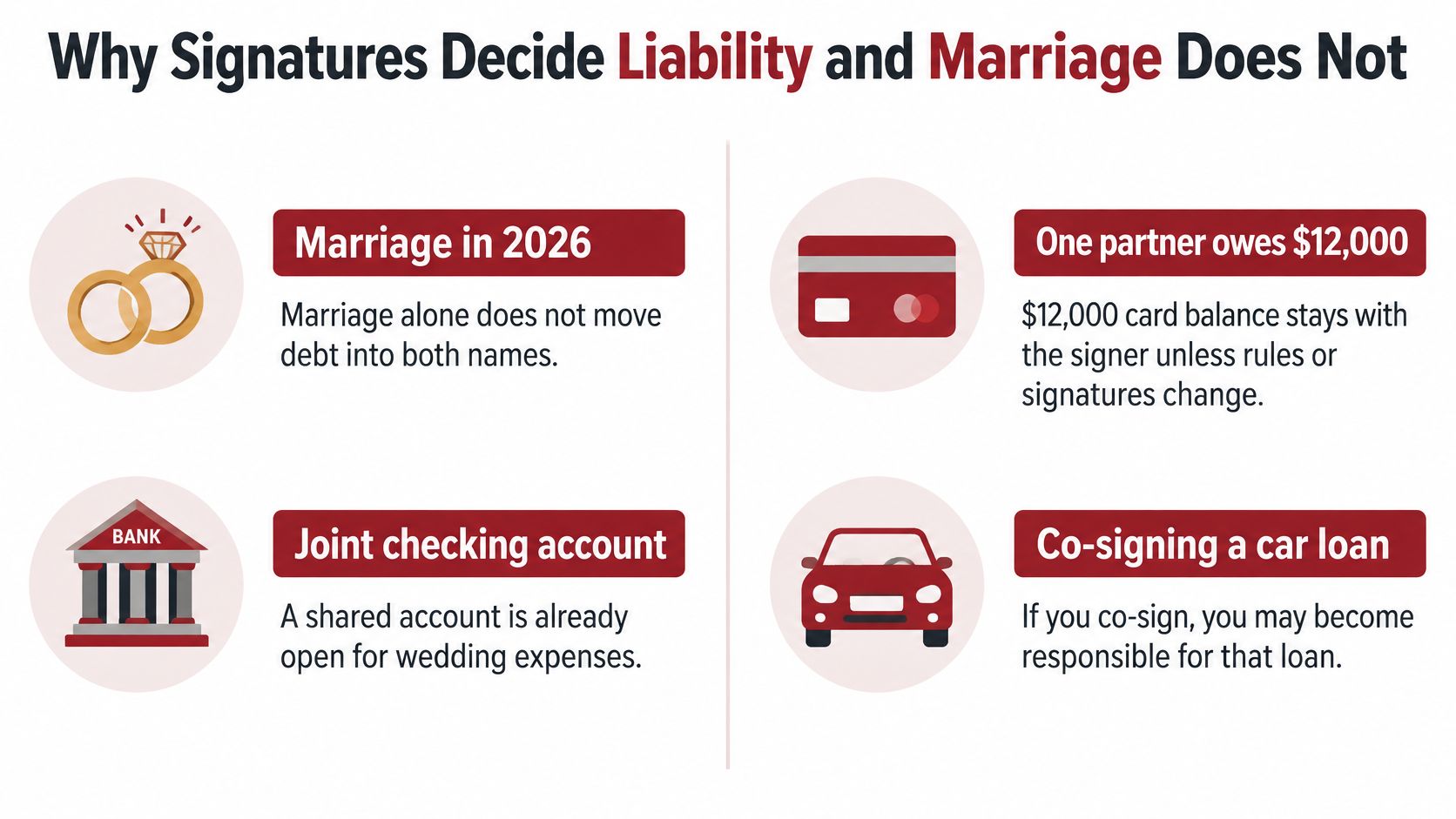
Creditors enforce the contract and the signature on file, not the marital relationship.
As the Georgia Secretary of State’s Marriage and Money guide explains, premarital debts such as student loans stay with the spouse who incurred them, while signing as a co-borrower, co-signer, or joint account holder makes you legally responsible for the balance.
Decoding the Four Labels on Any Account
Banks and lenders use four distinct labels on loan and credit contracts, and confusing them costs couples thousands of dollars:
- Primary Borrower: You signed the original agreement alone. Only you owe the creditor, and only your income and assets back the promise to pay.
- Co-Borrower: You and your spouse applied together and share ownership of the asset or credit line. Both of you owe the entire balance from day one, not a polite 50/50 split.
- Co-Signer or Guarantor: You backed your spouse’s loan so the lender would approve the deal or lower the rate. You receive no ownership right in the car or funds, yet if your spouse misses a single payment, the lender can demand the entire remaining balance straight from you. Before putting your name on a partner’s loan, review the full risks of co-signing debt for a loved one.
- Authorized User: Your spouse adds your name so you get a plastic card with your name embossed on it. You can swipe the card at the grocery store, yet you carry zero contractual obligation to pay the card issuer.
The Five-Minute Account Audit and the Conversion Trap
Run a quick check before merging a single dollar. Pull official credit reports for both of you from AnnualCreditReport.com and write every open account on one sheet of paper. Sort each line into four buckets: mine alone, theirs alone, joint, or authorized user.
Watch out for the account-conversion trap when calling a bank after the wedding. Asking a credit card issuer to “add my spouse to my account” can mean two wildly different things depending on the script the representative uses. Adding an authorized user creates convenience without liability, whereas converting a solo card into a joint account binds your name to the entire existing balance in a single phone call. Always ask for the updated cardholder agreement in writing before approving any change.
How State Law Changes the Picture When You Move
Signatures tell a lender who promised to pay. The state you live in tells a court which property that promise can touch. Move across a state line, and the second answer can change even though the signature on the old contract never did.
Most states follow separate-property, or common-law, rules. A smaller group follows community property: Arizona, California, Idaho, Louisiana, Nevada, New Mexico, Texas, Washington, and Wisconsin. In those states, income earned during the marriage and many debts taken on during the marriage belong to the marital community, not only to the spouse whose name is on the paperwork. Community property works like one shared pot. Separate property works like two wallets that stay distinct unless you deliberately mix them.
| Property regime | States | Default treatment of debt |
|---|---|---|
| Community property | Arizona, California, Idaho, Louisiana, Nevada, New Mexico, Texas, Washington, Wisconsin | Debts incurred during marriage can reach community property even if only one spouse signed |
| Separate property (common law) | Most other states, including Georgia | Each spouse is responsible for debts in their own name; premarital debts stay with the incurring spouse |
Read that table against four questions people usually mash into one. Who does the creditor have a right to collect from? Whose credit report absorbs the late marks? Which assets can a collector reach? What does one spouse’s later bankruptcy do to a debt the other never signed? A move can change those answers without changing the original contract.
Premarital balances do not hop onto the other spouse just because you now live in a community-property state. Old student loans, old credit cards, and other separate obligations stay with the spouse who created them. The shift shows up in new debts after the wedding. A household or family bill signed by only one spouse can still expose community wages and community property.
A separate-property state such as Georgia does not hand you your spouse’s individual credit card bill on the wedding day. As Consumer Financial Protection Bureau guidance on spousal debt makes clear, responsibility can still arise when a debt is shared or when state law steps in, including co-signed loans, joint accounts, and family-expense or necessaries rules for essential household costs.

Why Moving Across State Lines Complicates Old Balances
A new zip code does not wipe the property rules that applied when the debt was created. Which state’s law governs a dispute can depend on where you lived when the debt arose and which regime applied then, not only where you receive mail today.
A couple marries in Texas, puts household bills on a card in one spouse’s name, and moves to Athens, Georgia three years later. If that card defaults, the open question is whether the balance started as a community debt under Texas law. Georgia’s separate-property default does not automatically rewrite that history.
Treat the paper trail as the proof. Keep one folder, digital or paper, with the original loan agreements, the account-opening statements, and the receipts that show when each major debt arose and what it paid for. Those dates and purposes are what let you sort a balance into premarital versus marital, and into household versus purely separate, after a move.
Those records decide the legal question. General money skills only help you keep the folder current. Browsing free financial guides for schools from HearSmart is a way to find plain-English primers on budgeting, credit, and recordkeeping aimed at schools, not a map of what happens when a couple changes states.
When Shared Assets Are at Risk Even if You Owe Nothing
You can hold zero personal liability on a debt and still watch a joint bank account freeze overnight or see a jointly titled car towed from your driveway. That paradox catches couples off guard because they treat “I don’t owe the lender” as a force field around everything they own together.
Personal liability answers whether a creditor can sue you in your own name and garnish your solo paycheck. Asset exposure answers a different question: what property does your spouse legally own a piece of? If a creditor wins a court judgment against your spouse alone, state collection laws may allow that creditor to reach bank funds or property held in both names.
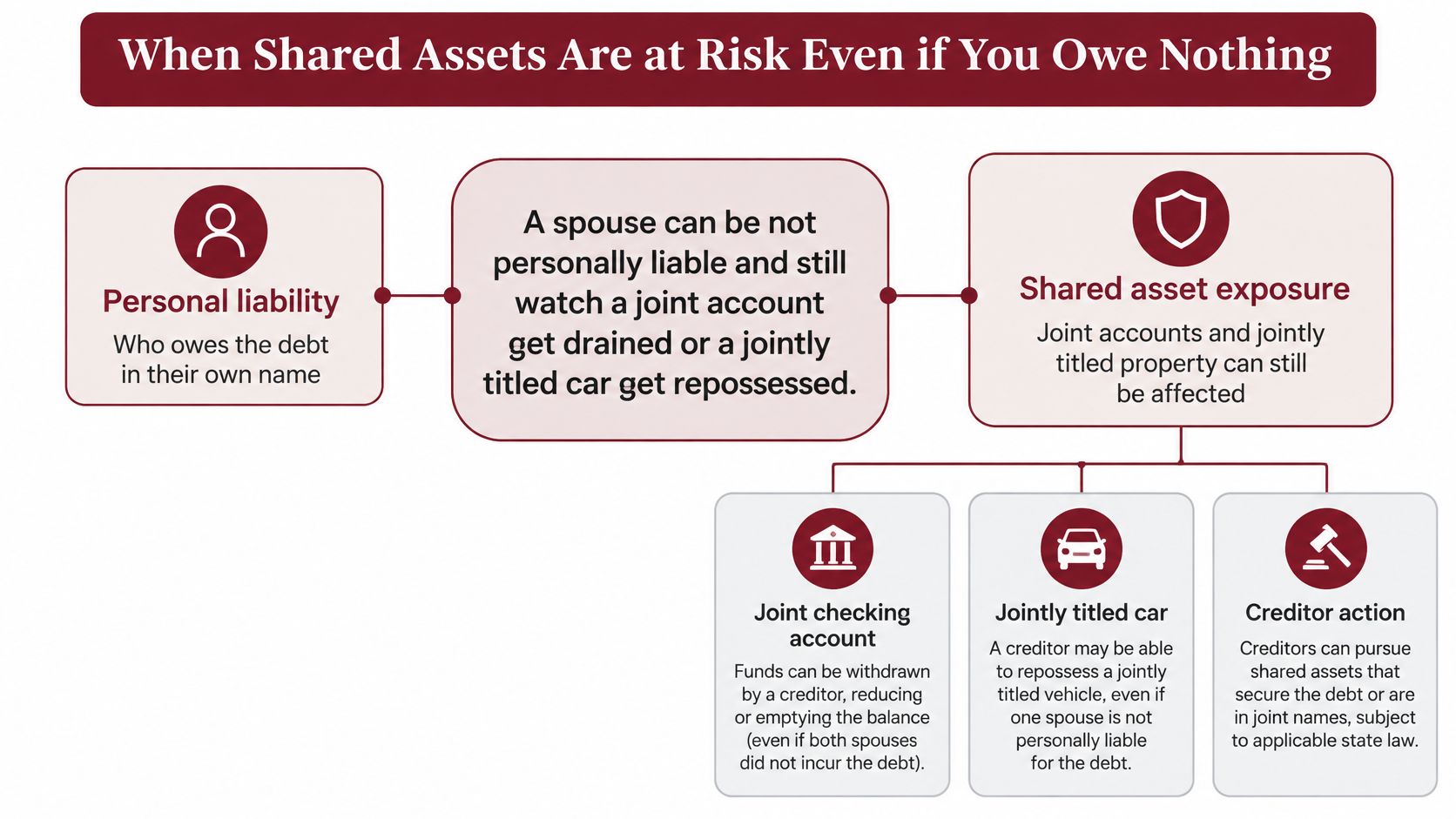
Where Everyday Household Assets Get Exposed
Four common marital arrangements create risk even when the underlying debt sits in only one name:
- Joint Checking and Savings Accounts: When you deposit your paycheck into a joint account with your spouse, the bank treats the pooled cash as accessible to either owner. A creditor levying your spouse’s bank accounts can hit those shared funds, forcing you to go to court to prove which dollars came solely from your wages.
- Jointly Titled Vehicles and Real Estate: Putting both names on a car title or home deed gives your spouse an ownership interest that judgment liens may attach to, depending on how title is held under state law. If the vehicle itself secures a joint loan, missed payments put the car straight into repossession.
- Joint Tax Refunds: Filing a joint federal or state tax return combines your refund into a single check. If your spouse owes back taxes, defaulted federal student loans, or past-due child support, the government can intercept the entire joint refund unless you file an injured spouse allocation with the IRS to reclaim your share.
- Shared Credit Lines and Credit Reporting: A joint credit card reports on both partners’ credit files, so a single 30-day late payment drags down the non-spending spouse’s credit score. By contrast, an authorized user isn’t legally liable for the balance, though a maxed-out card or missed payment can still show up on their credit profile until they request removal from the account.
Asset map rule: Before merging money, check three documents for every account: the ownership title, the account-holder signature card, and your planned tax filing status.
Build Your Pre-Wedding Asset Map
Take twenty minutes to draw a simple asset map before combining finances. List every checking account, savings account, vehicle title, home deed, brokerage account, and tax filing you plan to share. Next to each item, write whether your spouse carries an unpaid judgment, tax lien, or collection account that could touch it.
Keep any asset that doesn’t need two names in a separate account for now. If one spouse’s debts are already heavy enough that court filings are on the table, read up on how bankruptcy affects a non-filing spouse before transferring titles or moving cash between accounts, because last-minute transfers can create serious legal headaches in bankruptcy court.
Bankruptcy, Divorce and When to Call a Bankruptcy Attorney
Two major court events test every assumption couples make about spousal debt: bankruptcy and divorce. Many assume a judge’s order in either courtroom cleanly wipes the slate for both partners. In reality, both systems leave specific traps for the spouse who didn’t read the fine print.
What One Spouse’s Bankruptcy Does to the Other
When one spouse files Chapter 7 bankruptcy individually, the court discharge wipes out that filer’s personal obligation on many unsecured debts, such as credit cards and medical bills. That discharge does not erase a non-filing spouse’s contractual duty on a joint debt. If you co-signed a personal loan or held a joint credit card with your spouse, the creditor can’t chase the spouse who filed, so the lender turns straight to you for the entire remaining balance.
Certain obligations survive Chapter 7 for the filer as well. In Chapter 7, some debts such as taxes, student loans, and divorce or child support obligations cannot be discharged. Debts that have collateral, such as a car loan or a home mortgage, must be reaffirmed in order to protect the collateral. Reaffirmation matters most when both names sit on the deed or vehicle title, because walking away from the loan hands the lender the right to foreclose or repossess the shared property.
A Chapter 13 case works differently. A Chapter 13 case allows an individual or married couple with regular income to deal with their debts by making regular payments to a Chapter 13 Trustee over a period of 3 to 5 years. Filing Chapter 13 can stop a foreclosure, a car repossession, and wage garnishments, and lets you deal with your debts at a payment level you can afford while protecting shared household property.
Why a Divorce Decree Does Not Release You from a Lender
Divorce courts operate on a separate track from credit contracts. Georgia follows equitable distribution rather than an automatic 50/50 split, meaning a judge divides marital assets and marital debts based on fairness and the couple’s specific circumstances. Even a balance held in one spouse’s name during marriage can enter that courtroom calculation.
Here is the trap that blindsides divorced spouses every week. According to Consumer Financial Protection Bureau guidance on debt after divorce, if both spouses signed a mortgage, car loan, or joint credit card, a divorce decree ordering one spouse to pay that debt usually does not release the other spouse from the lender’s legal claim. The bank wasn’t a party to your divorce case.
A family court judge can order your ex-spouse to pay a joint loan, yet the lender can still sue you and damage your credit if your ex stops paying.
True separation from a joint debt requires the lender’s written agreement, typically through refinancing the loan solely into one spouse’s name or obtaining a formal written release from the creditor. When both financial distress and a breakup hit at the same time, timing changes everything, and understanding whether divorce or bankruptcy should come first helps you avoid paying legal fees twice or getting stuck with discharged joint debt.
Clear Trigger Points to Call a Bankruptcy Attorney
Waiting until a sheriff serves a lawsuit or a bank account hits zero strips away your best options. Reach out for legal advice right away if any of these warning signs appear in your household:
- Unsustainable Monthly Minimums: Combined debt payments consume so much of your take-home pay that you’re putting groceries or utilities on credit cards just to stay afloat.
- Collection Threats Against Shared Money: A creditor sues one spouse, threatens wage garnishment, or obtains a judgment that could target a joint checking account.
- Collateral in Immediate Danger: You’ve fallen behind on a jointly titled home mortgage or auto loan and received a default notice, foreclosure letter, or repossession warning.
- Solo Filing With Joint Signatures: One spouse is preparing to file bankruptcy individually while the other spouse’s name still sits on shared credit cards, car notes, or personal loans.
Because the right move depends on whose signature sits on each contract, when and where the debt began, and how your property is titled, generic internet rules fall short once real money is on the line. At Morgan & Morgan Attorneys at Law P.C., we offer a free consultation to fully review your financial situation and walk through every debt relief option before you make a move you can’t undo.
A Practical Checklist Before You Combine Finances
Good intentions don’t protect a household budget when an old collector calls. Turning legal rules into a concrete monthly routine keeps both partners informed and avoids accidental joint liability.
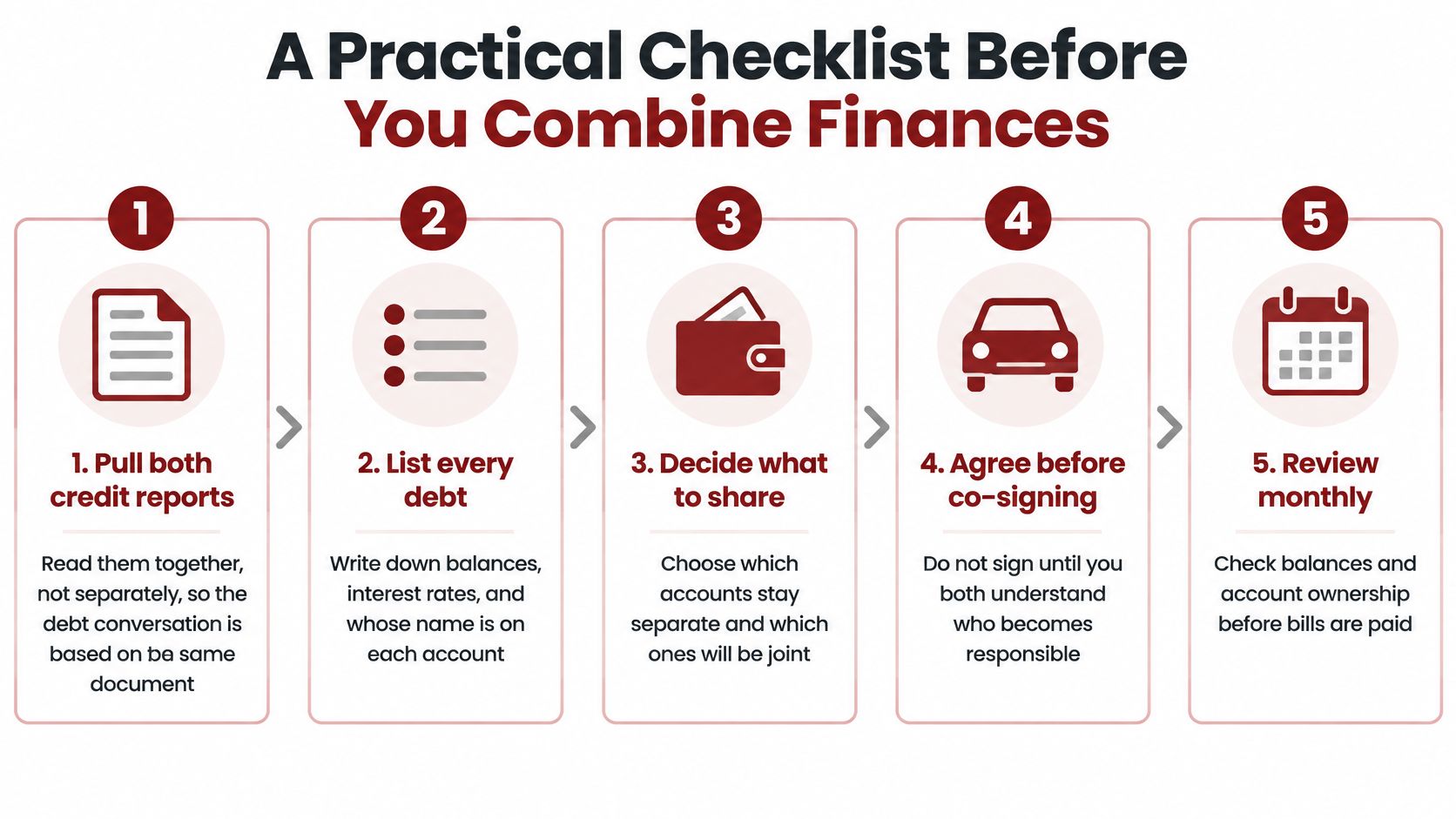
Nine Steps to Run Before Merging Accounts
- Review whether a prenuptial agreement makes sense. A prenup can spell out how premarital and future debts are divided between the two of you, though how courts enforce those terms and whether they bind outside creditors depends on state law.
- Pull both credit reports and read them side by side. Sit at the same table with both full reports printed out so your financial plan rests on real account statements instead of rough guesses.
- Label ownership status on every open line. Write “mine alone,” “theirs alone,” “joint,” or “authorized user” next to each creditor, because the account agreement decides who gets sued if payments stop.
- Pause before saying yes to any co-signing request. Treat co-signing as taking out the entire loan yourself. If you still decide to co-sign, agree in writing inside your household budget on who funds each payment and how you’ll monitor the account monthly.
- Keep two individual accounts alongside one joint bill account. Deposit only the agreed monthly amount for shared rent, utilities, and groceries into the joint checking account. Keeping personal savings separate limits what a creditor holding a judgment against one spouse can reach.
- Check titles and tax filing status deliberately. Before adding a second name to a vehicle title or house deed, verify whether any unpaid liens or judgments exist. If one spouse carries back taxes or defaulted federal loans, ask a tax preparer whether filing separately or filing an injured spouse allocation protects your refund.
- Save proof of when each debt started and what it funded. Keep digital scans of loan origination papers and payoff histories, since those dates settle state-law disputes if you ever relocate.
- Run a complete debt conversation script. Put six exact numbers on paper for both partners: total balance, interest rate, minimum monthly payment, any IRS or state tax debt, student loans that won’t disappear in bankruptcy, and which paycheck covers each bill. For practical budgeting frameworks once those numbers are on the table, review these steps to combine money as spouses from The Money Maniac.
- Bring in a professional early if the math breaks. If a debt is already joint and the monthly minimums don’t fit your combined income, get legal guidance while structured repayment options and asset protections are still wide open.
If you’re planning a wedding, combining accounts, or untangling joint debts that already feel too heavy, talking through the exact contracts on your table beats guessing from general rules. The attorneys at Morgan & Morgan Attorneys at Law P.C. work directly with Athens and Georgia individuals and couples to review credit reports, explain how Chapter 7 or Chapter 13 affects each spouse, and protect shared assets from creditors. Schedule a free consultation today so you can enter your next chapter with a clear plan instead of unpleasant surprises.

Lee Paulk Morgan
With more than 41 years of experience in the areas of Bankruptcy, Disability, and Workers’ Compensation, Lee Paulk Morgan is one of the most respected Bankruptcy and Disability attorneys in Athens, Georgia. His tireless dedication to serving clients has gained him the reputation of a premier attorney in his areas of practice, as well as the trust and respect of other legal experts, who often refer clients to him.
SHARE
RELATED POSTS

Delete Bankruptcy From Credit Report (When It Can Work)
Search for advice on how to delete bankruptcy from credit report and you’ll find the same recommendation in a dozen places. Dispute the entry and get it removed. That advice fails often enough to cost…

How Does Bankruptcy Affect Your Spouse? (Georgia Guide)
Your spouse’s bankruptcy does not automatically put you into bankruptcy, but joint debts and shared property can still affect you. If you never signed the loan, could you still lose access to money in a…