
Blog

How Much Compensation For Assault At Work In Georgia
You’re at work when a customer, patient, coworker, or stranger suddenly becomes violent. After the police leave and the immediate danger passes, a different question takes over: how much compensation for assault at work might be available in Georgia? The honest answer isn’t a single number printed on a chart.
The same incident can produce different results depending on whether you suffered a physical injury, a diagnosed psychological injury, or both. The claim route also matters. Workers’ compensation and a civil personal injury claim are different doors, with different rules and different types of recovery. Your medical records, time away from work, future treatment, and evidence of what happened can determine how far a claim goes.
What Happens After an Assault at Work and Why Compensation Varies
Suppose a retail employee is struck by a customer during a shift. The employee has bruising, misses some work, and returns after treatment. Another employee in the same store witnesses a similar attack but develops panic symptoms, insomnia, and a diagnosed trauma-related condition. Both workers experienced workplace violence, but their claims may look very different because their injuries and losses are different.
The first employee’s claim may focus on emergency care, follow-up visits, medication, and wage loss. The second may need continuing psychological treatment and may be unable to return to the same customer-facing role. A visible injury isn’t always the most expensive part of an assault. Psychological harm can affect work capacity and treatment needs long after bruises have healed.
The practical question isn’t only “What happened?” It’s also “What injury did the event cause, how is that injury documented, and which legal route applies?”
Georgia workers’ compensation generally focuses on injuries connected to employment, while a separate civil claim may depend on who attacked you and whether another party’s conduct created legal responsibility. A criminal case can also exist, but prosecution of the assailant doesn’t replace your own claim for medical care, wage-related benefits, or other legally available recovery.
Research from other compensation systems shows why broad assumptions can mislead. In Australia, accepted workers’ compensation data recorded 53,139 claims for assaults by a person or persons and 12,721 claims for exposure to workplace or occupational violence over the last 10 years. Safe Work Australia also reports that serious workers’ compensation claims for workplace violence and assault increased 56% from 2017–18 to 2021–22. These figures show that workplace assault claims are measurable, but they don’t create a Georgia payout schedule for an individual case. (Safe Work Australia’s workplace violence and aggression data)
The useful starting point is to separate the case into three questions: what injury occurred, what losses followed, and what claim path can legally address them? Once those questions are answered, the compensation estimate becomes more grounded and less dependent on an unreliable headline number.
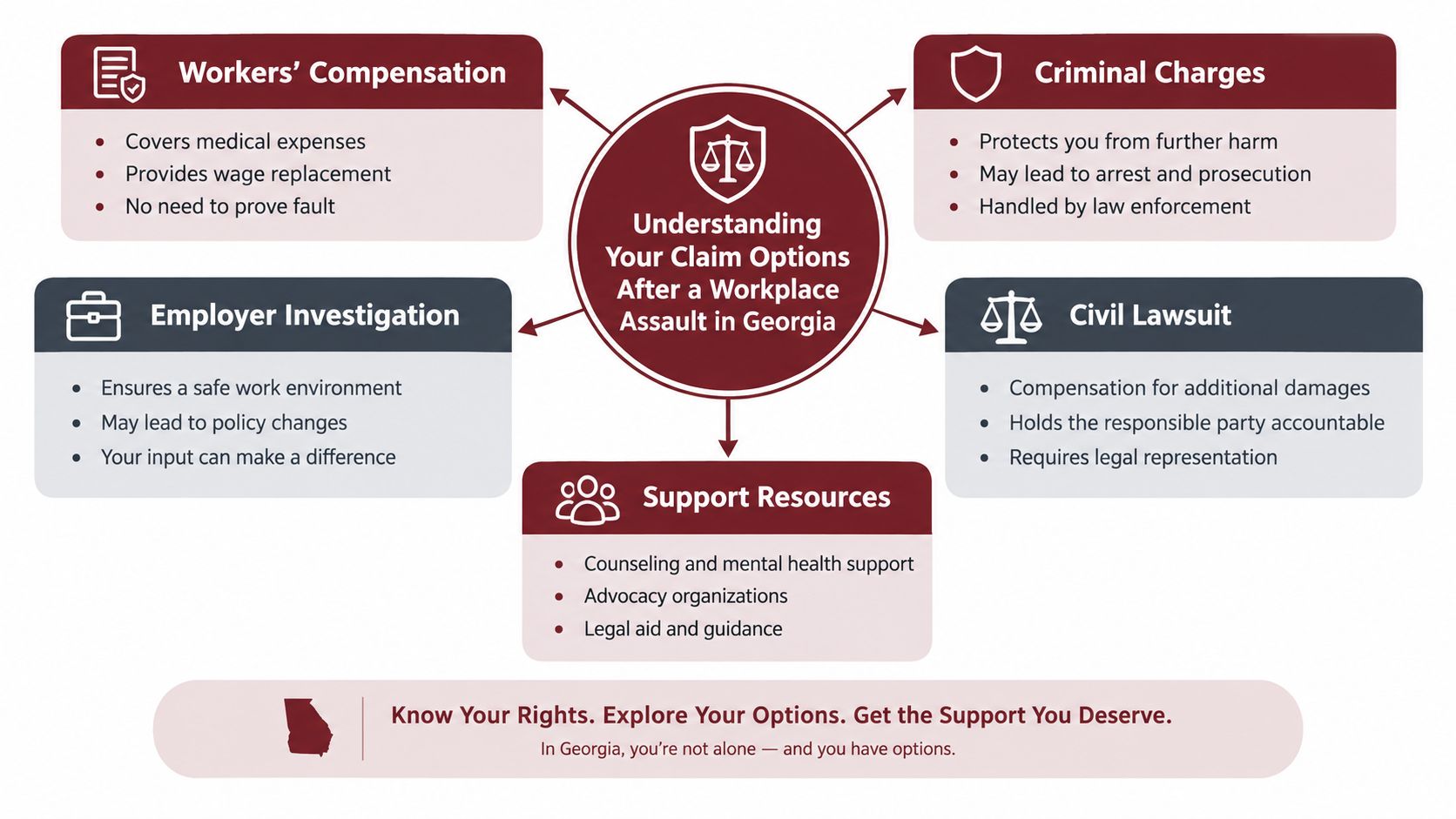
Understanding Your Claim Options After a Workplace Assault in Georgia
After an assault, think of your legal options as a fork in the road. One path leads into the workers’ compensation system. The other may lead to a civil personal injury claim against the assailant, an employer in appropriate circumstances, a property owner, or another responsible third party. Some cases may involve more than one potential source of recovery, but the rules governing those paths aren’t interchangeable.
The workers’ compensation path
Workers’ compensation is designed for injuries arising out of and in the course of employment. The central issue usually isn’t whether your employer intended the assault or acted negligently. Instead, the analysis focuses on the employment connection, the injury, and the benefits allowed under the applicable system.
That path can address necessary medical treatment and income-related benefits when a covered workplace injury prevents you from working or limits your ability to perform your job. An assault by a customer during assigned duties may be treated differently from an entirely personal dispute that happens to occur at the workplace. The facts matter, including where the incident occurred, why you were there, and whether the event was connected to your job.
The civil claim path
A civil personal injury claim is usually built around responsibility and fault. The possible defendant may be the attacker, an employer whose conduct created a legally actionable risk, a security company, a property owner, or another third party. A civil case can involve losses that workers’ compensation handles differently, but it also requires proof of the elements of the claim.
A civil route may be worth examining when a third party caused the harm or when the facts raise questions about negligent security, supervision, or failure to respond to known threats. It isn’t automatic just because an assault occurred at work.
For a plain-language comparison of the systems, review workers’ compensation versus personal injury claims. The criminal process is separate. Prosecutors may pursue charges against the assailant, but you shouldn’t assume a criminal case will pay your medical bills or replace lost income. A victim may need to protect a compensation claim independently while law enforcement handles the criminal investigation.
Types of Compensation Available for Assault at Work
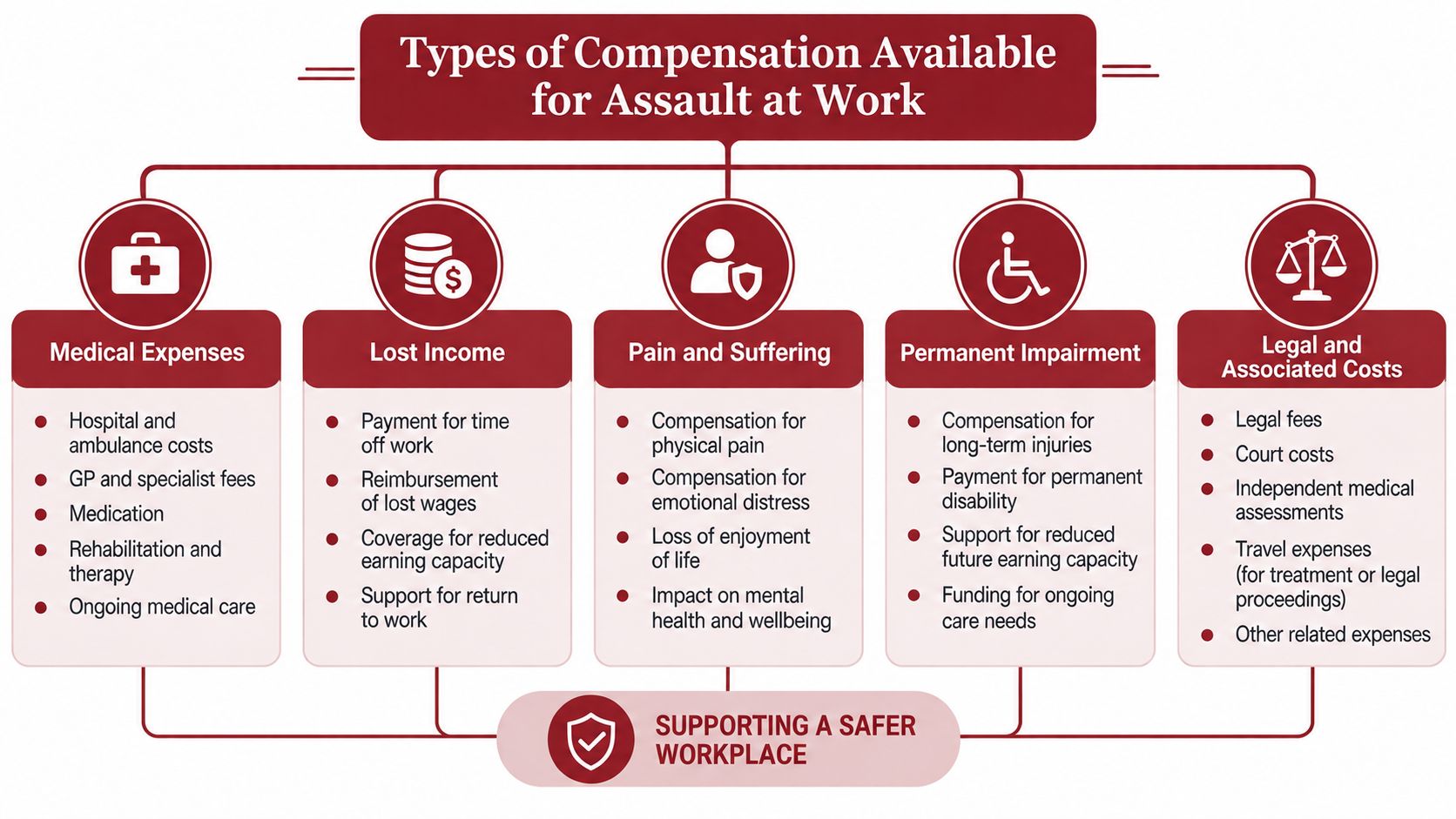
Compensation is easier to understand as layers rather than one lump sum. The first layer reflects the injury itself. Additional layers account for the financial consequences that follow, such as treatment expenses, lost earnings, and costs connected to recovery.
General damages and psychological harm
In a civil case, general damages may address pain, suffering, emotional distress, and psychiatric harm. The value depends heavily on severity, diagnosis, duration, and how the condition affects daily life and employment. A short period of distress supported by limited treatment is different from a diagnosed condition requiring ongoing care and work restrictions.
A UK compensation reference illustrates the range created by psychiatric severity. It lists indicative bands from about £6,540 for less severe psychiatric injury to roughly £122,850 for severe psychiatric harm, before special damages are added. Those figures aren’t Georgia awards, but they demonstrate why diagnosis and functional impact matter more than the label “assault” alone. (Workplace assault compensation guidance)
Medical treatment and rehabilitation
Medical expenses may include emergency care, physician visits, diagnostic testing, medication, physical therapy, and other reasonable treatment. Psychological treatment can be just as important. Counseling, psychiatric care, trauma treatment, and prescribed medication may document that the assault caused more than temporary fear or upset.
Keep every bill, explanation of benefits, pharmacy receipt, mileage record, and provider recommendation. Don’t assume a cost is too small to matter. A series of modest expenses can become significant when treatment continues.
Lost wages and future earning impact
An assault can create immediate wage loss when you miss shifts or cannot work full duty. A longer recovery may affect overtime, bonuses, job placement, or your ability to return to the same occupation. Medical restrictions and employer records help connect the injury to the income disruption.
If you can work only in a lower-paying role, or you can’t perform the duties you held before the attack, future earning capacity may become an important issue in a civil claim. Workers’ compensation benefits follow their own statutory structure, so the available remedy depends on the claim route.
Out-of-pocket and future care costs
Special damages can be layered on top of general damages. They may include lost wages, counseling, medication, mobility aids, travel for treatment, and security measures, depending on the applicable law and the evidence. The UK guidance cited above describes this additive structure and notes that a CICA summary lists a minimum award of £1,000, a maximum tariff award of £250,000, and an overall cap of £500,000 when loss of earnings and special expenses are included. Those are UK benchmarks, not Georgia limits. (UK workplace assault claim guidance)
Punitive damages are not a routine feature of every workplace assault case. They generally require conduct beyond ordinary carelessness and depend on the facts and governing law. Don’t build an estimate around them unless an attorney identifies a legally supportable basis.
Documentation turns a general allegation of harm into a record of treatment, limitations, and financial loss.
Factors That Affect How Much Compensation You Receive in Georgia
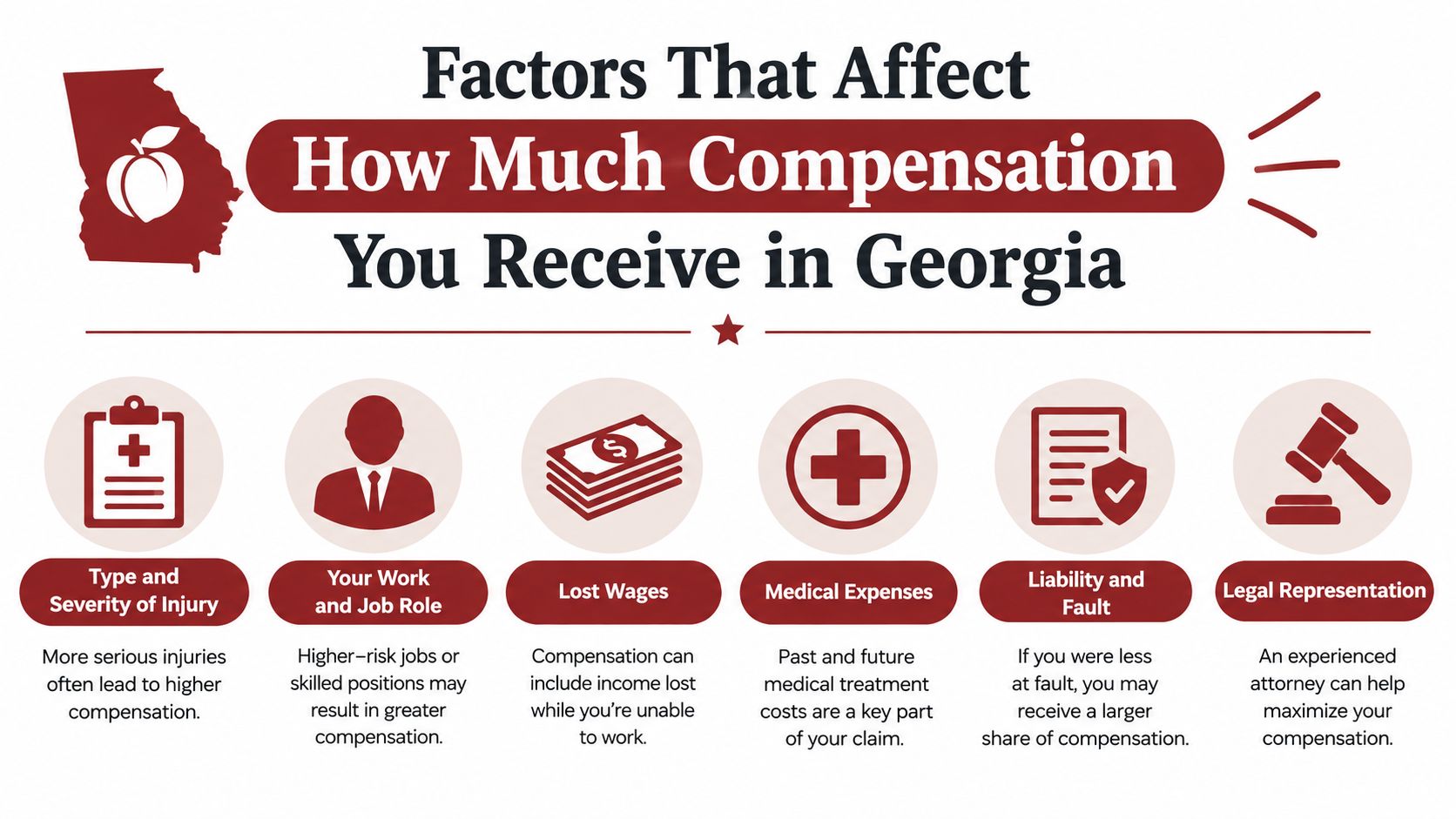
The amount of compensation depends less on the word “assault” than on the consequences that can be proven. Two people may report the same type of attack, but one may recover quickly while the other develops a lasting condition that affects work, relationships, and daily activities.
Injury classification changes the analysis
Start by asking whether the claim involves a physical injury, a psychological injury, or both. Safe Work Australia separately tracks accepted claims caused by mental stress and physical injuries. In a review of 1,219 psychological injury cases, physical assault or violence accounted for 20.26% of claims. (Safe Work Australia’s psychological injury information)
That distinction matters in Georgia because a psychological condition needs credible medical support and a clear connection to the workplace event. Repeated threats, witnessing violence, or nonphysical aggression may be relevant when they produce a compensable mental injury, but the legal test and available remedy depend on the claim route and facts.
Duration and functional impact
A person who needs brief treatment and returns to normal duties may have fewer documented losses than someone who requires extended care or cannot return to the same job. A diagnosis alone doesn’t determine value. The record should show symptoms, treatment, restrictions, missed work, and expected recovery.
Mental injuries can carry substantial long-term costs because recovery may take longer and work disruption may be greater. The same Australian source reports that mental stress claims represented 6.3% of all claims, with an average of 17.6 weeks of lost time per claim and an average cost of $28,400. These figures describe that system, not Georgia, but they show why psychological harm shouldn’t be treated as minor because it isn’t visible. (Safe Work Australia’s psychological injury information)
Evidence and responsibility
Medical records should connect the condition to the assault without unexplained gaps. Incident reports, witness accounts, video, messages, prior complaints, scheduling records, and employer communications may help establish what happened and how the workplace responded.
A civil claim may also turn on whether another party failed to take reasonable precautions or ignored known risks. Workers’ compensation may not require the same fault showing, but disputes can still arise over whether the event was work-related or whether the claimed condition resulted from it.
Georgia rules can also limit or shape available damages through the applicable claim system. That’s why an online settlement range can be misleading without knowing the injury classification, defendants, employment records, and treatment outlook.
Typical Award Ranges and Real World Assault at Work Examples
No responsible attorney can promise a Georgia payout from a short description of an assault. The scenarios below are illustrations, not predictions or guaranteed award ranges. They show how compensation layers can change as the injury, work absence, and future care become more serious.
| Scenario | Injuries and Time Off | Compensation Layers Included |
|---|---|---|
| Limited physical injury | Bruising or a minor soft-tissue injury, short treatment, quick return to regular duties | Medical care, medication, documented wage loss, and any legally available damages supported by the claim route |
| Psychological injury with extended absence | Physical symptoms may resolve, but diagnosed trauma symptoms require counseling, work restrictions, and extended leave | Ongoing psychological treatment, medication, wage-related benefits or lost income, and possible future care costs |
| Severe injury with lasting disability | Serious physical harm, significant psychiatric effects, prolonged inability to work, or permanent restrictions | Extensive medical treatment, rehabilitation, wage loss, reduced earning capacity, future care, and other recoverable damages supported by evidence |
The third-party facts can change the analysis. San Francisco’s 2025 workers’ compensation council presentation reported 322 violent incidents year-to-date, including 188 verbal incidents, 124 physical incidents, and 10 social-media incidents. It also reported 309 assault claims and about $3.98 million in fiscal-year assault-claim costs. The city data identified client assaults as 72% of reported workplace assault data, compared with 19% for stranger assaults and 9% for coworker assaults. These figures come from San Francisco, not Georgia, but they highlight an important point: customer or patient violence and repeated threats can create serious claims even when the attacker isn’t a stranger. (San Francisco Workers’ Compensation Council presentation)
Ontario provides another historical comparison. From 2002–2015, Ontario recorded 29,908 lost-time workers’ compensation claims involving an assault or violent act. The workplace violence injury rate was about 0.2–0.5 per 1,000 full-time equivalent workers, and the share of all compensation claims attributed to workplace violence rose from 1.7% in 2004 to 3.0% in 2013. (Peer-reviewed study summary on Ontario workplace violence claims)
For a starting point in organizing wage and benefit information, you can review the workers’ compensation benefits calculator. Use it as an organizing tool, not as a substitute for a case-specific legal evaluation.
Evidence Deadlines and Next Steps After a Workplace Assault
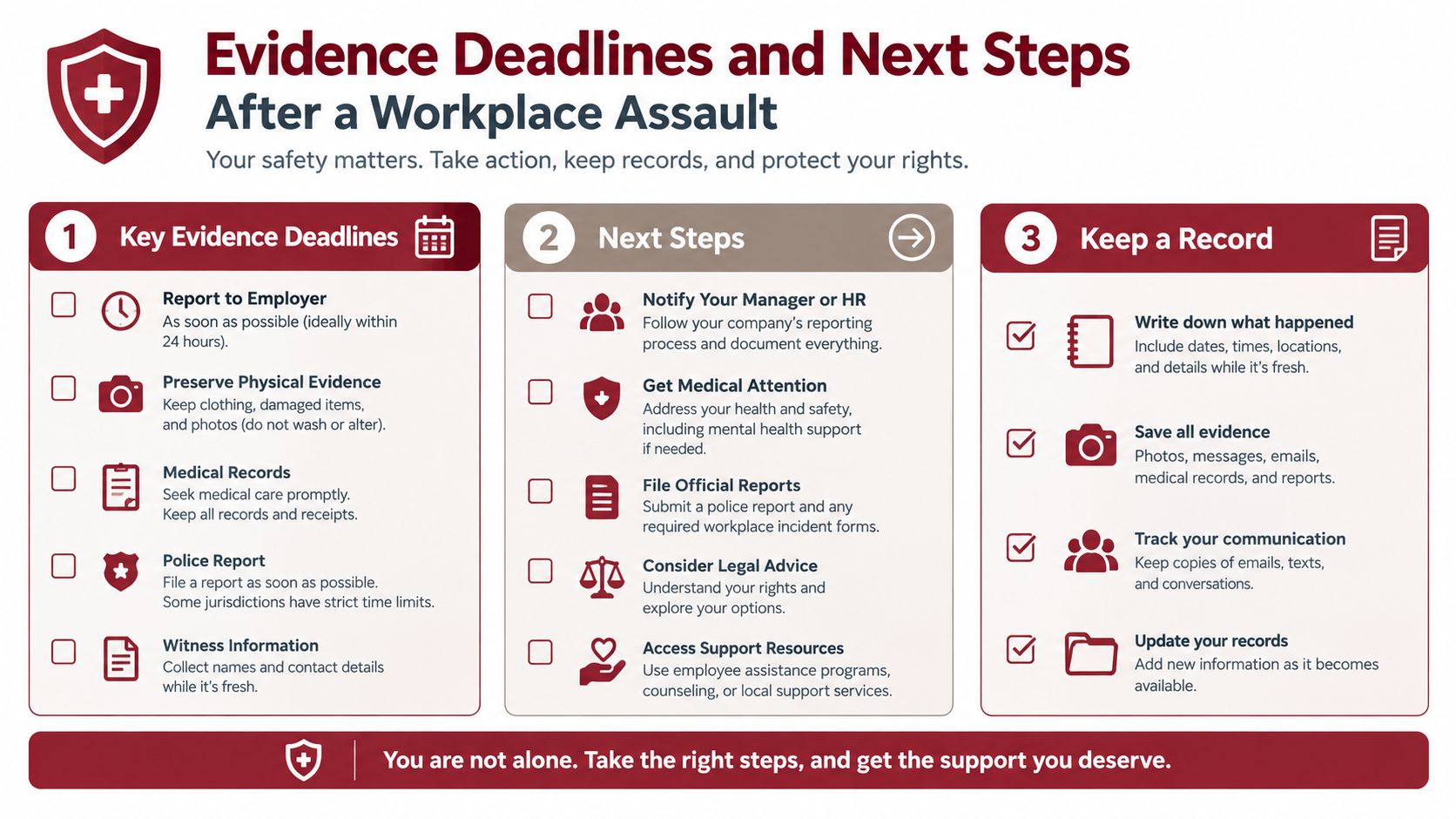
Act promptly, even if the injury seems manageable. Physical symptoms may appear immediately, while psychological symptoms can develop or become more obvious later.
Use this checklist:
- Get to safety and report the incident. Tell a supervisor or designated employer contact as soon as possible, and request a written incident report.
- Seek medical and psychological evaluation. Explain that the condition followed a workplace assault, and describe every symptom, including fear, sleep problems, panic, and difficulty returning to work.
- Preserve evidence. Save photographs, messages, emails, schedules, witness names, security information, medical records, pay records, and receipts.
- Avoid minimizing the injury. A lack of bruising doesn’t rule out a serious psychological condition.
- Get advice before signing a release. A settlement or employer document may affect other legal options.
Workers’ compensation and civil claims can have different notice and filing deadlines. The correct deadline depends on the claim type and facts, so don’t rely on a general internet statement. If the employer disputes the injury, an insurer delays treatment, or a third party may be responsible, review the issue with counsel promptly. Guidance on responding after a denial is available through workers’ compensation claim denial options.
Getting the Right Support to Maximize Your Assault at Work Claim
The most reliable way to evaluate how much compensation for assault at work may be available is to stop treating the case as a single-number question. First identify the injury. Then determine whether workers’ compensation, a civil claim, or both may apply. Finally, connect every claimed loss to medical evidence, employment records, and receipts.
Psychological harm deserves the same careful attention as a fracture or other visible injury. A person may appear physically recovered while remaining unable to return to the same workplace, interact with customers, or perform familiar duties. Early treatment creates a clearer record of what changed after the assault.
Morgan & Morgan Attorneys at Law P.C. offers workers’ compensation claim representation and can discuss workplace injury circumstances, documentation, and available next steps with Georgia workers. A consultation can help you understand whether the claim should be presented through workers’ compensation, evaluated as a possible third-party case, or examined under both frameworks.
If you were assaulted at work in Georgia, gather your incident report, medical records, wage information, and witness details before contacting Morgan & Morgan Attorneys at Law P.C.. Request a consultation to discuss the physical and psychological injuries you’re experiencing, the claim route that may fit, and the evidence needed to protect your recovery.

Lee Paulk Morgan
With more than 41 years of experience in the areas of Bankruptcy, Disability, and Workers’ Compensation, Lee Paulk Morgan is one of the most respected Bankruptcy and Disability attorneys in Athens, Georgia. His tireless dedication to serving clients has gained him the reputation of a premier attorney in his areas of practice, as well as the trust and respect of other legal experts, who often refer clients to him.
SHARE
RELATED POSTS

Do You Get Drug Tested For Workers Comp in Georgia
No, you are not automatically drug tested after a workplace injury in Georgia. An employer with a qualifying drug-free workplace program can require testing after a lost-time injury, and the result can create a rebuttable…

How Long Does It Take Workers Comp To Approve Surgery
In Georgia, when an authorized treating physician submits a complete Form WC-205 for surgical approval, the insurer has 5 business days to respond. If the insurer doesn’t respond within that period, the requested treatment is…