
Blog

Can I Resign While On Workers Compensation In Georgia
You’re sitting in your car outside the warehouse with a resignation letter on your phone. Your shoulder still hurts, the light-duty assignment made it worse, and every conversation with your supervisor leaves you wondering whether staying is costing you your health. The question feels simple: can you resign while on workers compensation in Georgia?
Yes, you can resign. But you shouldn’t treat resignation as a harmless administrative step. In Georgia, leaving your job can affect your wage checks, change the insurer’s argument about why you’re not working, and alter your negotiating position. Your medical claim may continue, but your income benefits can become much harder to protect.
The safest approach is to separate the decision into three questions: What happens to your wage checks? What happens to your medical care? What happens to your settlement position? Those answers are different, and confusing them is how injured workers lose benefits they might otherwise preserve.
What Happens the Moment You Hand In Your Notice
A resignation is generally a voluntary act. Your employer can’t retaliate against you for filing or pursuing a workers’ compensation claim, but the employer and insurer can still argue that you chose to leave the workforce. That distinction matters immediately.
Suppose your authorized doctor has restricted you to light duty, and your employer offers work that aggravates your shoulder. If you resign without documenting the problem, the insurer may say your lost income comes from your decision to quit, not from your injury. That argument can put temporary total disability, or TT benefits, and income benefits based on reduced work capacity at risk.
What usually stays in place
Your resignation doesn’t automatically erase an accepted injury claim. Authorized treatment for the covered injury can continue while the claim remains open and the care remains connected to the workplace injury. That can include physician visits, prescribed treatment, and other authorized medical services.
The insurer also can’t cancel treatment because you submitted a resignation letter. If it wants to challenge care, it must use the applicable workers’ compensation process. Your injury deadline doesn’t restart because you quit, either. Resignation changes the employment relationship, not the historical date of the accident.
Practical rule: Never assume that continued medical care means continued wage checks. They are separate parts of the claim.
What usually changes
The biggest immediate risk is wage replacement. Once you stop working voluntarily, the insurer may argue that you removed yourself from the labor market and that your lost wages no longer result from the injury. That can lead to a suspension or challenge to TT or income-maintenance benefits.
Your settlement position can also shift. An insurer may have less pressure to resolve wage exposure when it believes your checks can be stopped. Quitting is your right, but it redraws the map of who owes you what.
The Three Buckets Inside a Georgia Workers Comp Claim
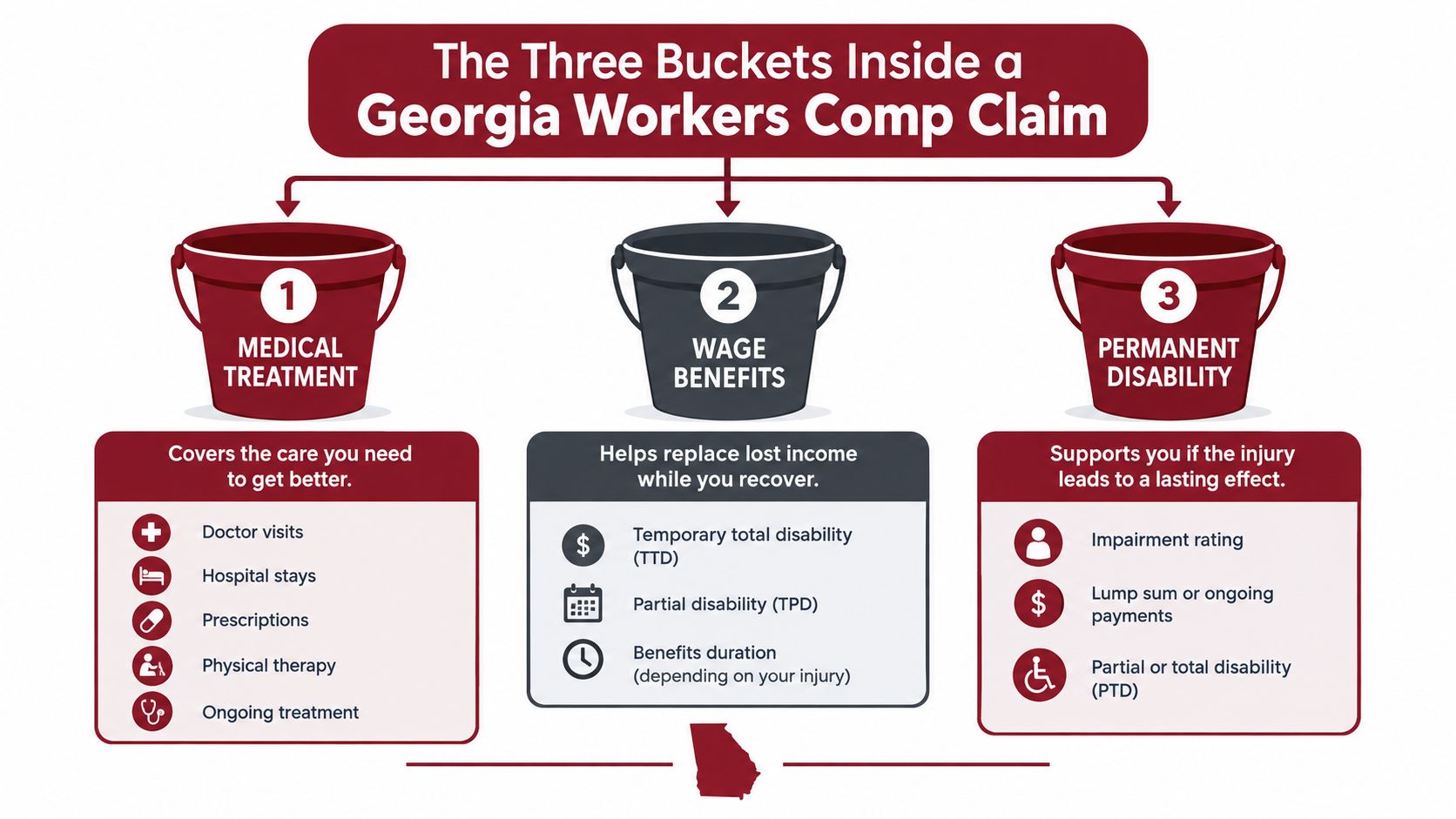
Think of a Georgia workers’ compensation claim as three separate buckets. Resignation doesn’t move all three in the same way.
The first bucket is medical care. This covers authorized treatment for the accepted injury, such as appointments, therapy, prescriptions, and related expenses that remain reasonable and necessary. Leaving the employer doesn’t automatically empty this bucket. The insurer can still dispute treatment, but the dispute concerns medical authorization and necessity, not the fact that you resigned.
The second bucket is wage replacement. Georgia claims may involve temporary total disability while you can’t work and temporary partial disability when you can work but earn less because of medical restrictions. The amount and continuation of those benefits depend on the claim’s facts, your restrictions, your earnings, and the reason you stopped working. A voluntary resignation gives the insurer a direct argument that the wage loss comes from your choice rather than your injury.
The third bucket is settlement. A compromise settlement may address future medical exposure, disputed wage benefits, permanent impairment, and the uncertainty of continuing litigation. Once you quit, the insurer may argue that future wage exposure is limited. That doesn’t eliminate settlement rights, but it can change the number and the issues being negotiated.
Where partial disability fits
Partial disability deserves separate attention because light duty can create a wage gap rather than a complete loss of earnings. Keep your pre-injury wages, restricted-duty pay, work hours, and physician restrictions together. For a plain-language explanation of how partial disability affects your claim, review the Nares Law Group LLC resource before making an employment decision.
The short version is direct: medical care can continue on its own track, wage checks are the bucket most directly threatened by resignation, and settlement negotiations must account for the new wage-loss argument.
How Georgia Law Actually Treats a Voluntary Quit
Georgia law protects workers from retaliation for pursuing workers’ compensation. O.C.G.A. § 34-9-19 addresses retaliatory treatment, and a worker who believes an employer punished the claim through a job action must act within the applicable filing period. The Georgia workers’ compensation retaliation guide explains the evidence that can matter, including communications showing that the claim caused the employer’s action.
That protection doesn’t turn every resignation into retaliation. The Board will look at what happened before the resignation, what the employer offered, what your doctor restricted, and why you left. If you quit for reasons unrelated to the injury, the insurer will likely argue that you voluntarily withdrew from employment and that the resulting wage loss isn’t compensable.
The reason for leaving matters
A resignation connected to an unsafe or medically unsuitable light-duty assignment is different from a resignation to pursue an unrelated opportunity. The label alone won’t decide the case. Documents do.
Your doctor’s restrictions, written job descriptions, emails about pain, requests for accommodation, reports of worsening symptoms, and evidence of a genuine job search can help establish that the quit was tied to the injury. A short resignation letter that says only “personal reasons” may give the insurer a cleaner argument.
A change in condition isn’t erased
Georgia workers’ compensation law includes a change-in-condition process under O.C.G.A. § 34-9-104. The Board can address a worsening condition even after wage benefits have stopped, subject to the governing requirements and filing deadlines. The 400-week reconsideration window is a major limit in the Georgia framework, not permission to ignore deadlines.
For example, a worker might leave Georgia for a lower-paying job, face a suspension of wage benefits after the insurer argues voluntary abandonment, and still preserve medical treatment and a later change-in-condition argument if the injury worsens. The worker should not assume that quitting destroys every future remedy. It does mean the claim must be managed carefully.
A Real Georgia Walk Through of What Changes After You Quit
Consider Maria, a Gwinnett County warehouse worker who injures her back lifting a pallet. Her doctor places her on restrictions, and the employer offers light duty at a lower hourly rate. Maria believes the assigned tasks worsen her symptoms, but she doesn’t want to keep fighting with her supervisor, so she signs a two-week resignation notice.
The insurer’s adjuster then stops her wage checks and argues that Maria made herself unemployed. The adjuster doesn’t necessarily have the power to decide the final issue alone, but the insurer can file paperwork seeking to suspend benefits and force the dispute into the State Board process. Maria’s authorized surgeon visits may continue because the injury remains accepted, while the wage portion becomes contested.
The documents that shape the dispute
Maria’s evidence needs to show more than frustration. Her attorney would gather:
- Medical restrictions: The treating physician’s work status notes and any statement connecting the assigned duties to increased symptoms.
- The light-duty offer: The written job description, schedule, pay information, and proof of whether the work matched the restrictions.
- The resignation record: The letter, email, text messages, and any explanation Maria gave before leaving.
- Job-search evidence: Applications, interviews, recruiter contacts, and records showing that she remained willing to work within her medical capacity.
- Expense records: Mileage logs, pharmacy receipts, and treatment-related documentation.
A resignation letter saying the job was medically unsuitable is more useful than a letter that gives no reason, but Maria still needs supporting medical and employment evidence. Her attorney may request a hearing before an administrative law judge, present the light-duty records, and argue that the resignation had good cause connected to the injury.
Don’t rely on a predicted hearing schedule. Contested matters move according to the Board’s docket, the filings, the evidence, and the insurer’s position. The practical lesson is simple: the letter matters, but the surrounding record matters more.
Quit Without a Settlement, Quit and Settle, or Stay and Settle
You generally have three practical paths, and none should be chosen from emotion alone.
| Exit Path | Wage Checks After Quit | Medical Care Status | Settlement Leverage | Likely Outcome |
|---|---|---|---|---|
| Quit without a settlement | The insurer may suspend or challenge TT or partial wage benefits based on voluntary withdrawal from work. | Authorized treatment may continue while the claim remains open and care remains related to the injury. | The insurer may argue that future wage exposure is reduced. | You leave employment with income uncertainty and an unresolved claim. |
| Quit and settle | Wage checks may be resolved through the settlement rather than continuing weekly. | Future medical rights may be released or handled according to the agreement, so the language matters. | The parties can price disputed wage exposure, medical risk, and finality. | You receive a negotiated resolution, but you give up future rights covered by the agreement. |
| Stay on light duty and settle | Continuing work may preserve an argument for partial benefits or other wage-related exposure, depending on the facts. | Treatment continues subject to authorization and claim rules. | The active employment and medical record may preserve negotiating pressure. | You keep working while the claim develops and settlement terms are negotiated. |
Don’t let anyone promise a fixed multiplier or guaranteed settlement figure. The value depends on medical stability, work restrictions, disputed liability, future care, wage evidence, and whether the agreement closes medical benefits. A treating physician’s impairment opinion can matter, but an impairment rating alone doesn’t determine the settlement.
A worker earning $48,000 annually with a 12 percent impairment rating still needs a case-specific evaluation. Those facts don’t produce a reliable settlement amount without knowing the injury, restrictions, medical prognosis, future treatment, and applicable benefit calculations. A helpful overview of Georgia workers’ compensation settlement types can help you understand the difference between a lump-sum agreement and an arrangement that preserves certain rights.
The strongest recommendation is to negotiate before resigning when possible. If you must leave, don’t sign a release or settlement document until someone reviews what happens to medical care, future wage claims, and change-of-condition rights.
Your Pre Resignation Checklist to Protect Benefits
Treat resignation like a legal event, not a routine HR transaction. The goal is to create a clear record showing your medical condition, the work offered, the reason for leaving, and your efforts to remain employable.
Before you resign
- Get the light-duty offer in writing. Ask for the job title, tasks, schedule, location, pay, and physical requirements. Compare each item with your doctor’s restrictions.
- Record the wage difference. Preserve pay stubs and schedules showing what you earned before the injury and what you earned on restricted duty.
- Request medical clarification. Ask the treating physician to document whether the assigned work is medically appropriate, whether it worsens the injury, and whether you have reached maximum medical improvement.
- Preserve impairment information. Keep any impairment-rating letter, work-status form, diagnostic report, and referral recommendation.
- Ask the adjuster for written settlement information. Don’t rely on a phone promise. Request the proposed terms, including whether future medical treatment would be closed.
- Send the draft resignation to your attorney. A single sentence can affect the insurer’s abandonment argument. Have it reviewed before HR receives it.
On resignation day
Resign by email and letter, keep the tone neutral, and avoid accusations you can’t support. Ask the employer or adjuster to confirm in writing that authorized medical treatment remains approved, then forward every response to your attorney.
After you leave
Continue every prescribed appointment. Track applications, interviews, and contacts for work within your restrictions. Respond promptly to insurer letters, and don’t provide a recorded statement or sign a release before getting advice.
Keep a mileage file: Record the date, destination, treatment provider, purpose, and mileage for every authorized medical trip. Save receipts with the log.
Don’t post that you quit because you “feel fine,” that you’re working beyond restrictions, or that you’re taking a physically demanding job. Insurers can use social-media posts to challenge your credibility.
Three Myths Georgia Workers Believe Right Before They Quit
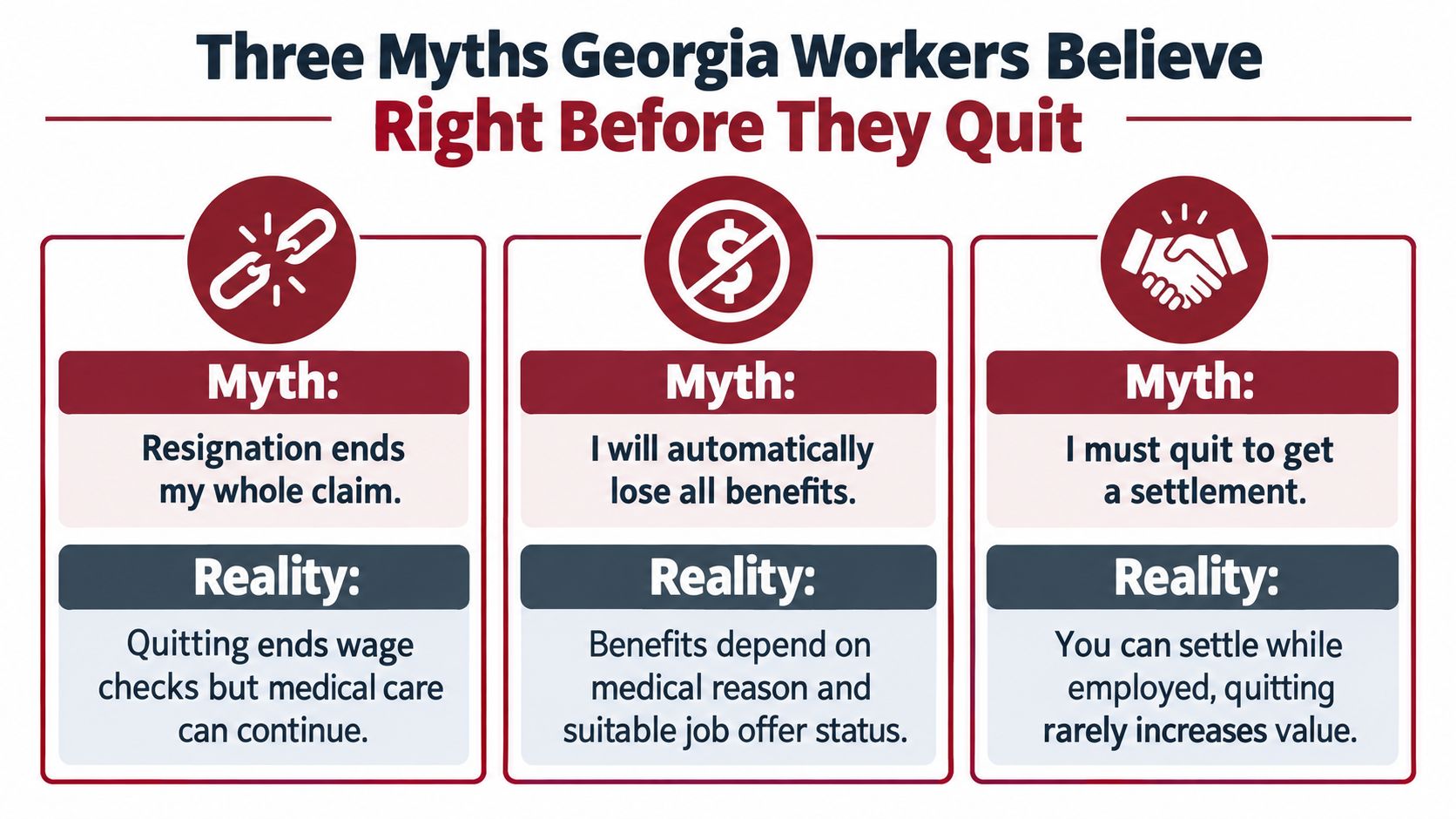
Myth one, resignation ends the entire claim
It doesn’t. Resignation may threaten wage-replacement benefits because the insurer can argue that you voluntarily removed yourself from work. It doesn’t automatically terminate authorized medical treatment, erase the injury history, or eliminate the possibility of settlement.
The danger is not that every benefit disappears at once. The danger is that the insurer separates the wage issue from the medical issue and wins the income dispute before you understand what happened.
Myth two, you must quit to get a settlement
You don’t. A settlement can be negotiated while you’re employed, while you’re working light duty, or after employment ends. Quitting rarely creates value by itself. Medical stability, documented restrictions, projected treatment, disputed wage exposure, and the terms of the proposed release matter more.
If the insurer believes quitting eliminated wage exposure, resignation can reduce its incentive to offer money. Leaving first and negotiating later is not a strategy I recommend unless the job is medically unsafe or otherwise untenable and the record supports that conclusion.
Myth three, the insurer will be fair once you leave
Don’t count on it. Once your earnings stop, the insurer has a stronger reason to argue that your unemployment caused the wage loss. Recorded statements, job-search activity, light-duty communications, and social-media posts can all become evidence.
Slow down before signing. Document the medical reason, preserve the job records, and get legal advice if the insurer is already threatening to stop checks or treatment.
When It Is Time to Call a Georgia Workers Comp Attorney
You don’t need to wait for a final denial. Call a Georgia workers’ compensation attorney when the insurer:
- Stops indemnity checks: The adjuster cuts TT or partial benefits after your resignation.
- Denies medical care: A recommended specialist, therapy course, prescription, or procedure is refused.
- Requests a recorded statement: Don’t give a detailed recorded account before understanding how it may be used.
- Files termination paperwork: A Form WC-3 or similar filing can signal an effort to end benefits.
- Pressures you to sign: A release or settlement agreement may close rights you still need.
- Challenges your job status: The employer changes light duty, labels a termination “for cause,” or claims you abandoned suitable work.
- Produces conflicting medical evidence: An independent medical examination contradicts your treating physician.
A first consultation usually focuses on the injury date, average weekly wage, current restrictions, medical status, employer and insurer letters, and the exact resignation language. Bring the claim number, medical records, wage documents, job offer, resignation letter, and mileage log. Many firms offer an initial consultation without charging a fee, and workers’ compensation attorneys commonly handle contested benefits and settlements under a fee arrangement that must comply with Georgia requirements. Learn what factors go into whether you need a workers’ compensation lawyer before deciding to handle a resignation dispute alone.
Morgan & Morgan Attorneys at Law P.C. offers Georgia workers’ compensation guidance for injured workers dealing with stopped wage checks, disputed medical care, retaliation concerns, and settlement decisions after resignation. Visit Morgan & Morgan Attorneys at Law P.C. to request a consultation and discuss your resignation letter, medical restrictions, and insurer communications with an attorney.

Lee Paulk Morgan
With more than 41 years of experience in the areas of Bankruptcy, Disability, and Workers’ Compensation, Lee Paulk Morgan is one of the most respected Bankruptcy and Disability attorneys in Athens, Georgia. His tireless dedication to serving clients has gained him the reputation of a premier attorney in his areas of practice, as well as the trust and respect of other legal experts, who often refer clients to him.
SHARE
RELATED POSTS

Do You Get Drug Tested For Workers Comp in Georgia
No, you are not automatically drug tested after a workplace injury in Georgia. An employer with a qualifying drug-free workplace program can require testing after a lost-time injury, and the result can create a rebuttable…

How Long Does It Take Workers Comp To Approve Surgery
In Georgia, when an authorized treating physician submits a complete Form WC-205 for surgical approval, the insurer has 5 business days to respond. If the insurer doesn’t respond within that period, the requested treatment is…