
Blog

Workers Compensation And Drug Testing (Practical Guide)
You report a work injury. Your supervisor sends you to a clinic. Before anyone talks about surgery, lost wages, or light duty, someone hands you a cup and tells you to provide a urine sample.
That moment rattles people for a reason. Most workers think the only question is whether the test comes back positive. In real workers compensation and drug testing disputes, that’s usually not the whole fight. The harder questions are whether the test was taken in time, whether the employer followed the right procedure, and whether the result can be tied to what caused the accident.
In Georgia, timing matters a lot. So does paperwork. So does whether the employer can connect drug use to the injury instead of just pointing to metabolites on a lab report. If you’re dealing with a post-accident test, those details can decide whether medical treatment continues and whether wage benefits get approved or frozen while the insurer investigates.
The Moment of the Test and Why It Matters
A common version of this starts the same way. A worker slips from a ladder, strains a back lifting inventory, or gets a hand caught in a machine guard. The injury is real. The pain is immediate. Then the next conversation isn’t about treatment. It’s about testing.
The worker gets escorted to occupational medicine, urgent care, or the ER. Forms get signed fast. Nobody explains much. By the time the sample is collected, the claim already has a new problem attached to it.
A lot of people assume a positive screen automatically kills the case. It usually doesn’t work that cleanly. What it does do is change the posture of the claim. Adjusters slow down. Employers start pulling policies. Somebody asks whether the test was timely, whether the chain of custody was clean, and whether there were signs of impairment before the accident.
Practical rule: In a post-accident test, the legal fight usually turns on timing, causation, and procedural compliance, not panic.
What the next few hours actually control
In Georgia, one of the biggest traps is delay. If testing happens inside the key legal window, the employer may gain a presumption that makes the claim much harder to win. If the employer waits too long, uses the wrong process, or can’t prove what happened to the sample, the same positive result may carry far less weight.
That’s why the records created on day one matter so much. The injury report, witness names, supervisor notes, clinic intake, medications disclosed, and even the exact time of collection can shape the whole dispute. If you’re going to a doctor after reporting an injury, this checklist on what to provide when reporting an injury to the doctor is the kind of practical guidance people should have before they walk into the exam room.
What workers should understand right away
A post-incident drug test isn’t automatically improper. Employers often have legitimate safety reasons to order one. If you want a plain-language employer-side overview of how those programs are commonly structured, My Safety Manager’s post-incident drug testing resource gives a useful operational picture.
What matters for your claim is simpler. Ask yourself four things immediately:
- When was the sample taken: The clock starts at the accident, not when HR gets around to acting.
- What type of test was ordered: Post-accident and suspicion-based tests matter more than routine screens.
- What policy applies: A written drug-free workplace policy often becomes part of the legal analysis.
- What caused the accident: If a machine failed, another driver hit you, or a floor was wet, those facts may matter more than the test result.
The Core Types of Drug Testing in Workers Compensation
Not every workplace drug test affects a comp claim the same way. In practice, post-accident and reasonable suspicion testing carry the most weight in a benefits dispute. Pre-employment, random, and return-to-duty testing can matter for employment status, but they usually don’t decide whether an injury is compensable.
The five categories that show up most often
Pre-employment testing happens before the job starts. If a worker passed a hiring screen months ago, that fact usually doesn’t prove much about a later accident. It may matter to the employer’s policy file, but not much to causation in a comp hearing.
Post-accident testing is the test usually meant when they ask about workers compensation and drug testing. This is the one taken after a reported injury. If a state statute gives employers a presumption based on a timely positive result, that fight happens.
Random testing usually exists to support a drug-free workplace program, especially in safety-sensitive settings. It may justify discipline under company policy. By itself, though, a random test taken before or after the accident date usually won’t answer whether the substance caused this particular injury.
Reasonable suspicion testing is different. A supervisor orders it based on observed behavior, smell, speech, balance, or conduct. If those observations were documented before the accident or right after it, they can become strong evidence in a comp dispute.
Return-to-duty testing shows up after rehab, after a policy violation, or before an employee returns to a safety-sensitive role. It can affect reinstatement or ongoing employment, but it’s usually not the main event in deciding the original injury claim.
Drug Test Types in Workers Compensation Claims
| Test Type | Trigger | Refusal Treated as Positive? | Impact on Comp Claim |
|---|---|---|---|
| Pre-employment | Hiring process | Sometimes under employer policy, but usually an employment issue | Usually limited direct impact on a later injury claim |
| Post-accident | Reported injury or workplace incident | Often treated as damaging to the claim if policy and state rules support testing | Highest impact on compensability, wage benefits, and medical disputes |
| Random | Selection under policy or program rules | Can lead to discipline under policy | Usually indirect unless tied closely to the accident facts |
| Reasonable suspicion | Documented signs of impairment | Often yes, depending on policy and state law | Stronger impact when observations connect impairment to causation |
| Return-to-duty | Reinstatement after treatment, rehab, or policy violation | Often an employment and compliance issue | Usually affects return-to-work status more than initial compensability |
A workers compensation case usually doesn’t turn on a hiring screen from months ago. It turns on the test taken after the accident, or on the observations that justified testing in the first place.
Why refusal creates its own problem
Workers often ask whether they can refuse. Physically, yes. Legally, that can go badly.
In some states, refusal can trigger benefit consequences if the employer had a valid written policy or cause to suspect use. Kansas is a good example. Under Kansas law, chemical-test results can be used as impairment evidence when the employer had a written pre-injury policy, the worker consented, or the worker voluntarily tested after the accident. The same statute says refusal can lead to forfeiture of benefits if the employer had sufficient cause to suspect alcohol or drug use or a written post-injury policy, as set out in the Kansas workers compensation statute.
The practical point is this. Refusal rarely leaves the case neutral. It usually gives the employer another argument.
State-by-State Rules and What Georgia Does Differently
Workers compensation and drug testing is mostly a state-law issue. That means the same accident can produce very different outcomes depending on where it happened. Kansas, Tennessee, Florida, and Georgia all treat a positive post-accident test seriously, but not in exactly the same way.
If you need a broad overview of how workers comp obligations vary from one state to another, the Benely guide to workers compensation insurance requirements by state is a decent starting point. It won’t answer a claim dispute by itself, but it helps show why state-specific analysis matters.
Georgia’s key issue is the eight-hour window
Georgia is where many workers get blindsided. A positive test isn’t just a bad fact. If the test falls inside the legal time window, it may create a rebuttable presumption that intoxication caused the injury. That shifts the case fast.
The reason this matters is simple. Once a presumption kicks in, the worker has work to do. The case may still be winnable, but the worker usually needs evidence that points to another cause. That can be physical evidence from the scene, witness testimony, medication evidence, or expert analysis showing the result doesn’t prove impairment caused the accident.
If you’re trying to understand the broader framework of Georgia claims, this summary of four important things to know about workers compensation in Georgia gives helpful background before you drill into the testing issue.
How other states frame the same problem
Kansas focuses heavily on admissibility, written policy, consent, and whether the result can be used as evidence of impairment. Tennessee goes further in one direction. According to the verified legal summary provided, a confirmed positive post-accident drug test can create a rebuttable presumption that the drug or alcohol was the proximate cause of injury, and the worker may forfeit benefits if the testing rules were followed.
Florida puts heavy weight on procedural compliance in its drug-free workplace framework. The denial issue isn’t just whether the test was positive. It’s whether the employer met the statute’s testing standards and procedures.
Georgia’s wrinkle is how quickly the test must happen for the presumption fight to become central. In the verified guidance, Georgia law is identified as allowing a rebuttable presumption only when testing occurs within eight hours of the accident, while Florida ties claim consequences to specific testing standards and procedures under its statute at the Florida workers compensation drug-free workplace law.
State Approaches to Drug Testing in Workers Compensation
| State | Post-Accident Presumption Rule | Key Time Window | Burden of Proof |
|---|---|---|---|
| Georgia | Positive test within the statutory window can create a rebuttable presumption tied to causation | Eight hours | Worker may need to rebut the presumption with evidence of another cause |
| Kansas | Test result can be admitted as impairment evidence if policy, consent, or voluntary testing requirements are met | State rules and accident response timing matter | Employer still needs a usable link between the result and the injury |
| Tennessee | Confirmed positive post-accident test can create a rebuttable presumption of proximate cause | Timing matters under the applicable rules | Worker can lose benefits if employer followed required testing rules |
| Florida | Claim outcome depends heavily on statutory testing standards and procedural compliance | Timing matters, but procedure is the main battlefield | Employer needs compliance with the drug-free workplace framework |
The same toxicology report can be powerful in one state and much weaker in another. State law decides what the report is allowed to prove.
How a Positive or Negative Result Affects Your Benefits
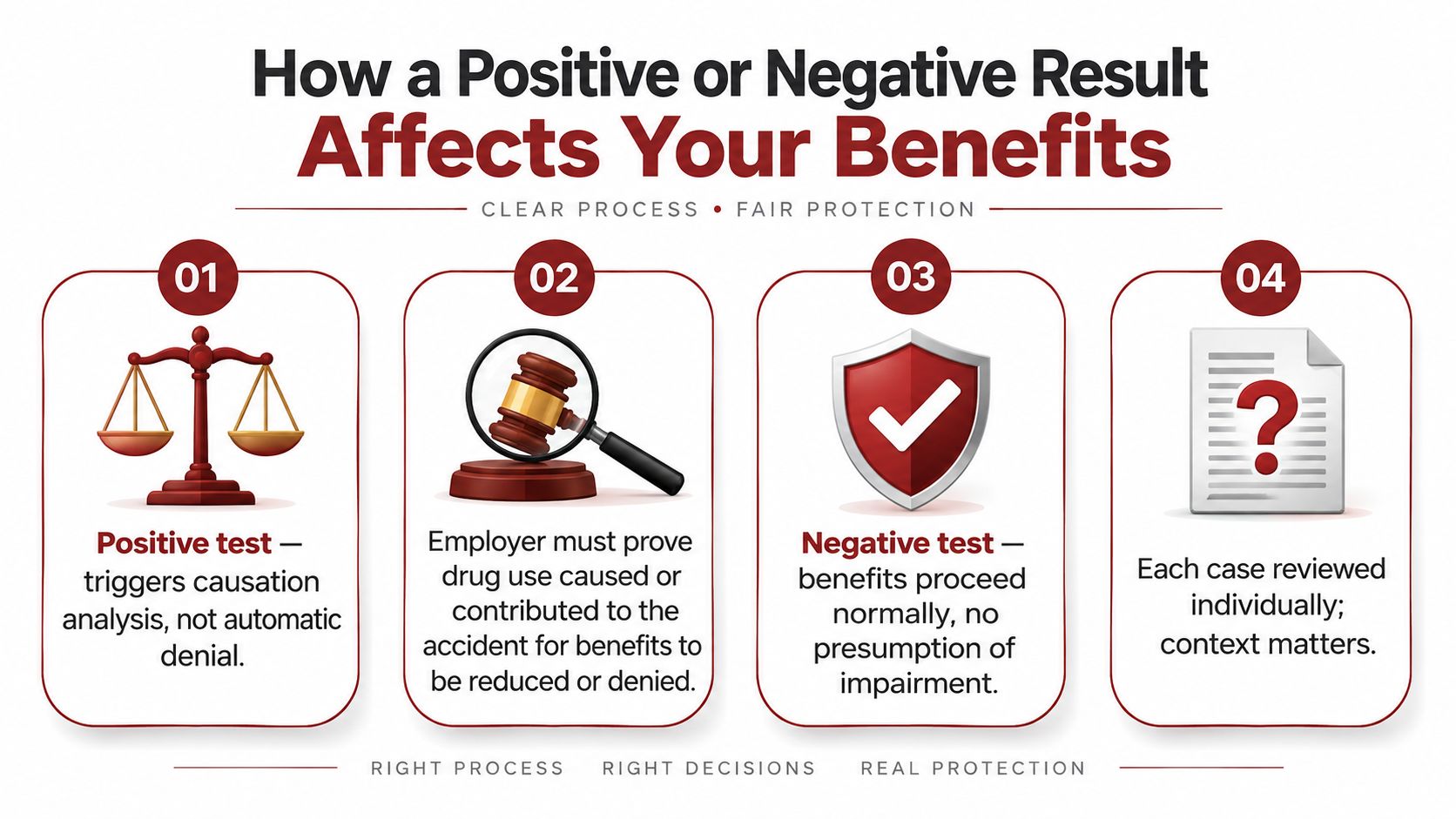
A positive test does not automatically end benefits. It starts a legal analysis. The employer still needs a result that holds up, a timeline that fits the statute, and facts that connect the substance to the accident.
The four parts that make a result matter
Causation comes first. A lab report showing presence isn’t always enough. The employer wants to argue that drug or alcohol use caused or contributed to the injury. If a forklift malfunctioned, a staircase collapsed, or another employee broke protocol, those facts may cut against that argument.
Timing comes next. In some states, delay weakens the value of the test. If the sample was collected outside the critical window, the employer may lose the presumption or face a harder argument on impairment.
Written policy matters more than people expect. If the employer relies on a drug-free workplace rule, it helps to have a policy that existed before the injury and was applied consistently. Sloppy policy enforcement often shows up in these cases.
Chain of custody can make or break the evidence. A positive result is only as strong as the paper trail behind the sample. If that trail has gaps, the result may lose force or become challengeable.
What a negative result usually changes
A negative result usually removes the intoxication defense from center stage. That doesn’t guarantee benefits. The employer can still dispute whether the injury happened at work, whether notice was given, whether the worker was an employee, or whether treatment is related.
Still, a negative result often clears a major roadblock. Medical care tends to move more normally. Wage benefits are easier to evaluate on ordinary workers comp grounds instead of impairment arguments.
What to preserve the day results come back
If a result is contested, the worker should preserve evidence immediately:
- Keep every test-related document: Collection form, clinic discharge papers, prescriptions list, and any employer notice.
- Write down the timing: Accident time, reporting time, transport time, and collection time.
- Identify non-drug causes: Unsafe equipment, missing guards, wet floors, traffic conditions, or coworker error.
- Request policy information: Ask for the written testing policy if the employer is relying on one.
A positive result can stall treatment authorization and wage decisions while the insurer reviews the file. A negative result usually puts the claim back on the standard track. Neither result should be read in isolation.
What Employers Must Get Right Under Drug-Free Workplace Rules
Employers often assume that ordering a test is enough. It isn’t. If they want a test result to hold up in a workers compensation dispute, they need a policy, a process, and records that all line up.
Policy before incident, not improvisation after
The cleanest employer position usually starts with a written drug-free workplace policy that existed before anyone got hurt. It should identify when testing can occur, who authorizes it, what refusal means, and how results are handled. It also needs to be applied consistently. Selective enforcement creates obvious problems.
Florida’s official guidance is useful here because it spells out the structure of a formal program. The state’s workers compensation drug-free workplace guide says certification is voluntary, but employers seeking the program’s benefits must follow state rules. It also states that the employer pays for required tests, and that under this program a breathalyzer can’t be used for initial or confirmation testing, as explained in the Florida Drug-Free Workplace Program guide.
OSHA concerns and reasonable post-incident testing
Blanket testing after every scraped knuckle can create a different problem. OSHA guidance discussed in industry summaries is commonly read to allow post-incident testing when there’s a legitimate safety reason, not when testing is being used to punish injury reporting.
That means employers need more than habit. They need a reason they can defend. In safety-sensitive industries, many employers use outside vendors and training programs to tighten that process. For example, this overview on a drug-free workplace in Tampa shows the kind of operational support employers often seek around screening, documentation, and program structure.
Employer Drug-Testing Compliance Checklist
| Requirement | Standard Practice | Georgia-Specific Rule |
|---|---|---|
| Written policy | Maintain a clear drug-free workplace policy before any accident | Helpful if employer wants testing to support a claim defense |
| Supervisor training | Train supervisors to document objective signs of impairment | Especially useful when relying on reasonable suspicion |
| Test method | Use a method allowed by the governing rule or program | Must fit the legal framework the employer plans to invoke |
| Payment for required test | Employer covers required post-incident testing under many formal programs | Employer should confirm state-specific obligations before testing |
| Chain of custody | Preserve signatures, seals, handoff records, and lab documentation | Critical if the result will be used in litigation |
| Consistent enforcement | Apply policy evenly across employees and incidents | Inconsistent enforcement can undercut credibility |
When employers miss these basics, the toxicology result may still exist, but its value drops. In a contested case, the paperwork often matters as much as the chemistry.
Chain of Custody and the Evidence Behind the Result
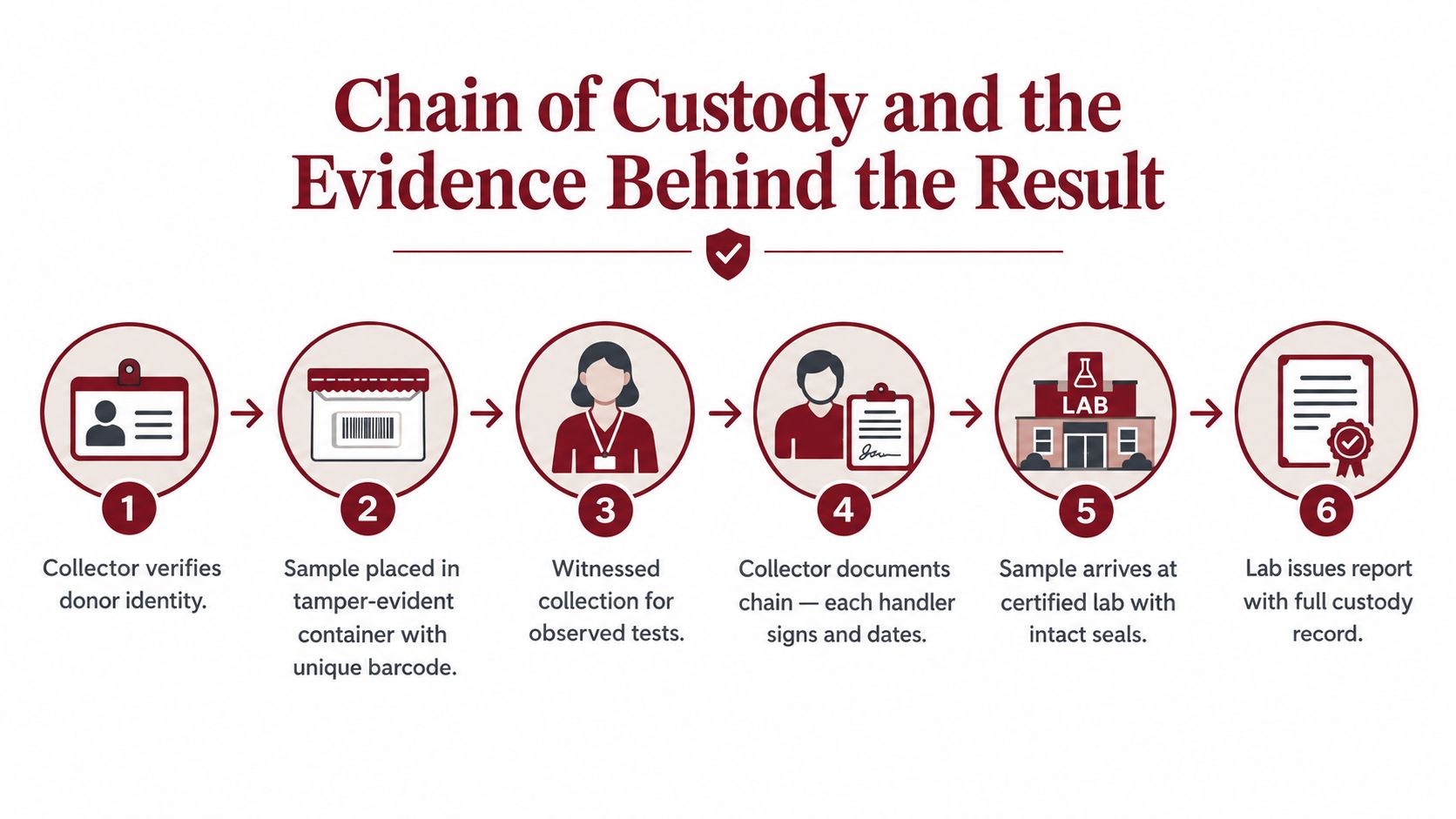
Lawyers challenge drug tests all the time for one reason. A result isn’t evidence just because a lab printed it. The employer has to show that the specimen came from the right person, stayed sealed, reached the lab intact, and was confirmed under the right process.
What a defensible sample looks like
The collector should verify identity, label the container correctly, and document each transfer. If the collection was observed, that should be stated. If the sample was split, the records should show how. If the lab performed only a screen without proper confirmation, that becomes an issue.
The strongest files usually include:
- Verified donor identity: The collector confirms who gave the sample.
- Tamper-evident sealing: The container is sealed and tracked.
- Signed custody record: Every handoff is dated and documented.
- Certified lab process: The sample arrives with intact seals and a clear record.
- Confirmation testing: A positive screen is backed by confirmation, not left as a preliminary result.
If the employer can’t prove who handled the sample and when they handled it, the test result becomes much easier to attack.
Common break points in real disputes
These challenges come up often in hearings:
- Missing signatures: A handoff wasn’t documented.
- Labeling errors: The container or form doesn’t match the worker.
- Transport delays: The employer can’t account for where the sample sat.
- Unconfirmed positive screen: The file shows only an initial screen result.
- Incomplete records: The worker gets the conclusion, but not the underlying custody paperwork.
A worker who gets hit with a disputed positive should quickly request the full custody and lab file in writing. That usually includes the collection form, chain-of-custody documents, confirmation report, and any policy the employer says authorized the test.
Appeals, Retests, and When to Call an Attorney
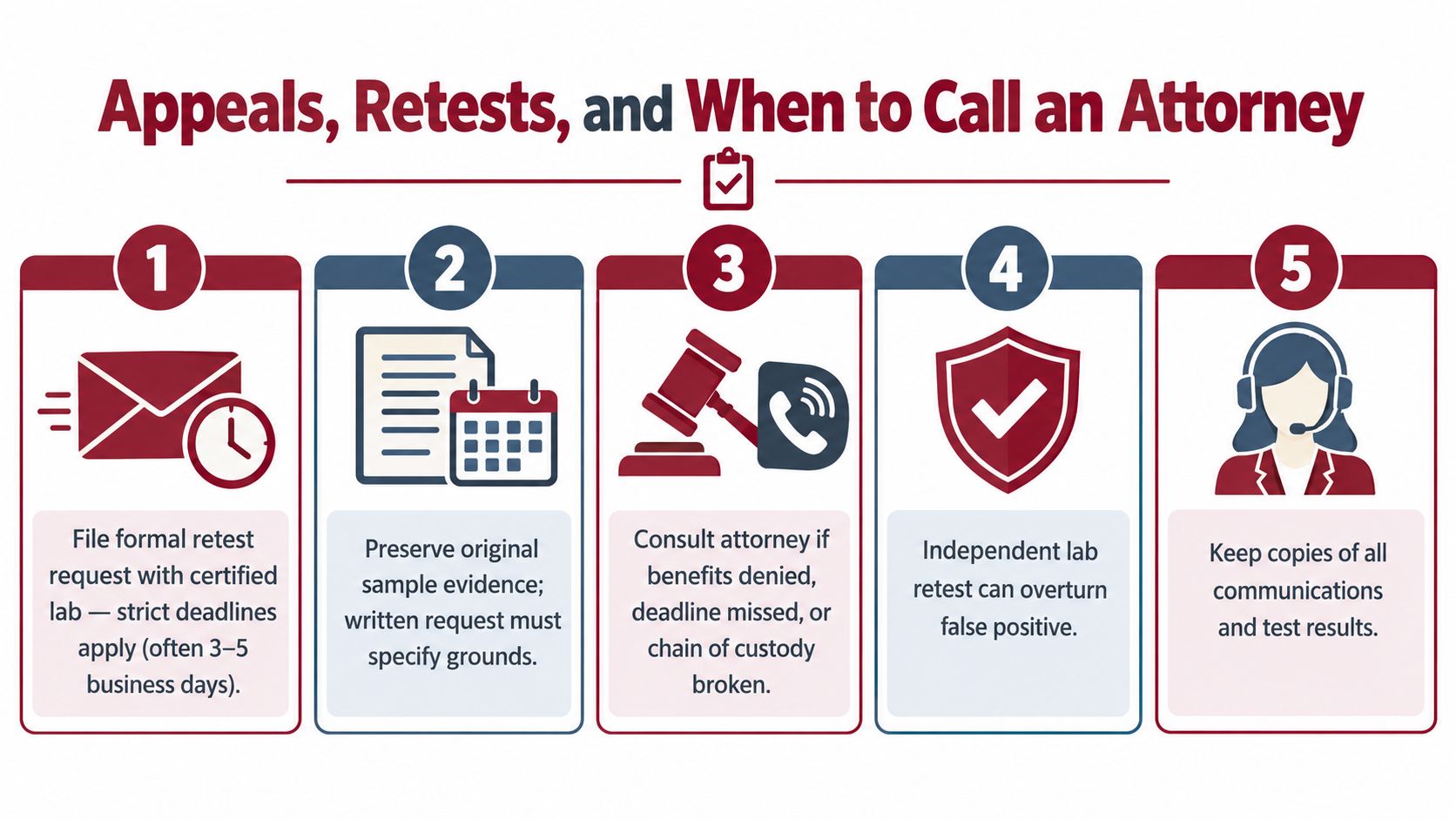
If your benefits were denied after a drug test, don’t treat the denial letter like the last word. These cases are often won or lost on speed, records, and whether someone preserved the sample before it disappeared.
What to do first after a disputed result
Start with the sample. If retesting is allowed, request it in writing immediately. The request should be clear, dated, and saved. If there was a split sample, ask where it is, how it was stored, and what lab can test it.
Then gather the records that explain the result or challenge it:
- Prescription proof: Pharmacy printouts, pill bottle labels, and prescribing records.
- Medication timeline: When you took the medication and at what dose.
- Accident evidence: Photos, witness names, incident reports, and machine records.
- Testing paperwork: Collection records, result report, and employer policy.
- Communication log: Emails, text messages, and calls with HR, the adjuster, and the clinic.
Warning signs that mean call a lawyer now
Some facts raise enough risk that waiting is a mistake.
- The claim was denied with no copy of a written testing policy.
- The employer won’t produce chain-of-custody records.
- The test happened outside the Georgia time window, but the employer still claims a presumption.
- A valid prescription was ignored.
- You were fired right after the result and nobody explained your appeal rights.
If you need a next-step overview after a denial, this page on what to do when your workers comp claim is denied is a practical place to start.
How appeals usually turn on proof, not outrage
At hearing, the dispute usually narrows fast. Was the test timely. Was the sample handled correctly. Did the employer follow its own rule. Can the employer tie the result to the cause of the accident. If the answer to any of those is weak, the worker may have a real path to restoring benefits.
There is also a fairness problem many consumer guides skip. In the verified guidance, Florida’s official materials say employers may pay for required testing, but employee-requested retests are typically the employee’s expense. That cost issue can affect whether a worker can challenge a bad result. The same verified materials also note a recent appellate dispute from Saskatchewan in which a 2026 Saskatchewan Court of Appeal decision upheld compensation after a contested post-incident drug and alcohol testing fight, showing that overbroad or flawed testing can create legal exposure, as discussed in this report on the Saskatchewan post-incident testing decision.
If you’re in Georgia and the case is already turning on the test, legal help isn’t just about arguing. It’s about getting the right records before they vanish, preserving the retest issue, and framing causation correctly. Morgan & Morgan Attorneys at Law P.C. handles Georgia workers compensation matters, including disputes where post-accident testing affects medical or wage benefits.
If a drug test is threatening your workers compensation claim, Morgan & Morgan Attorneys at Law P.C. can review the timing, policy, lab records, and causation issues that often decide whether benefits survive. The firm works with injured Georgia workers on denied claims, disputed testing results, and hearings before those early mistakes become permanent. Visit Morgan & Morgan Attorneys at Law P.C. to learn more or request a consultation.

Lee Paulk Morgan
With more than 41 years of experience in the areas of Bankruptcy, Disability, and Workers’ Compensation, Lee Paulk Morgan is one of the most respected Bankruptcy and Disability attorneys in Athens, Georgia. His tireless dedication to serving clients has gained him the reputation of a premier attorney in his areas of practice, as well as the trust and respect of other legal experts, who often refer clients to him.
SHARE
RELATED POSTS

Do You Get Drug Tested For Workers Comp in Georgia
No, you are not automatically drug tested after a workplace injury in Georgia. An employer with a qualifying drug-free workplace program can require testing after a lost-time injury, and the result can create a rebuttable…

How Long Does It Take Workers Comp To Approve Surgery
In Georgia, when an authorized treating physician submits a complete Form WC-205 for surgical approval, the insurer has 5 business days to respond. If the insurer doesn’t respond within that period, the requested treatment is…