
Blog

What Does A Workers’ Compensation Defense Attorney Do
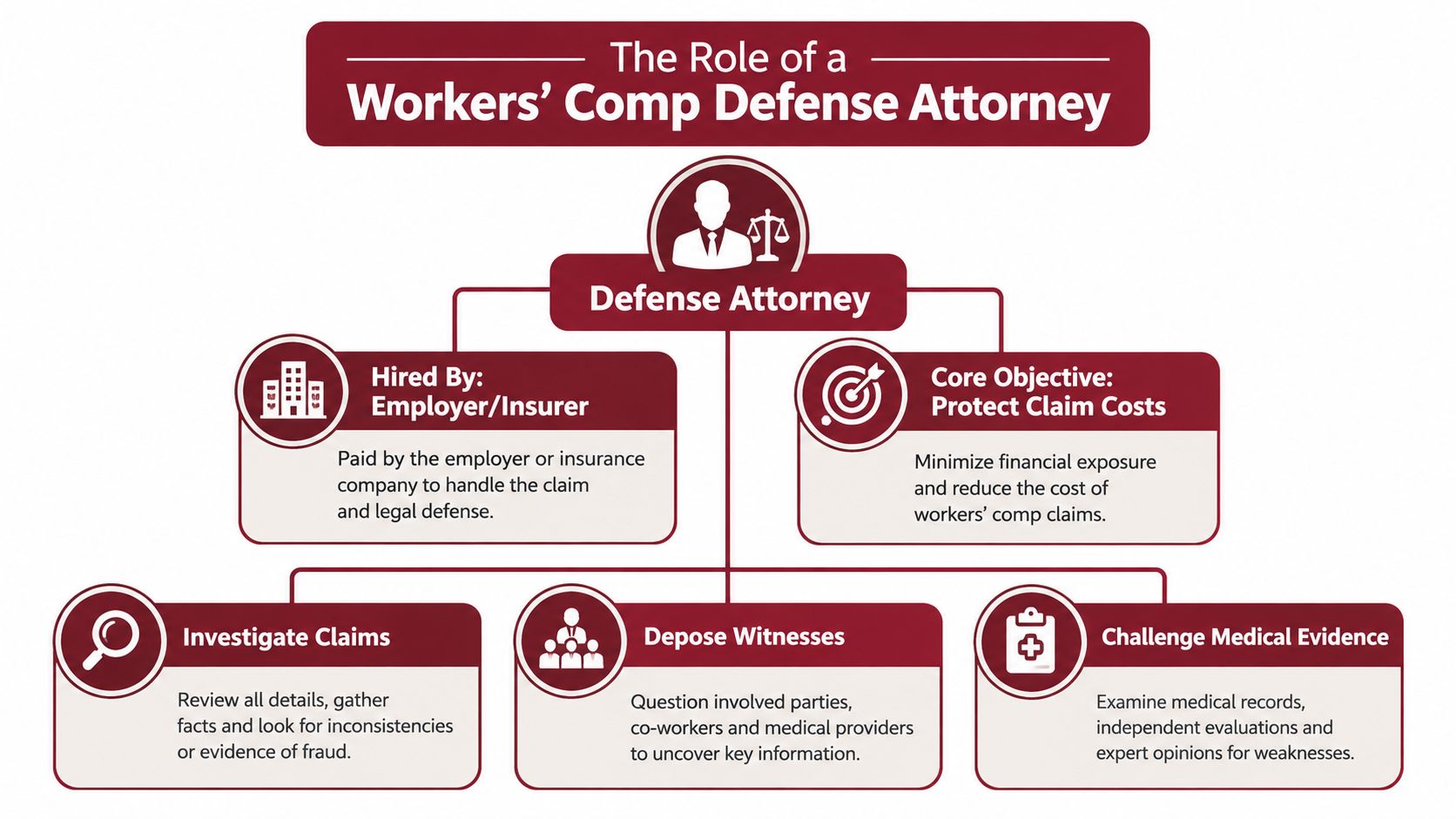
A workers’ compensation defense attorney is the lawyer hired by the employer, insurance carrier, or third-party administrator to investigate, contest, and resolve an injured worker’s claim. Defense-attorney payments have been reported as 2% to 7% of total claim payments in 36-month claims, and one study found defense attorneys involved in 90% of claims in some jurisdictions, with average defense-attorney payment of $2,750 per claim. Workers’ compensation defense research
You may meet this lawyer after reporting a back injury, receiving medical treatment, or asking why wage benefits stopped. The call can feel unsettling because you didn’t choose this attorney and they’re asking questions about an event that has already disrupted your health, work, and finances. Understanding the other side’s role helps you recognize what each request means and how to protect your own claim without treating every defense step as proof that you’ve done something wrong.
The Role of a Workers’ Compensation Defense Attorney
You report an injury at work in Georgia, give your employer the information it requests, and then receive a call from a lawyer you’ve never met. That lawyer may ask for a recorded statement, medical authorizations, or details about what happened. The attorney isn’t calling to represent you. The employer, insurance carrier, or third-party administrator retained the attorney to protect its side of the claim.
A workers’ compensation defense attorney is a licensed lawyer who investigates, evaluates, and responds to a claim on behalf of the employer-side participants. “Defense” doesn’t mean criminal defense. It means defending the employer or carrier against disputed requests for medical care, income benefits, impairment benefits, or settlement money.
Typical clients include:
- Private employers: Businesses that need legal advice when a claim raises questions about coverage, causation, or benefit exposure.
- Self-insured corporations: Companies that pay claims directly and need counsel to manage litigation risk.
- Insurance carriers: Insurers responsible for evaluating and paying covered claims.
- Government entities and third-party administrators: Organizations that manage claims for public employers or other businesses.
The attorney’s purpose is not to reject every claim. The job is to prevent payment of benefits that aren’t legally owed, challenge unsupported medical or wage demands, and help ensure legitimate claims are handled under the applicable rules. A published industry summary describes defense counsel as part of a broader process involving evidence review, cost control, and case strategy. In the Miami-Dade county-level study cited in that summary, less effective defense counsel increased settlement amounts by $12,557 on average and added 32.03 days to trial length, while effective counsel saved employers about $20,086 in settlement costs and roughly 44 days of trial time. Workers’ compensation defense findings
Practical rule: The defense attorney is not your neutral guide. Treat requests for information seriously, answer truthfully, and consider getting advice from your own lawyer before providing sworn or recorded information.
Workers often confuse the defense lawyer with the claims adjuster. The adjuster manages the claim’s administrative and payment side. The attorney handles legal strategy, pleadings, discovery, hearings, settlement positions, and appeals. That division of labor is why an adjuster may still manage ordinary benefits while a defense attorney becomes involved when the claim needs legal judgment. For a broader discussion of the employer-side relationship, see why employers may react negatively to workers’ compensation claims.
Employers and carriers also use legal technology and organized processes to manage documents, deadlines, and evidence. Resources describing workers comp solutions for attorneys can help explain the administrative side, but software doesn’t replace the attorney’s responsibility for legal decisions, filings, advocacy, or outcomes.
How a Defense Case Moves From Intake to Appeal
A defense file usually begins when the carrier or third-party administrator receives notice of an injury and decides that counsel should review the matter. The attorney reads the accident report, first notice materials, employment records, wage information, prior claim details, and early medical records. At this point, counsel is trying to identify the dispute. Is the injury connected to work? Did the worker report it promptly? Does the requested treatment match the event? Are the wage figures supported?
The attorney may contact the employer, supervisor, witnesses, and medical providers. Counsel can request records, preserve photographs, inspect the work area, and compare the worker’s account with timecards, safety reports, job duties, and communications. The worker might experience this stage as questions from a claims professional, a request for a recorded statement, or an independent medical examination.
Investigation shapes the next demand
After reviewing the evidence, the attorney advises the carrier or employer whether the claim should be accepted, denied, defended while more information is gathered, or resolved through compromise. That recommendation can affect whether medical care is authorized, whether income benefits continue, and whether a hearing becomes necessary.
The investigation may also involve witness interviews, subpoenas, surveillance planning, medical record requests, and an examination by a defense-selected physician. A technical legal task is testing whether a medical report meets the applicable substantial evidence standard. The answer can influence disputes over disability duration, impairment ratings, and treatment necessity. Defense counsel responsibilities and medical evidence
As discovery proceeds, lawyers exchange documents and take depositions. A deposition is sworn testimony given before the hearing, usually with a court reporter present. The defense lawyer uses it to understand the worker’s testimony, identify disputed facts, and decide which witnesses and records belong in the hearing presentation. A well-organized case management workflow for law firms helps counsel track these materials and deadlines, but the legal significance still depends on the facts of the individual claim.
Hearing, decision, and appeal
Before the hearing, defense counsel prepares motions, exhibit lists, witness outlines, and settlement positions. The attorney may negotiate with the worker’s lawyer during conferences or mediation. If no agreement is reached, counsel presents evidence and arguments to the administrative law judge.
After the hearing, the attorney may submit a brief or proposed decision, respond to the opposing party’s arguments, and advise the client about the ruling. If the result is unfavorable or a legal error is alleged, the case can move through Georgia’s administrative review and appellate process, potentially reaching the Appellate Division and the Supreme Court of Georgia. Each stage changes what the injured worker must do next, which is why ignoring a notice or deadline can damage a claim even when the underlying injury is genuine.
Everyday Tools and Tactics Defense Attorneys Use
Defense counsel doesn’t rely on one test or one document. The attorney builds a record, then compares the worker’s account, medical evidence, employment records, and testimony for consistency. Each tool has a specific purpose.
Recorded statements establish an early account
A recorded statement lets the defense preserve your description of the accident, symptoms, prior injuries, job duties, and reporting history. Counsel may later compare those answers with medical histories, deposition testimony, or hearing testimony. A difference doesn’t automatically mean you lied. Pain, stress, confusing questions, and ordinary memory gaps can produce differences. The defense will still examine them for an argument about credibility.
Prepare before answering. Stick to what you know, don’t guess at dates or medical conclusions, and don’t assume a friendly tone means the conversation is informal. You can ask whether the statement is being recorded and seek advice from your own attorney before participating.
The IME tests causation and restrictions
An independent medical examination, often called an IME, gives the defense a physician’s evaluation of the injury. The doctor may review records, ask about the work event, perform an examination, and offer opinions about causation, treatment, restrictions, or disability. “Independent” describes the examination process, but the appointment is usually arranged for the side that requested it.
Attend, tell the truth, and describe your symptoms accurately. Don’t exaggerate, but don’t minimize limitations to appear cooperative. Afterward, write down what occurred while it’s fresh, including the questions asked, the examination performed, and any unusual circumstances. Questions about medical-exam neutrality are discussed in whether IME doctors are fair.
Records, depositions, and surveillance fill gaps
A medical record audit looks for earlier complaints, preexisting conditions, treatment gaps, unrelated symptoms, and statements that appear inconsistent with the claimed mechanism of injury. Defense counsel may also subpoena records or take depositions from you, your treating physician, an employer representative, or another witness.
Surveillance, when used, is intended to compare reported restrictions with observed activity. A short video doesn’t necessarily show what you can do repeatedly or safely, but the defense may use it to challenge the severity of your limitations. Vocational experts can address work capacity, transferable skills, or possible employment. None of these tools decides the case alone. Their value depends on context, credibility, and how the evidence fits Georgia workers’ compensation law.
Common Defenses Raised in Disputed Claims
The same event can look different from opposite sides of a claim. The defense attorney searches for a legal reason to limit or reject benefits. The worker focuses on the lived sequence, including what happened at work, when symptoms began, and how the injury affected daily life.
| Defense | Defense Attorney’s Argument | How an Injured Worker Responds |
|---|---|---|
| Course and scope | The injury happened during a personal errand, after hours, during a commute, or outside assigned duties. A remote worker injured while stepping away for a personal task may face this argument. | Identify the work purpose, instructions, location, schedule, and witnesses. Preserve messages, assignments, calendar entries, and photographs that show why you were where you were. |
| Causation | A non-work event, degeneration, delayed reporting, or another incident caused the condition instead of the workplace event. | Give doctors a complete timeline. Explain prior symptoms honestly and identify the first work-related change, treatment visit, and functional limitation. |
| Major contribution | The workplace may have worsened a preexisting condition, but the defense argues the work event wasn’t the legally significant cause under OCGA §34-9-1(4). | Ask treating providers to address the work event, prior condition, specific change, and medical reasoning. Don’t rely only on a diagnosis without explaining causation. |
| Willful misconduct, horseplay, or substance use | The employer or carrier claims the injury resulted from prohibited conduct, horseplay, or drug or alcohol use. | Preserve safety rules, witness accounts, test information, and the full context. A label isn’t the same as proof of what occurred. |
| Average weekly wage | The defense challenges the wage calculation, overtime treatment, concurrent employment, or records used to set benefits. | Keep pay statements, schedules, time records, tax documents, and information about other employment. Check the calculation instead of assuming the first figure is correct. |
| Safety-rule violation | The attorney argues that a violation contributed to the injury or affects the benefits dispute. | Request the written rule, training records, enforcement history, and witness information. Explain whether equipment, supervision, or workplace conditions affected compliance. |
The worker’s response isn’t to argue with every defense theory in the abstract. It’s to assemble contemporaneous evidence that answers the specific question. If the issue is course and scope, location and purpose matter. If the issue is causation, the medical timeline matters. If the issue is wages, payroll records matter more than a general estimate.
Inside the Hearing Room and the Settlement Table
A Georgia workers’ compensation hearing is more organized than a television courtroom and more focused than a casual meeting. Before entering the room, defense counsel has usually prepared witness outlines, exhibit binders, medical records, employment documents, and subpoenas for necessary witnesses, including treating physicians when their testimony is material. Lawyers may also hold a stipulation conference to narrow what they agree on and isolate the issues the judge must decide.
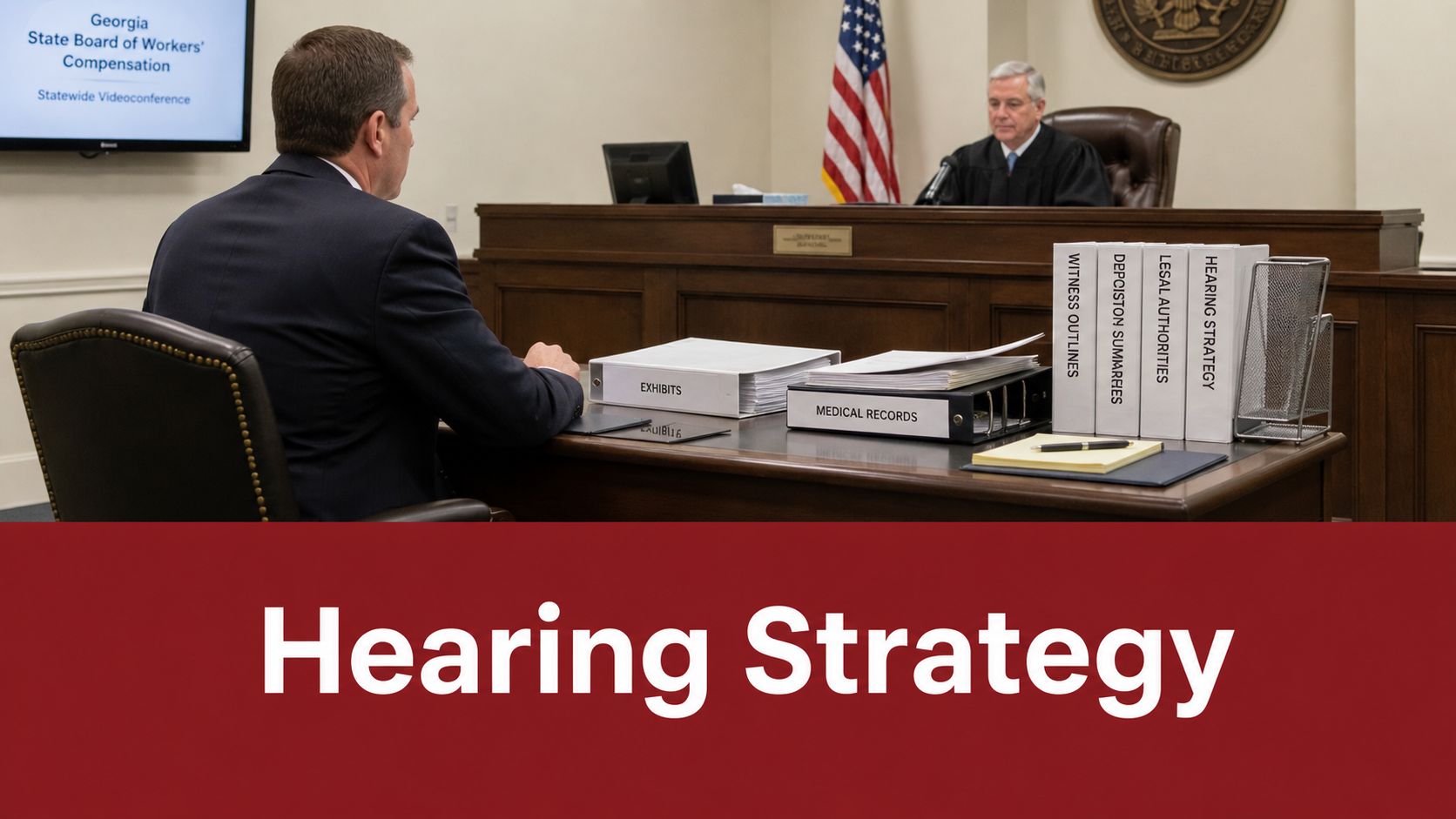
The defense lawyer may open by explaining the disputed point. During questioning, counsel could ask you about your job duties, the exact movement that caused the injury, previous symptoms, medical history, reporting, and activities after the event. The defense may call an IME doctor, employer representative, supervisor, or investigator. Your attorney has the opportunity to object, cross-examine witnesses, and present your evidence.
The administrative law judge evaluates the record rather than just choosing the more confident speaker. Credibility, consistency, medical causation, work records, and the timing of treatment can all influence how testimony is weighed under the applicable preponderance standard. A nervous answer isn’t automatically a dishonest answer, but unexplained contradictions can create problems.
The hearing is the defense attorney’s chance to turn scattered records into a legal theory. Your preparation should do the same for your account.
Settlement changes the setting but not the need for care. Defense counsel may use mediation, written stipulations, and Section 20/22 lump-sum negotiations to close the file. The parties may discuss settlement after medical status becomes clearer, including when treatment reaches maximum medical improvement. A settlement call can sound conversational, but it may involve rights you won’t easily restore after signing. Don’t accept or reject an offer until you understand the medical, wage, and future-treatment consequences.
Beyond Denial Managing Cost and Valid Claims
Many injured workers assume a defense attorney’s only task is to deny claims. That view misses an important part of the role. Defense work also involves risk management, including controlling medical costs, documenting decisions, complying with awards, and helping employers and carriers resolve valid claims correctly.
A carrier may accept that an injury is work-related while still reviewing whether every requested treatment is necessary, whether a medication is appropriate, or whether restrictions are supported. Defense counsel can advise on utilization review, treatment guidelines, pharmacy networks, and directed care under OCGA §34-9-201.1. The legal question isn’t always “pay or deny.” It may be “what does the law require the carrier to authorize, and what evidence supports that decision?”
Documentation protects both sides
Accurate records can reduce disputes before they become hearings. Employers and claims teams may need to preserve incident reports, medical notices, wage information, safety materials, and benefit-payment records. Timely Form WC-1 filings and post-award compliance reviews can help prevent later arguments about notice, payment, or administrative handling.
Good documentation can also protect a legitimate claim from being mishandled. A clear accident report may confirm the time and location. A consistent medical timeline may show why treatment developed gradually. A properly recorded return-to-work restriction may prevent an argument that the worker refused suitable duties.
Cost control can support recovery
Nurse case managers, field investigators, and vocational rehabilitation referrals can serve the employer’s financial interests while also helping an injured worker obtain coordinated treatment or return to suitable work. Their involvement doesn’t eliminate the adversarial relationship, and you should still understand who each person represents. But the presence of defense counsel doesn’t automatically mean the carrier believes the injury is fabricated.
The practical distinction is simple. Questionable claims are tested with evidence. Valid claims should be paid and managed accurately. A competent defense attorney tries to keep both categories from being confused.
What Injured Workers Should Do When Defense Counsel Shows Up
Your strongest response is organized, truthful, and deliberate. The defense attorney is collecting evidence for the employer or carrier, so you need to preserve evidence for your own position and understand the significance of each request.
Handle the recorded statement carefully
Prepare a timeline before the call. Include the event, symptoms, report, treatment, work restrictions, and any later change in condition. Answer the question asked, don’t speculate, and say when you don’t remember. Don’t use a guess to fill an uncomfortable silence.
You also don’t have to handle the conversation alone. Before giving a recorded statement, consult your own lawyer about the request, the scope of the questions, and whether counsel should attend. A claimant-side attorney can help you avoid accidental admissions without coaching you to change the facts.
Approach the IME with accuracy
Attend the appointment unless your attorney advises otherwise or the order is changed. Be truthful and consistent with your medical records. Explain what you can and can’t do in ordinary terms, rather than offering a diagnosis or arguing with the doctor.
After the exam, record the date, location, duration, tests, body parts examined, and questions asked. Keep copies of appointment notices and related correspondence. If the defense later relies on an incomplete description of the examination, your notes may help your lawyer identify the problem.
Preserve evidence before it disappears
Keep evidence that addresses the defenses described earlier:
- Witness information: Save names, job titles, phone numbers, and what each person personally observed.
- Scene materials: Preserve photographs, videos, equipment details, and the condition of the work area.
- Written reports: Keep accident reports, text messages, emails, supervisor notices, and claim correspondence.
- Work and wage records: Retain schedules, time records, pay statements, and restriction notices.
- Personal observations: Write dated notes about pain, treatment, limitations, missed work, and changes in symptoms.
You should strongly consider a claimant attorney if medical care is denied, an IME is scheduled, a hearing notice arrives, the insurer makes a low settlement offer, or your employment ends during the claim. Guidance on whether you need a workers’ compensation lawyer can help you identify questions to ask during an initial consultation.
Why Understanding the Defense Side Helps Your Own Case
Knowing what a workers’ compensation defense attorney does lets you read the process more accurately. The recorded statement creates an early account. The IME report may become central medical evidence. The hearing exhibit binder organizes the story the judge will review. The settlement valuation reflects how the defense assesses medical uncertainty, wage exposure, credibility, and litigation risk.
That knowledge doesn’t mean you should become defensive in every conversation. It means you can document the right facts, correct misunderstandings promptly, and avoid casual statements that don’t reflect your actual condition. Workers’ compensation is an adversarial system, and a legitimate injury still needs consistent evidence.
The best next step depends on your facts, not on a general explanation. Before signing a settlement, giving a recorded statement, or attending a scheduled examination, speak with a Georgia workers’ compensation attorney who can review the accident, medical history, employment records, and current benefit status.
Morgan & Morgan Attorneys at Law P.C. offers workers’ compensation representation for Georgia workers, including help with filing claims, gathering records, and responding to denied or disputed benefits. Visit Morgan & Morgan Attorneys at Law P.C. to request a consultation before you speak with defense counsel or sign an agreement.

Lee Paulk Morgan
With more than 41 years of experience in the areas of Bankruptcy, Disability, and Workers’ Compensation, Lee Paulk Morgan is one of the most respected Bankruptcy and Disability attorneys in Athens, Georgia. His tireless dedication to serving clients has gained him the reputation of a premier attorney in his areas of practice, as well as the trust and respect of other legal experts, who often refer clients to him.
SHARE
RELATED POSTS

Do You Get Drug Tested For Workers Comp in Georgia
No, you are not automatically drug tested after a workplace injury in Georgia. An employer with a qualifying drug-free workplace program can require testing after a lost-time injury, and the result can create a rebuttable…

How Long Does It Take Workers Comp To Approve Surgery
In Georgia, when an authorized treating physician submits a complete Form WC-205 for surgical approval, the insurer has 5 business days to respond. If the insurer doesn’t respond within that period, the requested treatment is…